Effect of hydrogen cyanamide on breaking dormancy in blueberries
Effect of hydrogen cyanamide on breaking dormancy in blueberries
Fund project: Supported by the Yunnan Province Universities Dominant and Characteristic Key Discipline (Ecology) Construction Project (05000511311).
1 Materials and Methods
1.1 Materials
The experiment was conducted in 2016 in a solar greenhouse at a blueberry base in Ganyu County, Jiangsu Province. The commonly planted northern cultivar Bluecrop was selected as the test material, with 5-year-old trees and a row spacing of 2 m x 1 m. The soil was sandy soil, with organic matter of 1.2%, and after improvement the pH value was 4.7; fertilizer and water conditions and management level were good. The solar greenhouse was covered every year on November 1 to accumulate chilling, and heating began on December 20. The main test instruments included: PAL-1 sugar degree meter (Atago Co., Japan); Firmtech II hardness tester (USA); acid-base titrator; electronic scale; tape measure; ZDR-20 automatic temperature and humidity recorder.
1.2 Methods
Three greenhouses were selected for the experiment, and an automatic temperature and humidity recorder was hung in each greenhouse. Data were retrieved every 3 d to calculate the chilling requirement. The chilling requirement referred to the 7.2 degrees C model, and the chilling amounts were controlled at 500 (November 27), 600 (December 7), and 700 (December 13) h respectively. In each greenhouse, 50% hydrogen cyanamide aqueous solution was used as the test agent, with 3 concentrations of 0.5%, 0.8%, and 1.1% set up, arranged in randomized blocks, with each treatment consisting of 5 ridges and 45 plants, and 3 replicates. The usual heating time was used as the control (December 20, chilling requirement reaching about 850 h).
The phenological periods of blueberries under different treatments at different chilling amount stages were recorded. In the greenhouses with different chilling amounts, a total of 9 trees were selected for each treatment, and 9 trees were randomly selected in the normal-heating control greenhouse. For each tree, fixed branches were randomly tagged in each of the 5 directions east, west, south, north, and center, and the fruit-setting rate of each branch was counted; before fruit ripening, the total length of new shoot growth on each branch was measured; yield per plant, single fruit mass, hardness, soluble solids, and titratable acid were measured.
1.3 Data processing
Excel 2007 and the data processing software SPSS 17.0 were used for one-way ANOVA analysis.
2 Results and Analysis
2.1 Phenological period of blueberries after hydrogen cyanamide treatment
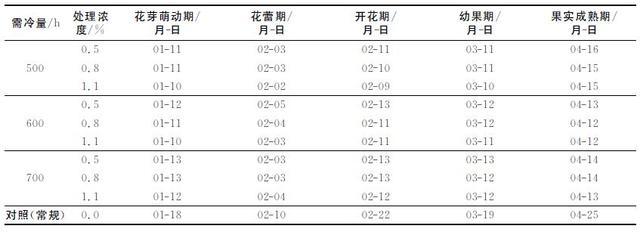
The test results showed that, compared with the control, the 3 hydrogen cyanamide spraying chilling amount stages and 3 spraying concentrations all advanced the phenological period of Bluecrop. Except for the large differences among treatments at the ripening stage, the other phenological periods were basically similar among treatments. After hydrogen cyanamide treatment, the flower bud break stage could be advanced by 5-8 d, the bud stage by 5-8 d, the flowering stage by 9-12 d, the young fruit stage by 6-9 d, and the ripening stage by 9-13 d. Among them, the 600 h chilling amount treatment had the best effect on advancing the ripening stage (see Table 1).
Table 1 Phenological period of Bluecrop blueberries after hydrogen cyanamide treatment
2.2 Effects on fruit-setting rate and new shoot growth
The test results showed that at 500 h chilling amount, the fruit-setting rate of the hydrogen cyanamide treatment was significantly lower than that of the other treatments, while at 600 and 700 h chilling amount, the fruit-setting rates of the hydrogen cyanamide treatments were not significantly different from the control. Except that at the 500 h chilling amount stage, the total length of new shoot growth per branch under the 0.5% and 0.8% hydrogen cyanamide treatments was not significantly different from the control, the total length of new shoot growth per branch under the other chilling amount stages and the 3 spraying concentrations was significantly higher than the control (see Table 2).
2.3 Effects on yield per plant and fruit quality
The test results showed that, compared with the control, under the 3 hydrogen cyanamide spraying chilling amount stages and 3 spraying concentrations, there were no significant differences in single fruit mass, hardness, titratable acid, or soluble solids. It can be seen that hydrogen cyanamide treatment did not have the effect of significantly improving or reducing blueberry fruit quality; at 500 h chilling amount, the yield per plant of the hydrogen cyanamide treatment was significantly lower than that of the treatments with different concentrations at the other chilling amount stages and the control (see Table 2).
Table 2 Effects of hydrogen cyanamide treatment on fruit-setting rate, new shoot growth, yield, and fruit quality of blueberry plants
Note: Different lowercase letters within the same column indicate significant differences (p <= 0.05).
3 Conclusion and Discussion
The chemical name of hydrogen cyanamide is amino cyanamide. It is a plant growth regulator used to compensate for insufficient low temperature and promote bud break in fruit trees. In order to meet the early market launch of facility-grown blueberries, this paper conducted related experiments on the performance of hydrogen cyanamide on facility-grown Bluecrop.
Through observation of the phenological period, treating blueberries with hydrogen cyanamide at different chilling amount stages and at different concentrations all advanced the phenological period of Bluecrop, with the ripening stage advanced by 9-13 d, among which the 600 h chilling amount treatment had the best effect on advancing the ripening stage.
In terms of fruit-setting rate, at 500 h chilling amount, the fruit-setting rates of the different concentrations of hydrogen cyanamide treatments were significantly lower than those of the other treatments and the control, possibly caused by insufficient chilling requirement. Although hydrogen cyanamide has the effect of compensating for insufficient low temperature, when the accumulated chilling amount of the plant is seriously insufficient, the effect of hydrogen cyanamide treatment is not ideal, and the obvious manifestation is a low fruit-setting rate. The results of this study indicate that hydrogen cyanamide can not only advance the breaking of flower bud dormancy, but also advance the breaking of leaf bud dormancy and promote new shoot growth, which is consistent with the results obtained by Stringer et al. using hydrogen cyanamide treatment on rabbiteye blueberry and highbush blueberry.
In treating facility-grown Bluecrop blueberries with hydrogen cyanamide, the research results showed that hydrogen cyanamide did not have the effect of significantly improving or reducing blueberry fruit quality. This is inconsistent with the conclusion of Wang Xingdong et al. that treating Spartan and Berkeley cultivars with hydrogen cyanamide could increase yield and fruit quality, while Li Bo et al. also reached the conclusion that hydrogen cyanamide significantly improved fruit quality when treating sweet cherry. This difference may be related to the fruit species tested and cultivar characteristics, and further research is needed. When the chilling requirement is insufficient, even with hydrogen cyanamide treatment, the yield per plant still cannot be increased, and the reason for the low yield per plant is the low fruit-setting rate.
Overall, for facility-grown Bluecrop blueberries at 600 h chilling amount, treatment with 0.8% hydrogen cyanamide had the best effect, advancing the fruit ripening stage by 13 d, and compared with the control it did not affect fruit quality.