High-yield Cultivation Techniques for Sweet Bell Peppers in Solar Greenhouses
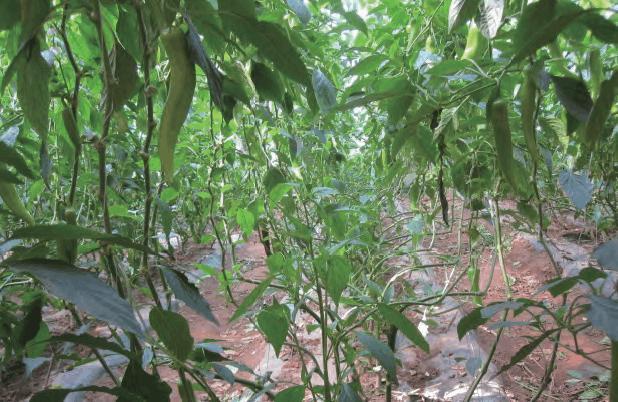
High-yield Cultivation Techniques for Sweet Bell Peppers in Solar Greenhouses
1. Variety selection
Varieties tolerant to low temperature and weak light should be selected.
2. Cultivation season
Early spring crop: sowing date mid-December to early February, transplanting early March to early April, harvesting mid-April to mid-June. Overwintering crop: sowing date mid-May to mid-June, transplanting mid-August, harvesting late October to late April.
3. Land preparation and fertilization
Per mu of land, apply 50 kg of superphosphate, 50 jin of diammonium phosphate, 50 jin of potassium sulfate, and 15-20 m3 of farmyard manure, evenly broadcast on the greenhouse floor, then carry out a 30 cm deep plowing, then rake the ground level and close the greenhouse to solarize the soil, and after ten days ventilate and prepare the beds.
4. Transplanting
Transplanting is best done on a sunny morning. At transplanting, water thoroughly with transplanting water. After three days, promptly water with the seedling-recovery water. After watering, wait 2 days and then do one root drenching, which can prevent diseases and promote root growth.
For the first 3 days after transplanting, the temperature is not high, so no ventilation is needed. After 3 days, ventilate slightly. While the seedlings are still small and in the early seedling-recovery stage, the temperature must not be lower than 28°C. After seedling recovery, ventilate appropriately to lower the temperature, which is beneficial for controlling vigorous growth. During the day, keep the temperature between 25-27°C in the morning and between 22-25°C in the afternoon. In the first half of the night, keep it between 22-23°C, and in the second half of the night, keep it between 16-18°C. Keep the low temperature above 20°C.
5. Rational pruning
Peppers can generally be pruned to three stems or two stems. Whether to keep the first pepper (the one at the first fork) can be decided according to the growth vigor of the seedlings. Plants with good growth vigor can keep it, while weak plants should have it removed promptly. To increase the early leaf area, 4 door-branch forks can be kept, with 4 to 5 leaves kept above them. For three-stem pruning, hang the three main stems separately in different directions to facilitate ventilation and air movement and promote flowering and fruit setting. However, whether three-stem or two-stem pruning, side branches on the main stems can be kept. According to growth vigor, side branches can keep 1-2 flower buds, and 1-2 leaves above the flower buds should be pinched off. After the peppers have set, remove curved peppers and deformed peppers, and keep those of good quality.
6. Scientific topdressing and irrigation
When the plants are flowering and fruiting, supplement foliar fertilizer in time, mainly nitrogen, phosphorus, and boron. After the first pepper has set, apply fertilizer by flushing in time, mainly balanced fertilizers; a balanced formula such as Lvbole can be selected at 4-5 kg per mu. When the fruits grow to about 3-6 cm, supplement potassium fertilizer, such as high-potassium Lvbole at 4-5 kg per mu or Xinshili at 5 kg. According to the growth vigor of the plants, fertilize appropriately and in a timely manner, mainly with organic fertilizer. For medium and robust plants, one bucket of Dashannong can be selected. When the plants are weaker, foliar fertilizer with high phosphorus, high nitrogen, and high potassium can be sprayed on the leaves, and for fertilizer applied by flushing, crystalline diammonium at 4 kg per mu can be selected. For plants deficient in calcium, a calcium-magnesium formula such as Lvbole at 5-6 kg per mu can be selected. These fertilizers should be used alternately. During the full fruiting period, potassium fertilizer should be dominant; high-potassium Lvbole at 4-5 kg per mu can be selected. After entering November, as the outside temperature drops, organic fertilizer can be used again; according to the growth vigor of the plants, Nadoli No. 2 or protein liquid can be selected. After entering March, apply diammonium phosphate combined with organic fertilizer by flushing. Strictly avoid large-water root drenching in severe winter; irrigate frequently with small amounts of water, depending on the situation, generally once every 10 days or so.
7. Pest and disease control
Pepper seedlings are prone to viral disease, so aphids, whiteflies, and thrips need to be controlled. After transplanting, spray Amistar 2-3 times to prevent powdery mildew. After powdery mildew occurs, treat with Amistar and Infinito, spraying 2 times in succession. Throughout the growing period, pay attention to controlling aphids, whiteflies, thrips, and harmful mites.
8. Harvesting and management
The first pepper and the second pepper should be harvested in time. Generally, when the fruit feels slightly firm when held in the hand, it can be harvested regardless of size. After harvesting, promptly remove old leaves, diseased leaves, and lower yellow leaves. Thereafter, as fruits are picked, remove yellow leaves in time. This is beneficial for reproductive growth. After harvesting, strengthen fertilizer and water management so that the next harvest will have a good yield.