What exactly causes little leaf disease in fruit trees?
What is really going on with little leaf disease in fruit trees?
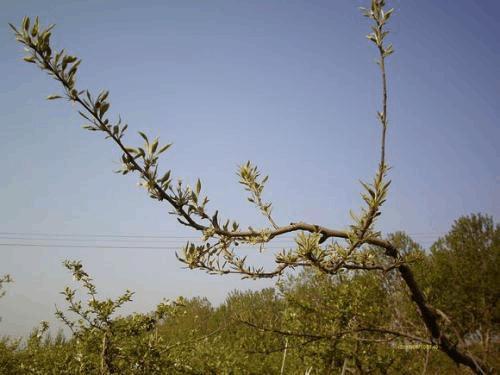
Little leaf disease in fruit trees (Figure 1) has occurred frequently in recent years, and there is a trend of it worsening. Little leaf disease mainly shows as stunted plants, diseased branches that bud late, wither or die; some bear flowers, but the flowers are very small and cannot flower and fruit normally, or the fruit is small and deformed. After years of observation, the author found that little leaf disease in apple trees is not only caused by zinc deficiency; there is also an important cause, namely improper pruning of fruit trees.
Figure 1 Whole-tree little leaf disease
1 Nutritional requirements of fruit trees
During growth and development, fruit trees need both the major elements nitrogen, phosphorus and potassium, and the medium and trace elements calcium, magnesium, sulfur, boron, iron, zinc, copper, manganese, selenium, molybdenum and silicon. When the tree body lacks a certain nutrient element, it shows symptoms (Figure 2) and cannot grow and develop normally. If it is supplemented in time, the symptoms can be greatly alleviated and normal growth restored.
Figure 2 Little leaf disease on main branches
But among the various elements, there are sometimes mutual synergistic or mutual antagonistic effects, and there is also shortening of internodes, narrow small leaves, yellowing leaf color, and leaves becoming brittle and hard, unable to carry out normal photosynthesis; when the disease is severe, the leaf margins of the diseased branches scorch, unidirectional antagonism. For example, there is mutual antagonism between potassium and nitrogen, calcium and magnesium, and there is mutual synergy among nitrogen, calcium and magnesium; when one element increases, it helps the absorption of the other two elements. But phosphorus has unidirectional antagonism with nitrogen, zinc, potassium, magnesium, calcium, copper and silicon; when phosphorus in the soil is excessive, if nitrogen, zinc, potassium, magnesium, calcium, copper and silicon are not increased, the tree body will reduce its absorption of nitrogen, zinc, potassium, magnesium, calcium, copper and silicon, and show symptoms of deficiency of nitrogen, zinc, potassium, magnesium, calcium, copper and silicon; zinc deficiency is related to applying too much phosphate fertilizer.
2 Causes that induce little leaf disease in apple trees
2.1 Little leaf disease caused by zinc deficiency
2.1.1 Soil zinc deficiency After excessive application of calcium phosphate, the zinc in the soil acts with the excessive phosphorus, producing zinc phosphate precipitate, which crops cannot absorb, causing crops to show obvious zinc deficiency symptoms; after excessive application of alkaline phosphate fertilizers such as calcium magnesium phosphate fertilizer, the soil becomes alkaline, reducing the availability of zinc and affecting the crop's absorption of zinc.
2.1.2 Deterioration of soil physical and chemical properties Superphosphate contains a large amount of free acid; continuous heavy application will cause soil acidification. Calcium magnesium phosphate fertilizer contains 25%-30% lime; heavy application will worsen soil alkalinity and deteriorate the physical and chemical properties.
2.1.3 Zinc deficiency in saline-alkali soil In saline-alkali soil, zinc undergoes replacement reactions with soluble salts, forming water-insoluble salts and producing precipitate, which affects the crop's absorption of zinc and causes zinc deficiency.
2.1.4 Zinc deficiency in sandy soil Sandy soil itself has low organic matter content, is barren, and lacks various nutrient elements. In addition, sandy soil has poor fertilizer and water retention capacity, and nutrients leach downward, causing soil zinc deficiency.
2.2 Little leaf disease caused by improper pruning of fruit trees
During winter pruning of fruit trees, due to non-standard operations, excessive pruning of the tree body or excessively severe heading back of strong vigorous branches often causes little leaf disease to occur locally.
Observation shows that all little leaves caused by pruning occur at the very top of each tree or the very front end of each main branch, and are all caused by many large pruning and saw cuts. Because in the first growth period of the apple tree, the pruning and saw cuts have already inhibited nutrient transport, seriously affecting the normal growth of the apple tree and causing little leaves (Figure 3).
Figure 3 Little leaf disease in the late growth stage
3 Symptoms and manifestations of zinc deficiency in fruit trees
When fruit trees are deficient in zinc, plant growth is hindered, plants are stunted, leaves lose greenness, and small leaves and deformities often appear at the tips of branches; branch internodes shorten and appear clustered, diseased branches bud late, leaf expansion is inhibited, leaves are narrow and small, leaf color turns yellow, texture becomes brittle and hard, or leaves do not spread and curl upward, and leaves cannot carry out normal photosynthesis; when the disease is severe, the leaf margins of diseased branches scorch and wither or the branches die; some bear flowers, but the flowers are also very small, with incomplete petals, and cannot flower and fruit normally, or the fruit is small and deformed, and the flesh of drupes and berries has purple spots. (Figure 4).
Figure 4 Manifestation of little leaf disease during the growing season
Little leaf disease caused by soil zinc deficiency is often distributed throughout the whole orchard, in rows or in patches, or on whole plants; little leaf disease caused by improper operations or overly heavy pruning in production appears sporadically and on individual branches. Diseased trees bud later in spring than healthy trees. After leaf expansion, the shoot tip leaves are clustered, and the middle and lower parts of the branches are bare. New shoot internodes are short, and diseased branches easily die. Flowers are few and small, and fruit is small and deformed. Old diseased trees are almost entirely little leaves, with hollow crowns and very low yield.
4 Solutions
Regardless of the cause of the little leaf disease, before and after budding use Weili Duo Zinc 200-fold solution, and spray twice in succession at the little leaf sites of the previous year at an interval of 7-10 days.
4.1 For tree body zinc deficiency caused by soil factors, apply more organic fertilizer, loosen the soil, and strengthen root activity
(1) Spray zinc before flowering. If fruit trees are found to bud late, promptly spray Weili Duo Zinc 500-fold solution or a mixed solution of 0.2% (mass fraction, same below) zinc sulfate and 0.3%-0.5% urea. Urea can promote zinc absorption.
(2) Apply zinc fertilizer to the roots. Before apple trees bud, dig radial trenches under the trees, and apply 50% zinc sulfate powder 1-1.5 kg per plant; the amount to apply can be flexibly controlled according to the size of the tree canopy. A 700-fold solution of 70% Antaisheng wettable powder can also be used. This achieves the purpose of zinc supplementation while preventing disease.
(3) Try the hanging-bottle infusion method. Prepare 2 infusion bottles of 250-500 ml for each tree, filled with 500-1,000-fold zinc sulfate solution. Also prepare medical infusion tubes and No. 9 needles. Use a trunk injection machine to drill 2 small holes on two sides of the base of the trunk of the diseased tree, with a diameter of 0.6 cm, reaching deep into the xylem, then insert the needles, place the medicine bottle upside down above the holes and tie and hang it on the branch or trunk. Infuse about 40 ml of zinc sulfate solution each time; the effect is best from late April to early May and during the vigorous growth period of new shoots. Note that the needles must be disinfected, and the infusion should not be too fast; it is best to drip 500 ml in 24 hours with no liquid flowing out. After infusion, prevent rainwater from flowing into the holes, and they can be plugged tightly with cork. On cloudy and rainy days, use cautiously on trees with severe rot disease.
4.2 Little leaf disease caused by improper pruning
Prune reasonably according to the tree, combining light and heavy pruning, just right. Achieve a reasonable tree structure, with ventilation and light penetration, shaped but not dead, unshaped but not chaotic. Branch arrangement should be reasonable, with long, medium and short branches combined and matched in a certain proportion. Winter pruning should avoid frost damage as much as possible. At the same time, do not cause too many wounds on the same branch or trunk.