Pig Illness Monitored by Drones! Foot-and-Mouth Disease Vaccine Withdrawal Paves the Way to Disease-Free Status, a Key Step to Returning to the International Stage
By Lin Pei-chun, reporter for Upstream and Downstream
Foot-and-mouth disease has plagued Taiwan's pig farming industry for 21 years. Since no further outbreaks have been reported since last year, the Council of Agriculture resolved to fully "withdraw the needle" in July of this year. If no foot-and-mouth disease cases appear within one year, Taiwan can hope to regain "disease-free status," an important step for Taiwan's livestock to return to the international market.
Foot-and-Mouth Disease "Needle Withdrawal": A Full Stop to Vaccination
In the 86th year of the Republic of China (1997), an outbreak of foot-and-mouth disease in pigs struck Taiwan, devastating the pig farming industry. Lin Tsung-hsien, chairman of the Council of Agriculture, said that 3.8 million pigs were culled that year, affecting the upstream, midstream, and downstream pig meat industries, causing many operators to leave pig farming in anguish, continuously shrinking Taiwan's pig farming scale and causing a loss of 170 billion yuan in livestock production value. "It was simply too horrible to look at!"
For twenty years the government relied on continuous vaccination to control the outbreak; in the 92nd year of the Republic of China (2003), Taiwan saw no further foot-and-mouth disease cases for two years and was recognized by the World Organisation for Animal Health (OIE) as a "vaccinated disease-free zone." In the 98th year (2009), a plan was made to stop vaccination, but unexpectedly the outbreak flared up again that same year, and the government immediately resumed vaccination.
In the 106th year of the Republic of China (2017), the OIE again recognized Taiwan as a "vaccinated disease-free zone." Starting in January of this year, the Council of Agriculture successively released three batches of "sentinel pigs" that had never been vaccinated and had no antibodies in their bodies, bringing them into contact with pigs at ordinary pig farms. After environmental testing, all showed negative for foot-and-mouth disease virus. Lin Tsung-hsien said that Taiwan's foot-and-mouth disease vaccination rate exceeds 90%, with antibody protection coverage reaching 86%, leading to the inference that no foot-and-mouth disease virus remains in the country. The Council of Agriculture therefore plans to "withdraw the needle" in July of this year, fully stopping vaccination.
One Year Is the Key
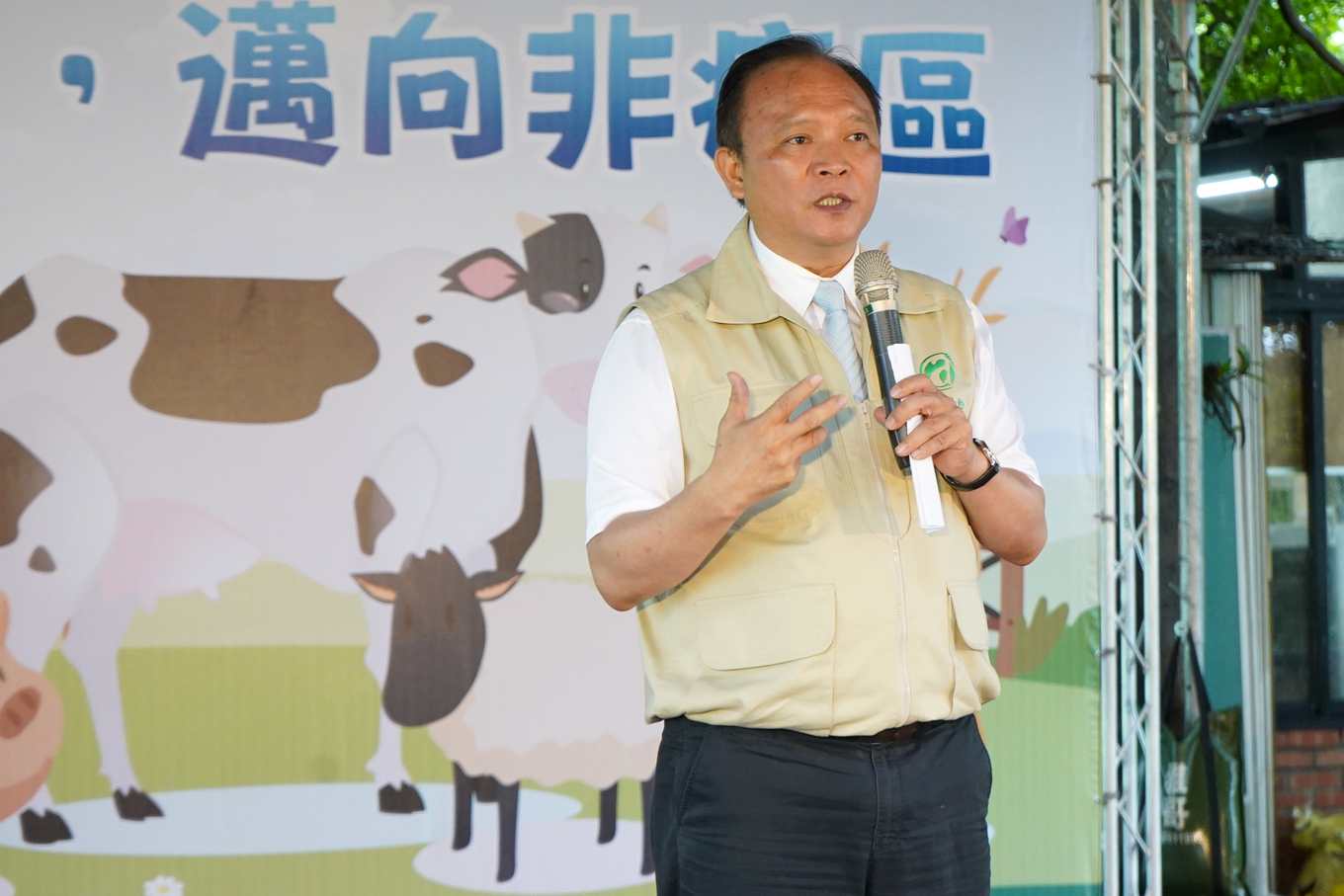
Lin Tsung-hsien today (the 19th) held a "Needle Withdrawal Pledge Rally" in Pingtung, Taiwan's pig farming heartland. Lin said he is confident that foot-and-mouth disease has been fully eradicated in the country, and that as long as no foot-and-mouth disease cases appear in the coming year, Taiwan can apply to the OIE to regain "disease-free status," hoping to revive Taiwan's pig farming industry and enhance its international competitiveness.
However, Lin pointed out, "This one year is the key!" emphasizing that the outbreak must not recur, otherwise everything would have to start over from the beginning.
Regarding epidemic prevention measures after needle withdrawal, "border management and smuggling interdiction are very important." Lin emphasized that after foot-and-mouth disease disappears domestically, even more attention must be paid to viruses brought in from abroad, so meat trade inspections at the border must be strengthened, especially for meat products shipped from Kinmen to Taiwan. At the same time, Lin also called on domestic livestock operators to strengthen personnel disinfection when returning to the country, so as to fully block the invasion of foreign viruses.
Pig Shipments Require a Signed Health Declaration
Shih Tai-hua, deputy director-general of the Bureau of Animal and Plant Health Inspection and Quarantine, said farmers should also carry out good self-managed biosecurity, such as avoiding cross-infection among pigs on the farm. "The main source of infection is transport vehicles." Shih emphasized that vehicles carrying pigs and delivering feed must be properly disinfected when entering and exiting.
Shih Tai-hua also said that after needle withdrawal, starting from July 9, if pigs are to be shipped, operators must sign a livestock "health declaration" confirming the pigs are not infected with foot-and-mouth disease. If an outbreak occurs and is not proactively reported, under the Regulations on the Prevention and Control of Animal Infectious Diseases, a maximum fine of NT$1 million may be imposed, and no compensation will be given for the loss of culled livestock.
Finally Withdrawing the Needle, Enhancing International Livestock Competitiveness
If foot-and-mouth disease cases break out again, Chien Mao-sheng, a professor at National Chung Hsing University's Graduate Institute of Veterinary Pathobiology, said small-scale infections (such as one or two farms) should be handled by culling; if the outbreak has already spread to other counties and cities, regional vaccination measures should be reinstated.
Regarding vaccine-related control and reserves, Shih Tai-hua emphasized that after needle withdrawal Taiwan still keeps physical vaccines on hand, and also has sufficient vaccine quantities stored at a vaccine bank in the United Kingdom; if needed, they can be delivered to Taiwan within five days.
Yang Chieh, vice chairman of the Republic of China Pig Farming Association, said that over these twenty-plus years Taiwan's pig farming industry has continuously battled foot-and-mouth disease, and he welcomes the fact that Taiwan can finally "withdraw the needle" this year and move toward disease-free status, looking forward to enhancing domestic livestock competitiveness and reducing dependence on imported meat.