Shaping, pruning and styling techniques for large mountain Chinese pine trees
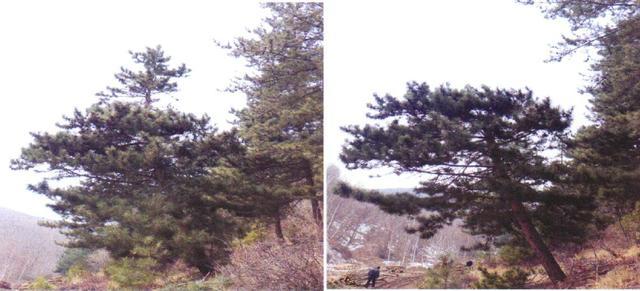
Large tree shaping and pruning techniques - styling mountain Chinese pine
(1) Overall styling approach
① For trees whose crown is greater than 1/2 of tree height and whose tree form is relatively full, carry out thinning and release, and cultivate them as normal nursery stock; for this type of tree, simply clearing dead branches is sufficient.
② For trees whose crown height is less than 1/2 of tree height but greater than 1/3, and whose trunks are relatively straight, carry out topping work to cultivate welcome trees for the market. For this type of tree, cut the top of the tree tip; the topping should be determined according to tree vigor, generally within a range of one to two meters, and should not be too large. For this type of tree, suitable small compartments for the work must be selected, and the cultivated height is generally between 6~8 m, and it must be on a scale; for trees with curved branches and peculiar tree forms that begin to show characteristics of grotesque trees, carry out key development and cultivation.
③ For double-stem Chinese pines that cannot be cultivated as grotesque trees and need work, and whose two trees have similar crown forms, cut the tree on the sunny side; if the crown forms differ greatly, cut the inferior tree.
④ Trees with straight trunks, excessive height and thickness, and relatively difficult transport (tree height above 12 m, crown width above 8 m) are not cultivated as large seedlings.
(2) Styling according to "vigor"
Because mountain Chinese pine seedlings are commercial resources for production, it is impossible to begin pruning from the juvenile stage. Their greatest characteristic is that most trees have already formed an inherent growth form in the early growth stage, that is, a relatively difficult-to-change "vigor". In principle, in the later growth stage, the trunk of Chinese pine seedlings is very difficult to change within a short period, so it is necessary to analyze and remove according to the different existing growth states of different seedlings, and to prune, cultivate and wire the side branches, with these as the focus, and further adopt reasonable styling means and methods to promote the growth of Chinese pine and the formation of the "vigor", forming different models of Chinese pine seedlings.
Figure 1 Before-and-after comparison of Chinese pine styling according to "vigor"
Figure 2 Chinese pine seedlings
(3) Emphasize the creation of layers
In the process of styling and pruning Chinese pine seedlings, the method of handling layer relationships in bonsai art can be used. Chinese pine sprouts and branches in many parallel lines, and it is easy to form relatively flat and extended branch and leaf directions. If artificial means are used to operate and prune, layers are easily formed. Finally, the branches and leaves are pruned to form several layers of horizontal cloud pads.
Figure 3 Layer pruning of Chinese pine
① Density of layers
Chinese pines that have not been pruned and shaped, or Chinese pine seedlings that have received only simple treatment, mostly retain their original growth trend, with luxuriant branches and leaves and numerous, scattered, disordered branches. Therefore, when pruning, not only must the growth requirements of the plant be considered, but the styling layers of the Chinese pine must also be clearly sorted out. Remove excess branches and leaves on the framework boldly; the sparse parts can reach "sparse enough for a horse to pass through"; the dense parts can be "dense enough that a needle cannot pass through". Attention must be paid to combining sparse and dense, breaking the shortcoming of monotonous modeling, so that the composition becomes vivid and lively, full of layers and contrast. There is sparseness and there is density, and the two complement each other; only with the foil of sparseness can tight layers be expressed, and only with dense branches and leaves can sparse accents be seen.
② Spatiality of layers
The spatiality of Chinese pine layers includes high-low layering and front-back layering of branches and leaves. Compared with the former, the high-low layering of Chinese pine is easier to handle, but front-back layering of branches and leaves is often easily overlooked in the early stage. Without front-back layers, there is only the middle ground, which appears too ordinary, thin as a sheet of paper, and without a three-dimensional sense. Therefore, if front-back layers are handled well, the styling of the whole plant will appear rich and substantial. To ensure that Chinese pine seedlings can withstand inspection from all angles, the front-back layers must be well interspersed, and can even achieve the artistic effect of "scenery changing with each step".
(4) Pruning essentials
Follow the pruning order from top to bottom, from outside to inside, from rough pruning to fine pruning, and prune thick branches first and fine branches afterward. First prune branches, removing dead branches, water sprouts, whorled branches and stacked branches; then style, pruning out the styling and layers according to the requirements of the tree form.
(5) Notes
① Chinese pine has limited branching ability, so this requires us to retain the 1-year-old tender branches on the lateral branches at the top of topped trees, and cut back 2-year-old branches, so that the upper branches and leaves are finally pruned to form several layers of horizontal cloud pads.
② Mountain nursery stock has a relatively large tree body, so its vegetative growth must be considered. Relatively more branches should be retained, so that the tree's own vegetative growth and reproductive growth are coordinated. In this way, tree vigor recovers much faster.
③ Chinese pine must be styled according to the tree, not uniformly. It is necessary to achieve high-low matching, space utilization and seedling material utilization.
④ The degree of retention or removal of key branches and leaves at certain positions (interest branches) still needs to be improved.