With just a few key steps for potted cucumbers, the flowerpot will be laden with healthy and delicious cucumbers
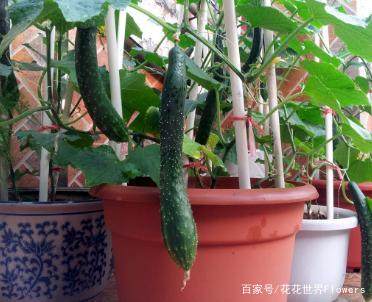
Potted cucumbers, with long fruits topped by small yellow flowers, hang among the green leaves, offering ornamental value and giving people a fresh and refreshing feeling. Growing potted cucumbers allows you to enjoy both their beauty and their taste, economical and practical, achieving two benefits at once. Although potted cucumbers are not as delicate and beautiful as potted flowers, their tender, juicy leaves and dainty small yellow flowers are even more endearing. The long fruits hanging among the leaves are more attractive than flowers. They can be enjoyed for their beauty, cultivating one's character, and can also be picked and eaten at any time. Therefore, potted cucumbers are very popular among many gardening enthusiasts.
Requirements for the pot. Clay pots are best. There is no uniform standard for pot size and shape. To achieve a certain yield of cucumbers, the pot volume cannot be too small; the diameter should be over 20 cm, and the pot height should not be less than 15 cm. The holes in the bottom of the pot should not be too small; a pot with "five-flower holes" is best. If you buy one with a single large hole, place a curved tile piece over the bottom of the pot to prevent soil from leaking out through the hole. Because the pot volume is limited, the nutrient soil must be rich in nutrients.
Potting soil. The potting soil can be fertile sandy loam field soil, but it must not have been used before for growing melons, fruits or vegetables. For base fertilizer, fully decomposed poultry and livestock manure, superphosphate, bone meal, etc. can be applied and thoroughly mixed when preparing the culture soil, with the aim of improving soil fertility and supplying the long-term needs of cucumber growth. Apply a portion of base fertilizer at the bottom of the pot by placing fermented soybean cake, dried manure and unfermented hoof pieces at the bottom of the pot or around the lower part of the pot, but avoid using too much or placing them too close to the plant. At present, organic fertilizers and inorganic fertilizers are more often applied in combination, which can ensure that cucumbers receive sustained and stable nutrients during growth.
When planting, first pour cucumber seeds into a basin of hot water at 60-70 degrees, stir until it is no longer too hot to touch, then soak for about 5 hours. After draining the water, keep them moist with a wet cloth. At a room temperature of 20 degrees, they can sprout after 24 hours. Then plant them in the pot and cover with 1 to 2 cm of soil. Generally, seedlings emerge after about a week. After the seedlings grow 2-3 true leaves, they can be transplanted into flowerpots. The planting depth should be such that, after watering, the surface soil is about 3 cm below the pot rim. If too much soil is added and the plant is set too shallow, the water-holding capacity during watering will be small, making it difficult to meet the cucumber's water needs; if too little soil is added and the plant is set too deep, watering is likely to be excessive and prone to causing root rot. It is best to plant 1-2 in one flowerpot, not too many, as too many will instead affect the normal growth of cucumbers.
Watering. Potted cucumbers have limited water-holding capacity and are directly exposed to the outside air, so evaporation is high. Therefore, the watering characteristic for potted cucumbers is small amounts and frequent watering. Otherwise, the roots growing along the pot wall are prone to root burn once they encounter a lack of water. Before fruiting, do not water too much; just keep the soil from drying out and the leaves from wilting. During the flowering period of the root cucumber, watering should also not be excessive. After the root cucumber forms, gradually increase the frequency of watering, or water once a day. In the afternoon, for individual dry pots, a little additional water can be given.
Because cucumbers are vine plants and will grow long climbing stems, when they reach about one meter, pinch off the growing tips to encourage branching, so supports need to be set up in time for cucumber growth. In addition, cucumber fruit stalks are tough, so it is best to use scissors when harvesting to prevent the vines from breaking.