What are the effects of pruning and training landscape trees?
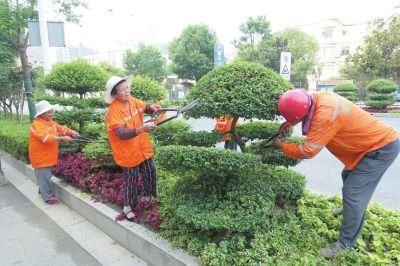
The effects of pruning and training landscape trees
(1) Cultivating beautiful tree forms. At present, most trees in landscapes use natural tree forms. In order to maintain these tree forms, they need to be pruned appropriately. However, in practice, the ornamental purpose of landscape trees in beautifying the environment also needs to be taken into account. Therefore, through pruning and training, trees can create a combination of artificial and natural beauty on the basis of natural beauty.
(2) Promoting and controlling growth. The size of the aboveground part of a tree and the growth condition of its branches and leaves are directly and closely related to the state of the root system and the amount of water and nutrients it absorbs from the soil. Pruning and training can cut off unnecessary aboveground parts, so that nutrients and water are supplied uniformly to the remaining branches and buds, promoting local growth; however, if the degree of pruning is too heavy, it will weaken overall growth. This is called the "dual effect of pruning," but whether the specific effect is promotion or inhibition depends on the pruning method, the degree of severity, the pruning period, and the quality of the bud at the pruning cut. Therefore, pruning can be used to restore or adjust tree vigor; it can both rejuvenate weakened parts and weaken overly vigorous parts. For weakened trees or ancient trees with long-lived latent buds, proper heavy pruning, combined with fertilization and watering, can promote the sprouting of latent buds and achieve renewal and rejuvenation.
(3) Promoting flowering and fruiting. Proper pruning can concentrate nutrients in the remaining branches after pruning, prompting most short branches and auxiliary branches to become flower and fruit branches, producing more flower buds, thereby achieving dense flowering and increasing the amount of fruit set.
(4) Improving light penetration and reducing pests and diseases. If some landscape trees grow naturally or are pruned with incorrect methods and intensity, adopting correct pruning methods can remove densely growing branches in incorrect positions, water sprouts, and diseased branches carrying pests and diseases. This can ensure ventilation and light penetration inside the canopy, reduce the occurrence of pests and diseases, and at the same time prevent injuries caused by mutual friction.
(5) Regulating conflicts. In cities, because municipal buildings and facilities are complex, conflicts often arise with trees, especially street trees, which have overhead lines above and pipes and cables below. Some trees can also affect vehicle traffic, for example, some branches touching or hanging on power lines or drooping branches hindering cars from passing. All of these problems must be solved by pruning branches.