How are plum trees grafted and propagated? A technical guide from Lingyuan City
Lingyuan City plum tree grafting and propagation techniques
1 The growing environment of plum trees
We all know the plum tree; it has a strong ability to adapt to climate, and it is a temperate plant. We can see that when fruit is abundantly on the market, plums are a very common fruit, and the price is also very cheap. Usually we can buy a lot of plums for just a few yuan, and its yield is also quite large. This also shows that its planting area is very large. As for the requirements for planting conditions, it does not have very high demands for the growing environment. As for the soil, as long as the soil layer is relatively thick, has a certain depth, and has a certain fertility, no matter what type of soil it is, it can perfectly adapt to the environment for planting. But the only point is that it has relatively high requirements for air and soil humidity. Once water accumulates or on rainy days, if drainage is not carried out in time, root rot may occur. Therefore, in the growing environment of plum trees, one requirement is to choose an environment with relatively loose soil, and the soil should be relatively breathable with good drainage. We should build our orchard in a place with a relatively deep soil layer, good drainage, and a relatively low groundwater level. For plum trees, some diseases or poor growth that may commonly occur, and some pests and diseases, these are all situations that may occur.
2 The grafting time and preparatory work for plum trees
For the grafting time of plum trees, we usually choose around July, when the climate is relatively suitable, and this is the best time for grafting. The grafting time can be slightly adjusted according to the different conditions of each region. Seven to ten days before grafting, we can first do some preparatory work by selecting strong-growing peripheral branches and pinching off their tips. Doing this can promote the earlier maturity of the scions. The grafting site is generally selected at a height of 5 to 8 cm from the ground, and this height is beneficial for the early sprouting of the grafted buds.
3 Selection of plum tree varieties
We can see that plum tree varieties are very abundant. Every year when plums are abundantly on the market, we can see differences in size, with colors including bright red, purple-red, and green, etc., and their tastes also differ greatly. Among the more traditional plum tree varieties in China are May Plum, Jiaqing Plum, Yuhuang Plum, and so on. At the same time, with the introduction of new varieties nowadays, we also select many excellent foreign plum varieties to graft with our varieties, in order to create plums with better taste. Some plum tree varieties that are relatively widely used in current production include the American Big Plum, and Japan's Liwang, etc. We graft different varieties together to cultivate plum varieties with better quality, better taste, stronger survival ability, and other characteristics. We combine excellent genes from both domestic and foreign sources to obtain the goal we hope for.
4 The specific operation of grafting
Grafting is mainly divided into three parts: preparation before grafting, grafting, and care after grafting. We will explain them step by step.
4.1 Treatment before grafting
This mainly involves the treatment of the rootstock and the scion. For the treatment of the rootstock, we need to select the stumps of wild plum, peach, or cherry trees that have already been transplanted and survived, and saw them off at 6 to 10 cm above the ground. At the same time, make some adjustments according to the shape of the tree. This section of stump will be used as the rootstock. As for the treatment of the scion, we select relatively sturdy one-year-old thick and plump semi-lignified branches that have not yet unfolded leaves as scion wood. At the same time, we must properly store and handle these scion woods, processing them to a length of about 5 to 6 cm and keeping 5 to 7 buds. These scion woods are wrapped with a wet cloth to facilitate our later grafting.
4.2 The grafting process
Because our rootstocks are generally relatively thick and sturdy, we often choose the cleft grafting method, and this method is also relatively beneficial for later healing. The healing speed at the interface will be very fast, and the success rate will also be very high. When grafting, we should do it when the rootstock buds begin to sprout or have already sprouted but have not yet unfolded leaves.
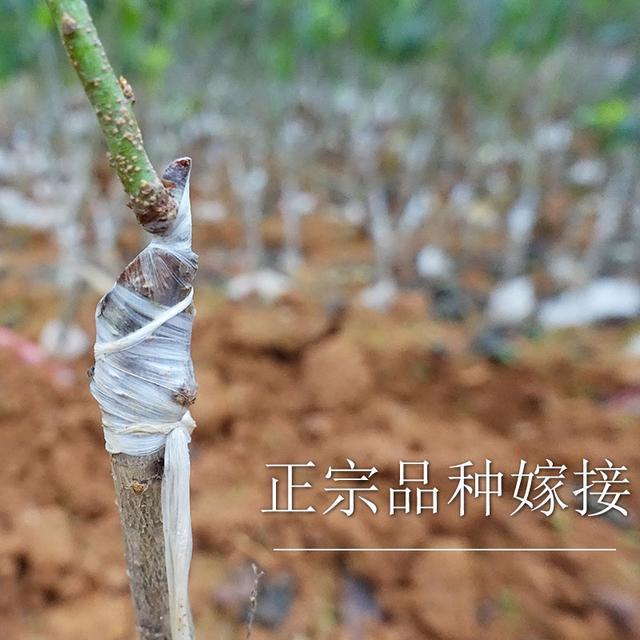
One day before grafting, we should water the rootstock once, smooth the interface of the rootstock with a knife, and then split open a cleft of about 3 cm. Then take our scion out of the wet cloth, trim the lower interface into a wedge shape that fits the cleft, and leave only two or three buds on the upper part. Insert the scion into the cleft, align it, and insert it firmly. Then we tie it tightly with a wide plastic cloth. Be sure to tie the upper end of the interface tightly as well, because this can prevent moisture loss and pests and diseases. At the same time, when the grafting conditions are relatively dry, we should stuff some cotton balls soaked with water inside, and cover the top with a transparent plastic bag.
4.3 Care after grafting
For care after grafting, when the grafted bud grows to 3 to 5 cm, we should cut it off, leaving a few leaves on the rootstock, and only cut the rootstock after the grafted bud sprouts. At the same time, watering should be done in a timely manner later. When watering, also pay attention to the amount to prevent root rot in the plum tree. At the same time, also pay attention to the growth of the tree roots, so that the root system develops vigorously and lays a good foundation for growing into a mature fruit tree in the future.
5 Other methods of propagation
Above we mainly introduced the cleft grafting method for plum trees. Through other methods, we can also propagate plum trees. For example, the cutting propagation method and the division propagation method are all very good cultivation methods. Each method has its different applicable conditions and points to note during operation. The key is that we should choose the most suitable propagation method for different varieties and environments to achieve the highest survival rate.
As a plant that is relatively easy to cultivate, the plum tree has relatively low environmental requirements during propagation, and at the same time the survival rate? is very high. However, in the specific implementation of plum tree grafting and propagation, there are many points to note. The specific implementation of many steps must be adjusted according to the varieties we choose, the local environment, and other factors. At the same time, in many steps, operations must be carried out according to the operating standards to ensure that our survival rate is very high, and also to lay the foundation for cultivating good new varieties.