High-yield cultivation and planting techniques for Balloon Flower (Platycodon grandiflorus) in Fuxin Mongol Autonomous County
High-yield cultivation and planting techniques for Balloon Flower (Platycodon grandiflorus) in Fuxin Mongol Autonomous County
Balloon Flower is a perennial herbaceous plant of the Campanulaceae family, with white milky sap throughout the plant. It grows on hillside grasslands or forest edges. It is a wild vegetable used both as food and medicine. Balloon Flower prefers cool and humid conditions, fears waterlogging, is cold-resistant, and loves light. The suitable growing temperature is 10-20°C, the optimum temperature is 20°C, and it can tolerate a low temperature of -20°C. The soil for planting Balloon Flower is mostly loam, sandy loam, clay loam, and humus loam. The soil must not be waterlogged; if there is too much soil moisture, the roots are prone to rot. Balloon Flower is afraid of wind damage; in windy areas, attention must be paid to preventing wind damage and avoiding lodging.
I. Morphological characteristics of Balloon Flower
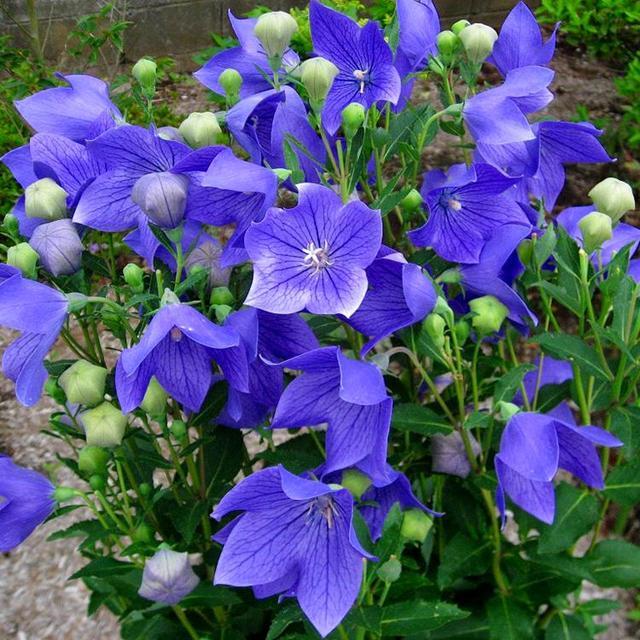
Perennial herb, plant height 30-100 cm, the whole plant smooth and hairless, root thick and fleshy, outer skin yellowish-brown or grayish-brown, stem upright, leaves ovate-elliptical, grayish-green on the underside, corolla broadly bell-shaped, deep blue; capsule obovate. Leaves ovate to lanceolate, 2-7 cm long, 0.5-3 cm wide, apex acuminate, margin sharply serrate, base cuneate. Flowering period July-September, fruiting period August-October.
II. Growing environment
Balloon Flower prefers cool and humid conditions, loves light, and is cold-resistant. The suitable growing temperature range is 10°C-20°C, the optimum temperature is 20°C, and it can tolerate a low temperature of minus 20°C. Plants grow well in deep, loose and fertile, well-drained humus soil or sandy loam. It fears waterlogging; waterlogged soil easily causes root rot.
III. Planting techniques
1. Site selection and land preparation. Balloon Flower is a deep-rooted plant, so it is best to select deep, loose and fertile, well-drained humus soil or sandy soil. After selecting the site, apply 2500 kg of compost per mu, add 20 kg of superphosphate, spread it into the field, deep-plow more than 30 cm, and level and harrow fine.
2. Timely sowing. Balloon Flower is mainly propagated by seed; spring sowing, autumn sowing or winter sowing are all acceptable, with 2 kg of seed per mu. Seedling transplanting can also be used, but because direct sowing gives higher yield than transplanting, and the roots are straight with few branches, making peeling and processing easier and the quality good, it is mostly used in production. Note that when propagating by seed, newly produced seed of the current year must be used; new seed germinates quickly and has a high germination rate, and the seedlings grow evenly and robustly, which is good for management, whereas old seed from the previous year has a low germination rate or may even fail to germinate.
To increase the seed germination rate, the seed can first be treated: before sowing, soak the seed in warm water for 12 hours, mix evenly with an appropriate amount of wet sand, pile it for a few days, and then sow, which can significantly increase the germination rate. Use the drill sowing method: on the prepared seedbed, open furrows at a row spacing of 18-21 cm, about 2 cm deep, and cover with 1 cm of soil after sowing. Or use the relatively advanced wide-band drill sowing method, that is, the furrow width is 10 cm, the row spacing is unchanged, and soil is covered after sowing; the wide-band drill sowing method has many advantages, such as simple management and good finished-product quality. With suitable temperature, seedlings emerge in about 15 days.
III. Field management
1. Reasonable close planting. Row spacing 17-20 cm, plant spacing 3-5 cm. If too dense, the plants grow thin and weak and are prone to pest and disease damage. If too sparse, the yield is low. When using the wide-band drill sowing method, thin the seedlings appropriately; it is enough that the seedlings are not crowded, and there is no need to remove too many seedlings. Appropriate close planting is the key to increasing yield.
2. Cultivation and weeding. Balloon Flower grows slowly in the early stage and is prone to weeds, so weeds should be pulled out in time to prevent them from spreading and causing a weed infestation. For the planting site, first water thoroughly, and when the moisture is suitable, immediately loosen the soil shallowly once, so as to avoid the ground cracking and letting air through, which causes seedling death. Cultivation should be carried out when the soil moisture is moderate. Once the plants have grown large and closed the rows, there is no need to cultivate and weed again.
3. Topdressing. During the seedling stage, apply 1-2 topdressings of thin human and animal manure to promote seedling growth. At the end of June, increase the application of flowering-stage fertilizer, mainly phosphorus and potassium fertilizer, to prevent excessive nutrient consumption from flowering and fruiting from affecting growth. After entering winter, apply a heavy overwintering fertilizer, and combine fertilization with earthing up. In the following spring, when the plant height is about 1 m, appropriately control the amount of nitrogen fertilizer and apply phosphorus and potassium fertilizer as a topdressing, so that the stems grow thick and strong, which can prevent or reduce lodging. Flower and fruit thinning. The flowering period of Balloon Flower is relatively long and consumes a large amount of nutrients, affecting root growth. Except for seed-production fields, flower and fruit thinning can improve root yield and quality; in production, flower buds can be removed by hand, such as cutting off the flower buds with a sickle. Or use paclobutrazol, sprayed at full bloom, to prevent flowering.
4. Drainage. Balloon Flower is planted at high density, so in summer when it is hot and humid, drainage ditches should be cleared in time to prevent waterlogging and root rot, which reduces yield.
IV. Main pests and diseases
1. Root rot. (1) Symptoms: a root disease caused by the fungus Fusarium, a member of the Fungi Imperfecti. The onset period is June-August; initially part of the root turns yellowish-brown and rots, then gradually expands, and when the disease is severe, the aboveground part withers and dies. (2) Control methods. A. Pay attention to crop rotation and drain standing water in time. When planting in low-lying land or rainy areas, raised beds should be made. B. During land preparation, apply more base fertilizer to improve the soil and enhance the disease resistance of the plants; apply 50-100 kg of lime powder per mu, which can reduce the damage, or use 5 kg of carbendazim per mu for soil disinfection; when the disease occurs, it can be controlled by drenching with a 1000-fold solution of 50% thiophanate-methyl. C. Pull out diseased plants in time.
2. Violet root rot. (1) Symptoms: a disease caused by a basidiomycete fungus. It damages the roots, starting first from the fibrous roots and then extending to the main root; the diseased part is initially yellowish-white, with white mycelial strands visible, then turns purplish-brown, and the diseased root rots from the outside inward; the outer mycelial strands interweave into a mycelial membrane, and when it ruptures, a mushy residue flows out. The aboveground diseased plants gradually turn yellow and wither from bottom to top, and finally die. (2) Control methods: the same as for root rot.
V. Harvesting and processing
1. Harvesting. Because the region and sowing period differ, the harvest year for planted Balloon Flower also differs; generally it is harvested in the same year or the second year, and in Northeast China it can be slightly earlier. The harvest period can be from late September to mid-October in autumn, or before Balloon Flower sprouts in the following spring. Those harvested in autumn are heavier and more solid, and of better quality. Generally, dig when the aboveground stems and leaves wither; digging too early means the roots are not yet plump, the dry ratio is low, and yield is affected; harvesting too late makes peeling difficult. When digging, prevent breaking the main root.
(1) Seed harvesting. From August to October, when the capsule shell is light yellow and the top of the fruit has just begun to split, and the seeds inside are plump and black after being broken open, they can be picked in batches. The harvested seeds should not be directly exposed to the sun; they can be piled indoors in a ventilated place for 3 to 4 days so that the seed embryos mature naturally, then dried in the sun, removed from the fruit shells, and stored in cloth bags or paper bags in a dry, ventilated place. Seed life is one year, and low-temperature storage is preferable. (2) Root harvesting. Dig and harvest in the same year of transplanting or in the second year of direct sowing. Harvest in late autumn from October to November: first cut off the stems and leaves, dig out the roots, wash off the soil with clean water, drain the water, and while fresh, scrape off the cork layer with bamboo slices, glass pieces, porcelain pieces, etc., wash clean, then sun-dry or oven-dry.
2. Processing. After the fresh roots are dug out, remove the soil and the rhizome head, scrape off the cork layer with a bamboo knife, wooden edge, porcelain piece, etc., wash clean, and sun-dry or oven-dry. The skin must be scraped clean while fresh; if too much time passes, the root skin becomes difficult to scrape. After scraping, it should be dried in the sun in time. If too much Balloon Flower is harvested to process all at once, it can be buried in sand to prevent the outer skin from drying and shrinking, which makes peeling easier. The dry ratio is 30%.
The quality of Balloon Flower is best when the roots are thick and plump, white or slightly yellowish, solid, and with a chrysanthemum pattern.
VI. Harvest
Cultivated Balloon Flower can be harvested after 2-3 years. The digging time for Balloon Flower is best in autumn; too early affects yield; too late makes the root skin difficult to scrape and not easy to dry. The suitable digging period is from late September to mid-to-late October. For the dug Balloon Flower roots, shake off the soil, soak them in water and wash clean, scrape off the outer skin while fresh with a bamboo knife or bowl shard, soak in water for 24 hours after scraping, take them out, place them on a wire mesh, and dry them in a ventilated, dry place, and they become white Balloon Flower. This meets the commercial standard.