How many times a year does freesia bloom, and how do you care for it in a pot day to day?
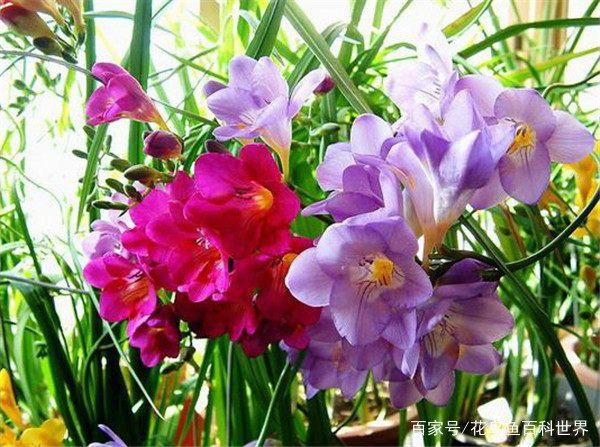
Freesia's flowering period is in April-May, but I can regulate the flowering period appropriately to make it bloom earlier, thereby extending the flowering period, so that freesia can keep blooming from February to May. So, under normal circumstances, how many times a year does potted freesia bloom? Below, the editor and everyone will explore this together.
Freesia's most suitable growing temperature is usually between 15°C-20°C, and the flowering temperature generally needs to stay between 13°C-15°C. However, only spring and autumn can usually meet this temperature condition. But after freesia enters June and summer, the parts of the plant above the soil gradually wither, and the bulbs in the potting soil gradually enter a dormant state as the temperature rises. Based on this, it is usually not suitable to plant it in spring
What remains is naturally autumn, and freesia is also most suitable for planting in autumn, not only because the temperature is suitable, but also because light is relatively easy to control. And freesia is a bulbous plant, generally propagated by burying bulbs in potting soil to grow young plants. After entering September in autumn, the bulbs can be buried in a large pot of soil for planting
Although freesia is planted in autumn, it often only blooms from late winter to spring, and necessary care and management work needs to be done during this period. In order to make freesia bloom earlier and extend the flowering period, it is usually necessary to raise the temperature, and at the same time change the light conditions; of course, some plant growth regulators can also be applied appropriately.
Because winter temperatures are low, the plant is still prone to entering a dormant state. In order to promote the formation and differentiation of flower buds, Original: wWw.pJCn.ORg the temperature can be raised appropriately, keeping the winter temperature between 13°C-15°C; at the same time, if it is a sunny day, it can be given 9-10 hours of sunlight; in order to promote flowering, some low-concentration gibberellin dilution can also be sprayed on the plant, and after about 1-2 weeks the inflorescence can be successfully produced. By adopting the above three care methods, the goal of making freesia bloom early can be achieved
But after the flowers fade in May and June of summer arrives, the plant will wither again, and the bulbs will gradually enter a dormant state as the temperature rises. And after autumn arrives, as the weather turns cooler, the bulbs will gradually wake up from dormancy again. As long as the temperature is suitable and the potting soil is kept moist with a little watering, the bulbs will continue to take root and sprout. Thus it returns to the previous process, completing one cycle.
Through the above analysis, it is found that potted freesia is mostly planted in autumn, blooms in spring, and begins to wither in summer. It can be seen that potted freesia often blooms only once a year, but in order to extend the flowering time, the flowering period can be extended by taking the necessary measures to adjust the flowering period.
Freesia flowers are elegant and beautiful, mainly white; it is a bulbous herbaceous flowering plant, generally blooming in April-May and bearing fruit in June-September. But many people also grow red, yellow, purple and other varieties, which also have very high ornamental value. Therefore, freesia is very suitable as a potted ornamental plant, and essence can also be extracted from it.
In recent years, as people have gradually come to know and understand freesia, more and more people like to grow this flowering plant in pots, and potted prices have also shown an upward trend in various places. So, about how much does a pot of freesia cost at the flower market? I believe that due to different regions, its price also differs.
Through visits and surveys, it was found that the price of potted freesia plants with good appearance is generally around 15 yuan, which, compared with many other flowering plants, is also relatively cheap. For potted freesia with slightly poorer appearance, the price will be lower, ranging from 2 yuan to 10 yuan. But if it is to be grown as a potted plant, generally about 5 plants are suitable per flower pot.
Although there is a relatively large price gap between potted freesia and other flowering plants, this is mainly because people do not understand it deeply enough. However, through understanding freesia on the market, this flowering plant is becoming more and more accepted by people, and I believe its price will also become higher and higher, and we will quietly wait for its price changes and trends.
Relatively speaking, the price of potted freesia is relatively low. On the one hand, this may be because many potted-plant enthusiasts still do not understand it well; on the other hand, it may be because after this flowering plant finishes blooming and enters summer, the branches and leaves of the plant turn yellow and wilt, and the bulbs left in the potting soil need to be cultivated and then stored, and will also enter a dormant state. So, it seems a bit troublesome to manage.
However, as the saying goes, "no pains, no gains." If I want to harvest the beauty, elegance and striking fragrance brought by potted freesia, I still have to put more effort into growing and caring for it. And potted freesia has high ornamental value and practical value, so it is usually worth my effort. However, it is suggested that enthusiasts who like growing freesia in pots plant multiple varieties in one flower pot; after all, this plant has many varieties and rich flower colors, and when it blooms, it will surely become a beautiful sight.