At first glance, bonsai may seem ordinary, but in reality they are heavyweight national treasures, owned only by the rich and powerful.
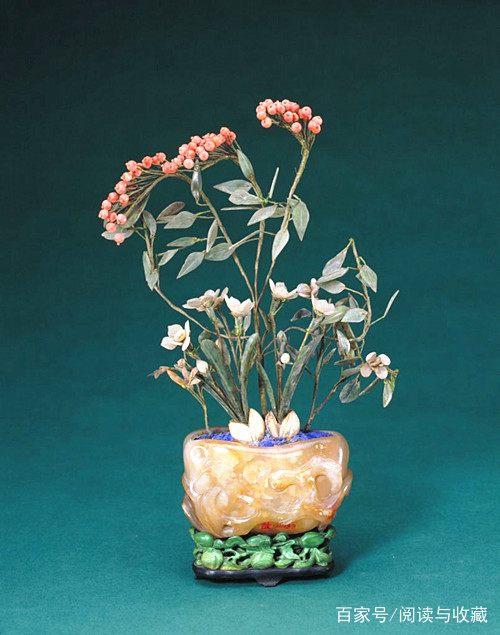
This bonsai is called a "material stone flower bonsai," a product of the Qing Dynasty, made using agate, asparagus fern, and white jade; the red fruits at the tips of the asparagus fern are coral beads, the white jade forms the flowers, and the green jade forms the leaves. The entire composition is full of vibrant life.
This bonsai has gnarled, vigorous branches and fresh, lovely flowers and plants. It is set in a painted enamel rectangular basin with cut corners, the outer walls painted with flowering branches. The main scene, a wintersweet tree, uses dyed copper for leaves and dyed ivory for petals. It is surrounded by dyed stone mountain ornaments, crystal crabapple flowers, creamy white glass camellia, and small copper grass blades. The scene is graceful and elegant. The wintersweet bonsai symbolizes "spring light and longevity," and it was one of the bonsais liked by Emperor Qianlong, dating to the 13th year of his reign.
This bonsai is the "wood-core crabapple-shaped basin with green bamboo." The rim of the basin is lacquered gold, and the outside of the basin is painted in gold lacquer on a light blue ground with ice-plum patterns, the flowers outlined in red, bright and pleasing to the eye; green kingfisher feathers are attached at the tips, arranged in a pleasing irregular pattern. Beside the bamboo stalks are placed three green jade ornamental lake stones, along with one green bamboo shoot. The bamboo stalks stand leaning against one another, while the lake stones and bamboo shoot are set slightly farther away, the dense and sparse, tall and short forming a delightful contrast. This wood-core crabapple-shaped basin with green bamboo bonsai is made of precious materials, finely crafted, and elegant in style, a fine piece among desk ornaments.
This one is called the "amber fingered citron bonsai." The amber fingered citron bonsai, Qing Dynasty Qianlong period. Painted enamel rhombus-flower-shaped basin, the outer walls painted with peony patterns on dark and light lake-blue grounds. The main scene on the basin is a fingered citron tree, with agarwood branches, golden stamens and white jade flowers, and amber fingered citron fruits. Beneath the tree are arranged Chinese roses, orchids, small grass, and more. The Chinese roses use copper for branches and leaves, the branches gilded, the leaves dotted with blue, with petals made of colored materials and coral, and flower buds made of rose quartz. The whole scene is vivid and lifelike, closely resembling real flowers. "Fingered citron" is a homophone for "fortune and longevity," a theme widely used in Qing Dynasty crafts. This bonsai is finely made with great ingenuity, reflecting the level of craftsmanship in the production of imitation-life bonsai in Suzhou during the Qianlong period.
The image shows the "red coral tree bonsai," mid-Qing period, made by the Imperial Workshops, formerly in the Qing palace collection. The three-tiered peach-shaped basin is made by combining gold engraving, filigree enamel, painted enamel, and other techniques. The copper stems and filigree enamel branches and leaves coil at the base and extend and wind among the three tiers of double peaches, interwoven and partially hidden. This bonsai is extremely complex in craftsmanship, combining filigree enamel, painted enamel, engraved flowers, and welding and pasting, among other skills, making it more difficult than ordinary enamel work. The large coral tree is brilliant red in color, as thick as a wrist and as broad as a fan, quite spectacular; it was a auspicious display set out in the Qing court only on the days of emperors' and empresses' birthday celebrations.
This is the "painted enamel rectangular basin magnolia bonsai," with magnolia as the main scene. The magnolia petals are made of carefully polished material stone, and the flowers are joined together with copper holders and metal wire. The petals are pure white and flawless, and the flower shapes are lifelike, some in bud, some in full bloom; together with the purplish-red trunk, the refined and elegant quality is fully revealed. Beneath the tree are dotted material stone wild chrysanthemums, set off by lapis lazuli rockery. The rim and foot of the painted enamel basin are decorated with key-fret patterns, and the belly of the basin has a cyan ground fully decorated with scrolling flowers, brilliantly colorful. Magnolia is a traditional auspicious flower of ancient times, and there are not a few bonsais with magnolia as the main scene, but in terms of craftsmanship and scenic arrangement, this bonsai must be considered a superior work.
"Green jade chrysanthemum-petal-shaped basin narcissus bonsai," mid-Qing period. This is a bonsai themed on narcissus, titled "Zhi Xian Offers Longevity." According to the "Palace Tribute List," it records: "On the 27th day of the 10th month of the 56th year of Qianlong, Fukang'an came to the capital and presented a pair of green jade narcissus bonsai." This piece is one of them. This bonsai is elegant in style, and the jade basin is in a typical Hindustan style; the scene in the basin has upright ivory leaves and bright, beautiful jade flowers, reflecting the craftsmanship level of the flourishing period of the carving industry during the Qianlong reign of the Qing Dynasty.
This one is called the "immortal riding a raft bonsai," mid-Qing period; the immortal raft originates from mythological legend. In Zhang Hua's "Records of Diverse Matters" of the Jin Dynasty, it is recorded that someone rode a raft out to sea and drifted away, unexpectedly meeting the Cowherd and the Weaver Girl. Later generations attached the story's character to Zhang Qian, saying that he rode a raft to seek the source of the Yellow River. The earliest known figure to use the immortal raft as a craft subject is the famous Yuan Dynasty silversmith Zhu Bishan, whose silver raft has been passed down to the present day.