What is the difference between zongzi and glutinous rice balls?
During the Dragon Boat Festival, you can skip the realgar wine, you can skip the dragon boat racing, and you can skip hanging mugwort on the door, but as a Chinese person, you absolutely musteat a few zongzi。
And so it was that, at my son's strong insistence, I bought zongzi leaves, bought glutinous rice, bought red dates, and after some experimentation, finally ended the battle with a"lazy person's zongzi"made by laying zongzi leaves on the steamer, spreading on the glutinous rice, and covering it with more zongzi leaves. One conclusion: wrapping zongzi still requires skill.
From north to south across the land, the leaves used to wrap zongzi are wonderfully varied. In a previousGuokr articlethere was already a very detailed introduction - some are wrapped with reed leaves, some with banana leaves, some with oak leaves, and some with h[zhōng] leaves. It seems thatall sorts of broad leavescan serve as the outer packaging for zongzi.
Swipe left and right to see what differently shaped zongzi are collected in the Jiaxing Zongzi Museum! Image: Cat's Diary / wiki commons
But when it comes to the classic image of zongzi, it naturally has to bezongzi leavesand nothing else. But what kind of leaf are these zongzi leaves exactly? Is their existence merely to let glutinous rice stand in for Dr. Qu Yuan and fill the bellies of the fish and shrimp masses?
Indocalamus is not a giant reed
Many years ago, I always thought that what wrapped zongzi was reed leaves (although reed leaves really are used to wrap zongzi). It was just that the reed leaves I saw on the Loess Plateau were all thin and slender, clearly different from the broad zongzi leaves sold in the market. For a time I thought that was simply the result of the farmers fertilizing them.
A whole basin of zongzi leaves. Image: lanbu / wiki commons
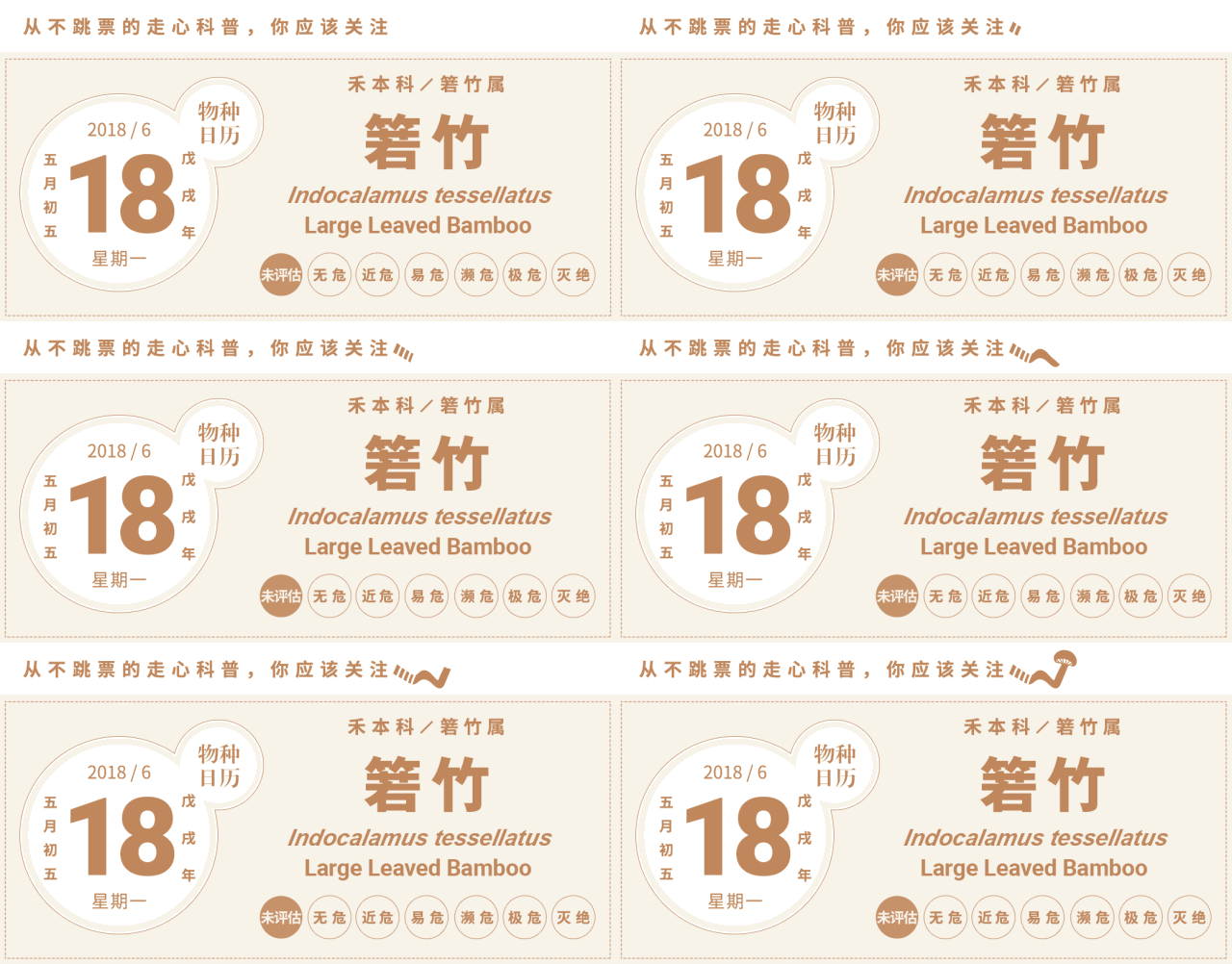
Later I learned that the typical leaf for wrapping zongzi is not reed leaf, butindocalamus leaf. To be precise, it is the general name for the leaves of a group of plants in the genus Indocalamus of the grass family. In this family with 22 species and 6 varieties, there is no lack of types with broad leaves, such asIndocalamus tessellatusandIndocalamus latifoliusare both good choices. The leaves of these plants can carry glutinous rice, red dates, red bean paste, fresh pork, salted egg yolk, and ham, and ultimately become the zongzi we know so well.The sweet-versus-savory debatethus opened a new battlefield. (Another example of the sweet-versus-savory debate:How do you eat lychees?)
Leaves of Indocalamus. Image: Thesurvived99 / wiki commons
Plants of the genus Indocalamus do not have tall bamboo culms like moso bamboo and golden bamboo; they usually grow into low shrubs, which is no wonder some friends confuse them with reeds. Of course, these plants are bamboo after all, and their biggest difference from reeds is that reed marshes have reed flowers drifting every year, but in an indocalamus thicket you canhardly ever see flowers. Members of the bamboo family bloom only once in their lifetime, and indocalamus follows this rule of life as well.
The tea-like flavor of zongzi packaging
If we speak of the texture of the rice in zongzi, it is actually not significantly different from rice cake in a steamer, but thefresh fragranceprovided by the zongzi leaves is unique, and it is precisely this scent that gives zongzi its own special charm.
What does the flavor of zongzi smell like? In fact, busybody scientists have long been tinkering with this question. Just as roses have a rose scent and oranges have an orange scent, zongzi leaves really do have a special zongzi-leaf scent.
Now, can you smell the fresh fragrance of the zongzi even through the screen? Image: Siweihuang1028 / wiki commons
The backbone of zongzi leaf aroma is two chemical substances -leaf alcoholandleaf aldehyde. It is these that give zongzi leaves their fresh plant fragrance, and these two substances also often appear in fresh vegetables.
Besides these two aromas, there is alsohexanal. This smell usually appears onfreshly mown lawns, and if properly diluted, it also gives a fresh feeling. In fact, this odor is related to plants that have been chewed by pests (cabbage butterfly larvae) attracting carnivorous predators (wasps). That humans actually have a felt response to this smell - just let your imagination run a little, and the picture becomes too beautiful.
All right, no need to dig deeper into the reason; the scent of green grass is always pleasant. Image: pixabay.com
Fortunately, the aroma components in zongzi leaves go far beyond this.2-ethylfuranis also one of the sources of zongzi leaf aroma. This is a chemical substance with a roasted scent, usually also found in coffee, tomatoes, and mint. It is the presence of this roasted aroma that makes the flavor of zongzi fuller.
On the whole, the aroma of zongzi leaves issimilar to green tea and green grass. If an eco-friendly zongzi leaf tea were developed, the fresh fragrance of the leaves would strengthen the flavor of the tea, and it might perhaps be a new opportunity. As a Chinese nation living amid seas of bamboo, the fragrance of bamboo has always been a favorite of Chinese people. Not to mention in Xishuangbanna, where recently some places have stored rice wine inside living bamboo nodes, letting the aromatic components of bamboo blend into the wine - that is another new way to play.
A pioneer of ecological packaging
We often overlook the essential nature of this layer of zongzi leaf - it is theouter packagingof a glutinous rice ball.
Today, we are already familiar with all kinds of food packaging, and plastic bags and plastic lunch boxes have become the main force of food packaging today. Although widely criticized for white pollution and other issues, there is no doubt that food packaging has greatly extended the storage time of food and promoted the circulation of food. And in this sense, zongzi leaves arethe ancestor of food packaging, and wrapping zongzi is the beginning of the food packaging industry.
In the hands of a "skilled worker," the efficiency of wrapping zongzi can be very high. Image: Caterpillar / wiki commons
The choice of zongzi leaves was not accidental. Besides the fresh fragrance mentioned above, zongzi leaves also contain many flavonoids, and indocalamus polysaccharides have a good effect oninhibiting harmful bacteria.
Of course, indocalamus is not an isolated case. Other commonly used zongzi "packaging" can more or less also reveal some rationale for being chosen. Oak leaves contain a large amount of tannins, lotus leaves contain quite a few flavonoids, and amomum even contains a range of antibacterial substances unique to the ginger family.
Lotus leaf zongzi obviously more easily allow for a larger volume. Image: Jason Lam
The antibacterial and preservation functions of bamboo products have been valued since ancient times. Everyone knows that the lychees eaten by Yang Guifei depended on fast-horse couriers, but few people know that the container holding the lychees was actuallya giant bamboo tube. Placing freshly picked lychees into fresh bamboo tubes and sealing the opening made an excellent storage and transport container. With such packaging plus fast horses, there was a chance to deliver lychees that had not yet changed color to the consort's presence.
Preservation methods change human tastes
Looking at zongzi again today, it is hard to define clearly whether we chose zongzi as food or whether our tastes were changed by zongzi - because in many cases,our taste buds are shaped by food。
Hops - the source of beer's bitterness. Image: pixabay.com
In the 9th century AD, the Corvey monastery brewery in the Westphalia region of Germany already widely used hops; in 1516, Duke William IV of Bavaria legislated the four main ingredients of beer, and hops was one of them; and later, British colonists, in order to meet the needs oflong-distance beer transport, further increased the amount of hops used, giving rise to heavily flavored beer styles such as India Pale Ale (IPA).
Today, there are all kinds of beer, but the presence of hop bitterness is surely only natural. Image: Quinn Dombrowski
As for staple foods,fermentationis an even more common measure for ensuring food safety.
In south-central Guangxi, local villagers all bring a jar of congee to the fields during the busy farming season. If an unfamiliar friend tastes it, they will certainly think the congee has gone bad - that really is sour congee. Coincidentally, when I was traveling in Tanzania in East Africa, I once filled a big bowl of "oatmeal," and the first mouthful almost made me spit it out; the taste of that porridge was already comparable to aged vinegar.
Fermented sour congee is a popular "delicacy" in Africa. Image: kalekyehealth.com
Yet whether they are Guangxi villagers or African friends, they all gladly accept sour congee - this is probably food domesticating humans.
Many foods have a legendary origin, and zongzi is one example. Perhaps the origin comes from fact, or perhaps it is merely far-fetched - none of that matters. What matters is that our creativity and compromise regardingfood preservation and transportsuccessfully domesticated our stomachs.
This article is the 169th article of the fourth year of Species Calendar, from Species Calendar author @Shi Jun.
Calendar Girl's avatar for today
Poaceae, Phragmites