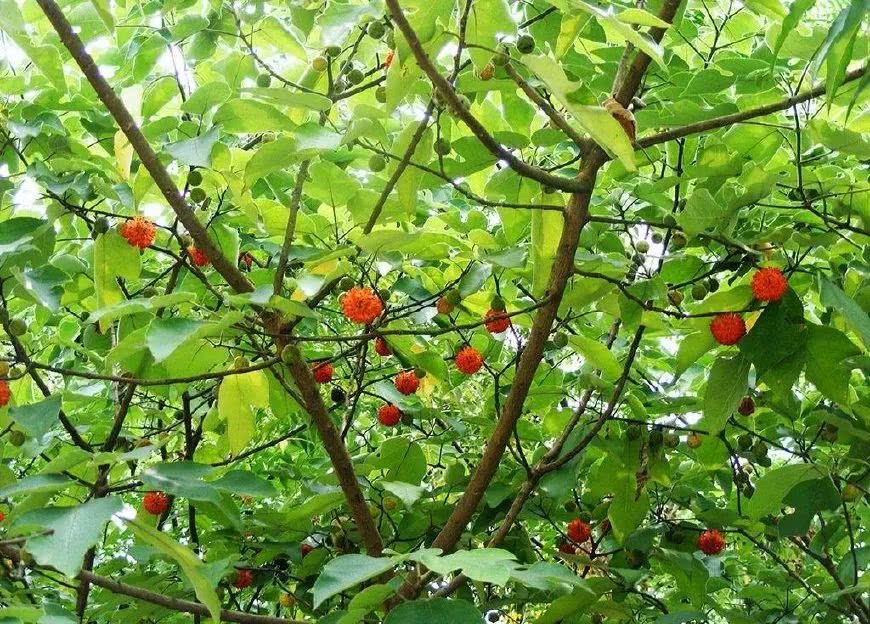
This wild fruit looks like a bayberry and was called "the fruit of the kidney" by the ancients, yet it rots on the tree and no one dares to eat it
Warm reminder
Hemu Report aims to share and popularize information about various plants and their uses, for reference only. If medicinal use is needed, it is recommended to consult a professional doctor to avoid problems!
Children who grew up in rural areas have more or less eaten some wild fruits. The tastier wild fruits include raspberries, mulberries, wild grapes, and some of them have now become crops that people grow on a large scale. However, not all wild fruits are popular. In rural areas there is one of the most common wild fruits; it is bright red, looks like a bayberry, and tastes as sweet as honey, but most of them grow and die on their own, rotting on the tree with no one daring to eat them, and only a few are taken by farmer friends to feed pigs. Why is that?
This wild fruit is called "chutaozi" because its fruit looks like a green peach, hence the name. The tree that bears chutaozi is the paper mulberry. In rural areas it can be said to be one of the most common trees; as long as one grows, it will not take long to become a grove. In rural areas it can be said to be a "pest tree" because its reproductive capacity is too strong, it destroys soil fertility, and it damages farmland, so farmer friends generally cut down its leaves together with the fruit and feed them to pigs. After pigs eat them, they gain meat quickly, which is more cost-effective than feeding corn or grain chaff, so farmers like to use it to feed pigs.
In fact, its fruit can be eaten as a wild fruit. As a child I often saw birds come to peck at it, and I secretly tasted a few and found that its taste was very sweet. In the past I saw that some chutaozi growing by the water would fall into the water, and even the fish would swim up to snatch and eat them. Moreover, the sweet fragrance it gives off after ripening not only attracts birds and fish, but also attracts large numbers of flies, blowflies, and ants, so when people see these insects crawling on it they dare not eat it and can only let it rot on the tree. In fact, chutaozi is not only edible, but is also a very good rare item for tonifying kidney deficiency.
In ancient times, chutaozi was considered a good medicine for tonifying deficiency and tonifying yang. The famous "Shenxian Chushi Wan" was prepared with chutaozi as the main ingredient, and its main effects were to lighten the body, tonify warmth, benefit the kidneys, and tonify deficiency. In the book Yaoxing Tongkao, its effects are recorded: "Chushizi, impotence can be strengthened, edema can be reduced, it replenishes the skin and flesh, helps the waist and knees, boosts qi and strength, tonifies consumptive disease, beautifies the complexion, strengthens the sinews and bones, and brightens the eyes." Therefore, in our country's traditional Chinese medicine, chutaozi is regarded as the "fruit of the kidney" and is an important medicine for tonifying the kidneys and tonifying deficiency, which shows that the effects of chutaozi are still very powerful. It is said that in some rural areas of Chongqing, some farmers use it to make wine and drink it, and it can also treat tinnitus.
However, although chutaozi is sweet, it should not be eaten in large amounts. After eating too much, it will cause internal heat, and blisters will appear on the mouth and tongue. Some elderly people also warn children not to eat it, otherwise their mouths will "rot," not realizing that it is actually a rare item for tonifying kidney deficiency. After drying, the chushizi (the seeds inside) can sell for 35 yuan per jin, making it a very expensive medicinal material. Reader friends, have you ever eaten chutaozi?
Text/Hemu Report, Images/Internet
If you like Hemu's articles, you are welcome to follow