Is your office dull and lacking vitality? These three potted plants will keep your employees full of energy
The office is dull and lacking vitality. Check out these three potted plants and keep your employees full of energy!
Nowadays the pace of life is speeding up, and many people easily become irritable, especially in summer. Add to that the heavy work pressure on young people today, and office workers who spend almost every day in the office, over time nearly half of them end up in a sub-health state. For this reason, we must learn to change some things, such as changing the atmosphere and adjusting the company environment. At times like this, placing a few beautiful potted plants is more suitable than anything.
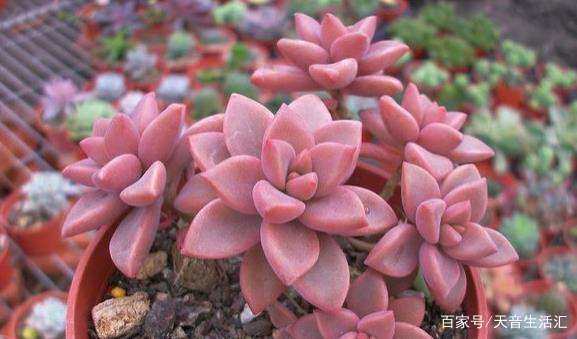
Graptopetalum paraguayense 'Variegatum' is a succulent of the Crassulaceae family, genus Graptopetalum, native to Mexico. It is a perennial herbaceous plant and also a succulent. Its plant form is very similar to that of the genus Echeveria, but this genus does not have urn-shaped or bell-shaped flowers; instead, it has star-shaped flowers. The petals are covered in wax, the leaves are arranged in an elongated rosette, and they are covered with white powder or have whiskers at the leaf tips. Graptopetalum paraguayense 'Variegatum' likes a sunny, warm and dry environment and is drought-tolerant. Spring and autumn are the main growing seasons for plants of the genus Echeveria. During cultivation, the air humidity can be slightly higher, but the soil should not become waterlogged, otherwise root rot will occur. When temperatures are high in summer, the plant grows slowly or stops completely. It can be placed in a well-ventilated spot for care, avoiding direct sun exposure, and watering and fertilizing should be reduced. At this time it basically does not need watering, but the plant can be lightly misted to lower the temperature.
Cereus repandus is one of the cactus plants, forming irregular cylindrical or rockery-like shapes, with thick fleshy stems and hairy spines, and a spectacular form. It takes 8-9 years to bloom. Cereus repandus likes sunlight, is drought-tolerant, tolerant of poor soil, and also tolerant of shade. For pot cultivation, choose an airy, well-drained sandy soil rich in lime. Cereus repandus is not suited to overly moist soil or an environment with too little light. Watering should be less rather than more; water once every 3-5 days to keep the soil slightly dry. Like other cactus plants, Cereus repandus is very easy to propagate and survive. Cereus repandus is propagated by cuttings, which can be done throughout the year, with April-May being best. Cereus repandus is abbreviated as Shanying, also called Xianrenshan. This kind of plant has a peculiar and elegant form, very much like lush, layered, undulating mountain ranges. Although it is a plant, it expresses the artistic conception of a landscape stone bonsai.
Echinocereus pectinatus belongs to the Cactaceae family, genus Mammillaria, a strongly spined perennial succulent plant. During cultivation, Echinocereus pectinatus produces small red flowers, which contrast beautifully with the white woolly hairs on the top of the ball, making it very distinctive. Echinocereus pectinatus is drought-tolerant and likes dryness, growing in sandy soil or rock crevices. It is not cold-tolerant and should avoid direct sun exposure. It should avoid waterlogging, and in most parts of China it must be brought indoors to overwinter. Echinocereus pectinatus is robust and grows relatively fast, easily forming very large clumps. It likes ample sunlight but is also tolerant of partial shade, and cultivation requires fertile sandy loam. Echinocereus pectinatus likes a warm, dry and sunny environment and is not cold-tolerant. It is tolerant of partial shade and drought and fears waterlogging. Its growing temperature is 15°C-25°C, and the minimum winter temperature must not fall below 7°C. It is suitable for planting in fertile, loose and well-drained sandy soil.