How to manage grapes in spring? Technical points for Wuqing District, Tianjin
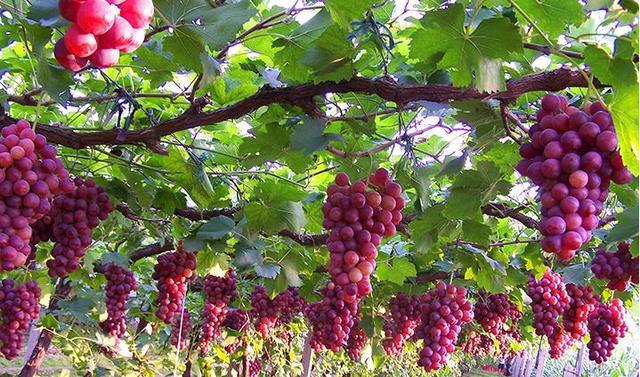
Spring management techniques for grapes in Wuqing District, Tianjin
Spring is the key season for grape management and a critical period that determines the final yield and profitability for growers. Strengthening spring grape management is the issue of greatest concern to grape growers. The following 6 aspects should be noted in doing a good job of spring grape management.
1 Clearing the orchard
1.1 Determining the time to uncover the grapes
The time to uncover the grapes should be determined according to the local temperature. When the surface soil temperature exceeds 12 degC, the grapes begin to be uncovered and the root system begins to become active, so that nutrients can be absorbed. If uncovered too early, they are prone to freezing damage from a late spring cold snap. In addition, if uncovered early, the temperature rises early, the grapes sprout and grow quickly, grow vigorously, and are prone to the phenomenon of uneven berry sizes. If uncovered late, the temperature rises late, the grapes sprout and grow slowly, and growth is relatively weak. For vigorous old grapevines, uncovering late can play a role in controlling vigorous growth, but if uncovered too late, blind buds and dead buds are very likely to appear. Therefore, in terms of temperature, the time to uncover the grapes is best controlled for when the surface soil temperature exceeds 12 degC, or based on the time when local apricot trees bloom (the flowering period of apricot trees is about March to May each year, but this also depends on the specific region and local weather conditions; apricot trees usually bloom in March, and north of the Yangtze River basin they do not bloom until April or May). When the apricot trees bloom, uncover the grapes. When uncovering, try to avoid damaging the sprouts and bruising the buds.
1.2 Supplementary pruning
Supplementary pruning is the continuation and supplement of winter pruning, also called spring pruning. The main task is to deal with branches missed during winter pruning, thin out diseased and insect-damaged branches and dried-up branches missed in winter, and thin out or cut back dense branches and thin weak branches to suitable positions, adjusting the amount of flowers and branches. Its purpose is to adjust the tree structure, balance the relationship between growth and fruiting, and achieve high quality, stable yield and high yield. After supplementary pruning, all residual branches and rotten leaves should be removed from the orchard and buried deeply in a centralized manner or burned.
1.3 Spraying
After uncovering and clearing the orchard, spray during the period when the flower buds have not fully swollen and opened. Generally, 3 to 5 degrees Baume lime sulfur mixture or sulfur water-dispersible granule Chengpiao (BASF Chengpiao, Germany) 400 times solution plus profenofos (Duochongqing) 1 500 to 2 000 times is sprayed together to clear the orchard. Spray the branches and vines and within the 2 m width of the planting trench to eliminate various insect eggs and pathogens. Spray until the branches, vines and ground appear grayish-white, in order to remove pathogens such as white rot and downy mildew carried on the branches and trunks and reduce the occurrence of diseases.
2 Training onto the trellis and tying the vines
When training onto the trellis, for trees in full production, hurry to train them onto the trellis after removing the soil; training onto the trellis too late easily knocks off buds. For young trees, in order to make the buds sprout evenly, they can be left for a few days first, and trained onto the trellis once the buds begin to swell. Training onto the trellis too early easily forms strong upper growth and weak lower growth, and even causes the middle and lower parts to become bare, affecting yield. When tying the vines, tie the grape branches and vines along the previous year's growth direction and inclination onto the trellis, and at the same time note to leave room for branch growth. When training onto the trellis, handle them gently to avoid breaking or twisting old vines and knocking off buds. For tying material, it is best to use coarse grass, corn husks, rice straw or strips of old cloth, and avoid using plastic rope that has no elasticity or does not rot easily, so as not to restrict the thickening growth of the branches and vines. When tying, first fasten the rope firmly to the wire, then twist it into a figure "8" shape, gather the branches and vines, and tie a slip knot so that the branches and vines are fixed within the slip knot, so that the branches do not directly press close to the wire, leaving growth space for the branches and vines.
3 Fertilizing
When fertilizing, spring fertilizer is often applied in a one-sided way, and autumn fertilization is generally not done much; this practice has a great impact on grape quality and grade. So if autumn fertilization was not carried out, then during spring fertilization all the previously lacking nutrients must be fully replenished. For orchards where base fertilizer was not applied the previous autumn, according to the previous year's yield, per 667 sq m use 50 to 75 kg of 45% potassium sulfate-type compound fertilizer, plus 10 kg of second-generation prebiotic microbial fertilizer mixed together, all applied around the root system, 50 to 60 cm from the main trunk, with a trench dug 20 to 30 cm deep, and water once thoroughly. But note one point: if the previous year's tree vigor was especially strong and the diameter of the fruiting branch group reached more than 1 cm, then when the soil is not especially dry, try not to fertilize, to control tree vigor and prevent it from growing too vigorously and producing uneven berry sizes later. If autumn fertilization has already been carried out, only about 15 kg of urea per 667 sq m needs to be applied.
4 Bud thinning and sprout removal
Bud thinning and sprout removal are key to determining grape growth.
4.1 Bud thinning
The early or late timing of bud thinning is decided according to tree vigor. If tree vigor is on the weak side and the thickness of the fruiting branches is between 0.6 and 1 cm, bud thinning should be carried out early, thinning buds in mid-April, removing weak buds and keeping strong buds. When the thickness of the fruiting branches exceeds 1 cm, tree vigor is on the strong side, and late bud thinning should be carried out, removing strong buds and keeping weak buds. Late bud thinning also has a time limit: when all the new shoots have grown to 10 to 15 cm, remove strong buds and keep weak buds. The purpose is to reduce the occurrence of uneven berry sizes; reducing the tree's vigor can also increase yield.
4.2 Sprout removal
Many new branches grow from the root area and consume a great deal of nutrients, so they need to be removed early. Within 30 cm from the ground surface, do not keep any fruiting branches or new shoots. Ensure ventilation and light below, and prevent the later emergence of white rot and anthracnose.
5 Thinning flower clusters and pinching the tips of new shoots (pinching)
Thinning flower clusters and pinching the tips of new shoots (pinching) means pinching and thinning fruit and thinning flower clusters. The purpose of thinning flower clusters is to ensure that the berries are uniform and consistent and improve fruit quality. The purpose of pinching the tips of new shoots is to control apical dominance before flowering, control nutrient consumption, promote nutrient return, and improve the fruit-setting rate. Determining the pinching time is crucial. The pinching time must be 2 to 3 days before flowering. Because temperatures differ in different years, the specific time cannot be determined, so a commonly used method is that when the strongest tree in your own orchard first shows flowers, the whole orchard is about to bloom, and at this time you should pinch. Pinching follows the same principle as bud thinning: decide exactly how many leaves to keep according to tree vigor. First pinch the tip of the cluster, pinching off 1/4 to 4/5 of the cluster tip, and at the same time remove the basal shoulder cluster to reduce nutrient consumption. Next, for pinching and pinching new shoots, there is no absolute number of leaves to keep. The principle for pinching the tips of new shoots is that leaves above the flower cluster that are larger than 1/3 of a normal leaf can be kept, and all those less than 1/3 are removed. That is to say, the second or third leaf can represent the size of a normal leaf on this fruiting branch group. Looking from top to bottom, those that reach 1/3 of this normal leaf are kept, and those that do not are pinched off. Keeping 1/3 is because if less than 1/3, it proves that the nutrients consumed are more than the nutrients produced, and the nutrients cannot be allowed to return for fruit setting; if more than 1/3, the nutrients produced are more than the nutrients consumed, so keep more leaves. After pinching, secondary lateral shoots will grow, and the secondary lateral shoots will likewise grow leaves, requiring repeated pinching. When the leaves that grow from the secondary lateral shoots reach 1/3 of the second leaf, looking from the shoot downward, they should also be pinched, kept to 1/3 and then pinched off. After pinching again, tertiary lateral shoots are then kept, keeping 2 to 3 leaves and pinching them off, and repeated pinching is sufficient. Later, when the first-generation leaves begin to decline and age in photosynthesis, the second-generation leaves begin to produce nutrients; when the second-generation leaves age, the third-generation leaves begin to produce nutrients. The new leaves continuously produce nutrients for this cluster of fruit, yield rises, and quality improves.
6 Pest and disease control
6.1 7 days before sprouting, spray the whole orchard with 3 to 5 degrees Baume lime sulfur mixture or 10 to 20 times ammonium sulfate solution to prevent black pox disease and the like.
6.2 In early May, at the flower cluster separation stage, focus on controlling 2 pests: the mulberry bug and the tobacco thrips. Deltamethrin plus fipronil (Ruidan) 1 000 times solution or spirotetramat (Movento) 5 000 times solution plus propineb (Antracol) 800 times solution can be sprayed. This both prevents disease and supplements zinc, reducing the occurrence of uneven berry sizes. Before the grapes flower, spray once more with propineb plus spirotetramat 5 000 times solution or fipronil 1 000 times solution to prevent pests from stinging the fruit.
6.3 At full bloom, spray once more with 2 000 times Ruipeng boron solution to promote pollen tube growth, increase the chance of pollination, and reduce the occurrence of uneven berry sizes.
6.4 Apply fully decomposed and fermented organic fertilizer. If the organic fertilizer is not decomposed and fermented, it will cause root suffocation or root burning, so apply more prebiotic or Yiwai microbial agent (beneficial microbial bacteria), or broadcast 300 g of Songtujing per 667 sq m on the ground surface, then water.