A Detailed Guide to Common Pests and Diseases of the Japanese Pagoda Tree and Their Control Techniques
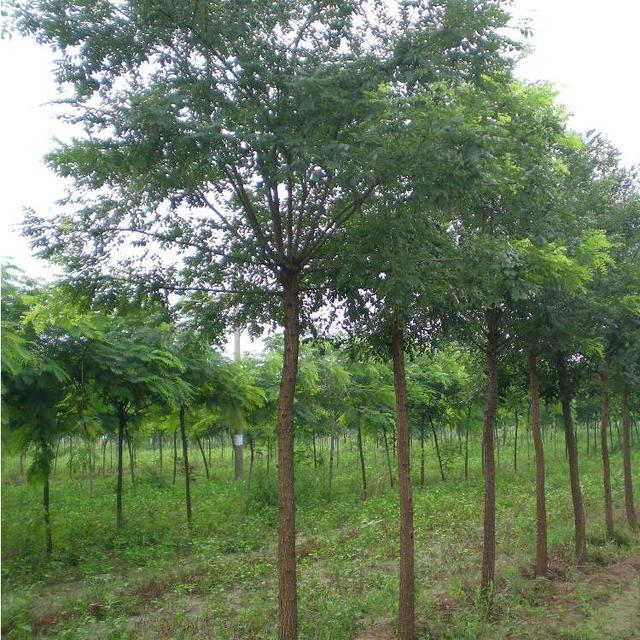
Common Pests and Diseases of the Japanese Pagoda Tree and Their Control Techniques
The Japanese pagoda tree, also called the pagoda tree or Chinese scholar tree, is a tree of the genus Sophora in the Fabaceae family, native to China. It grows relatively fast and adapts strongly to various soil types. Its flowers can be seen from late summer to early autumn, and its flowering period is long. It is also an excellent nectar-source tree species.
1 Morphological Characteristics
The Japanese pagoda tree is a deciduous tree, up to 25 m tall; the bark is grayish brown with vertical fissures, and the current-year branchlets are green. It has no terminal bud; the lateral buds are infrapetiolar buds. The leaves are once-pinnately compound, with 7-17 leaflets that have short petiolules, are ovate to lanceolate-ovate, with acute apex and rounded or broadly cuneate base, the abaxial surface pale white and covered with appressed hairs; the stipules are subulate and caducous. The panicle is terminal, and the corolla is white or pale yellow. The pod is moniliform, 2.5-8 cm long, fleshy and indehiscent. Seeds number 1-6, kidney-shaped, pale yellow-green when young and dark brown when mature. The flowering period is June-August, and the fruiting period is late August-October.
2 Growth Habits
The Japanese pagoda tree is slightly shade-tolerant when young and light-demanding after growing up. It also adapts strongly to dry and cold climatic conditions. It grows most vigorously on deep, moist, fertile, and well-drained sandy loam, and can adapt to neutral, calcareous, and slightly acidic soils. It can grow normally in mildly saline-alkaline soil (salt content of about 0.15%), but grows poorly in sites with long-term water shortage, infertility, or low-lying waterlogging. It is strongly resistant to SO2, CL2, HCL, and smoke and dust. It begins to flower and set seed at 5-7 years, and reproduces by seed and root suckers. It is deep-rooted, strongly wind-resistant, and grows relatively fast.
3 Main Diseases and Control Measures
3.1 Canker Disease
Canker disease of the Japanese pagoda tree, caused by Fusarium fungi, mostly occurs on the green main trunks of 2-4-year-old saplings and on 1-2-year-old twigs of large trees. At the early stage of the disease, yellow-brown water-soaked round lesions appear on the branches and trunk, then expand into spindle shapes; the centers of larger lesions are slightly sunken, have a sour mash smell, and show a typical wet rot appearance. After about 20 days, orange-red conidial masses appear on the lesions. The lesions can often girdle the main stem, causing the upper branches to die. If the lesions have not yet girdled the trunk, they can mostly heal in the same year. Mid-March to late April is the peak period of disease occurrence, and by early summer, when the vigorous growth season begins, the disease gradually stops developing.
Control methods: 1. During human operations such as lifting seedlings, heeling in, transport, and planting, minimize the dehydration rate of the seedlings as much as possible; keeping the bark expansion degree from dropping below 85% can effectively reduce disease occurrence. 2. Timely remove diseased branches and dead branches, scrape off the lesions, and apply fungicide for protection. 3. At the early stage of the disease, spray the trunk with 70% thiophanate-methyl wettable powder at 800 times dilution, or 70% chlorothalonil wettable powder at 300 times dilution. Spray once about every 10 days, for 2-3 consecutive sprays.
3.2 Powdery Mildew
Powdery mildew is a fungal disease that mostly occurs on leaves, and sometimes also on young fruit and tender twigs. A layer of white powdery substance appears on the affected parts, hence the name powdery mildew. Later, scattered black granular objects the size of pinheads gradually appear on the white powdery layer, sometimes forming continuous patches covered with a gray-white mold layer. If not removed and treated in time, the pathogen (fungus) parasitizes the plant body and overwinters. In northern regions, July-August is the peak period of disease occurrence, and it is more severe after autumn.
Control methods: 1. Timely remove diseased branches and destroy them. 2. At the early stage of the disease, spray 0.2-0.3 degree lime-sulfur mixture, once every half month, 1500 kg/ha each time, for 2-3 consecutive sprays. 3. At the peak period of occurrence, spray 50% carbendazim wettable powder at 1000 times dilution + 50% thiophanate-methyl wettable powder at 800 times dilution.
3.3 Chlorosis
There are many causes. If the soil is compacted and waterlogged, pay attention to drainage and loosening the soil. Sulfur deficiency, nitrogen deficiency, and iron deficiency can all cause leaf chlorosis. Foliar spraying of potassium dihydrogen sulfate and ferrous sulfate can alleviate the symptoms.
Control methods: Use a 0.5% ferrous sulfate + 0.05% citric acid aqueous solution for foliar spraying, or slowly inject a 0.75% ferrous sulfate solution into the trunk.
4 Main Insect Pests and Control Measures
4.1 Japanese Pagoda Tree Aphid
The number of generations of the Japanese pagoda tree aphid varies by region each year. In northern regions, generally more than 10 generations can occur. It overwinters as eggs on branch tips or under bud axils of trees. In March of the following year, as temperatures rise, the overwintering eggs begin to hatch slowly. As the flowers and trees sprout, they first gather on tender buds to suck sap and cause damage; when the leaves begin to unfold, they shift to feeding on tender leaves. Generally, they reproduce rapidly from late April to early May and produce winged aphids, and the population density rises markedly. From June to July, the damage on Japanese pagoda trees is most severe; affected leaves curl toward the underside, and sooty mold is also induced. In mid-to-late October, as temperatures gradually decrease and the temperature difference between day and night increases, the population density declines. From November, they migrate to warm places or overwinter at the root zones of weeds around tree roots, with a small number overwintering as eggs.
Control methods: 1. In autumn and winter, spray lime-sulfur mixture to eliminate overwintering eggs. 2. When the occurrence is heavy, spray 40% omethoate + 2.5% deltamethrin emulsifiable concentrate at 3000 times dilution, or 4.5% beta-cypermethrin emulsifiable concentrate at 2000 times dilution, or 10% imidacloprid wettable powder 50 g, diluted with 150 kg water.
4.2 Japanese Pagoda Tree Inchworm
The Japanese pagoda tree inchworm, also called the pagoda tree looper, with larvae commonly known as "hanged ghosts," is an important pest of the Japanese pagoda tree. When other food is insufficient, it often eats all the tender leaves of the pagoda tree, affecting the normal growth of the tree. It has 3-4 generations per year and overwinters as pupae in loose soil about 4 cm deep near the trees. In mid-April of the following year, adults enter the peak emergence period. In early and mid-May, the first-generation larvae hatch and cause damage; in late June, the second-generation larvae hatch and cause damage; in early August, the third-generation larvae hatch and cause damage; and in September, they enter the soil to pupate and overwinter. During the larval stage, the feeding marks are net-like. When disturbed by the outside world, the larvae immediately spin silk and hang down, then climb back up afterward to continue feeding; they can also spin silk, hang down, and drift with the wind to spread, hence the name "hanged ghost."
Control methods: Focus on the first generation, and selectively treat the 2nd and 3rd generations. 1. During the larval stage, spray 4.5% beta-cypermethrin emulsifiable concentrate + 80% dichlorvos emulsifiable concentrate. 2. During the peak emergence period, spray 1% avermectin emulsifiable concentrate at 2000 times dilution, or Green Weilei at 200 times dilution.
4.3 Fall Webworm
The fall webworm is native to North America and is an important international quarantine object. This insect has extremely diverse feeding habits, with more than 300 host plant species. It has 2-3 generations per year and overwinters as pupae in cocoons under old bark, in fallen leaves on the ground, and in surface soil. In early May of the following year, emergence begins. From mid-May to July is the damage period of the first-generation larvae, and from early August to late September is the damage period of the second generation. Soon after hatching, the larvae spin silk and form webs, gathering in the webs and eating the leaf surface into a sieve-like pattern. When the insect occurrence is heavy, all the leaves of affected trees are eaten, leaving web curtains hanging on the trees, and in severe cases the trees die. Adults are phototactic.
Control methods: 1. During the larval stage before the 3rd instar, spray BT + fall webworm virus for control. 2. During the larval damage period, spray 3% high-penetration fenoxycarb emulsifiable concentrate at 1000-1500 times dilution, or 1.8% avermectin emulsifiable concentrate at 2000-3000 times dilution. 3. For tall trees, use the method of drilling holes at the trunk base and injecting chemicals for control.