Training and pruning techniques for peach trees under wide-row, close-planting conditions
Training and pruning techniques for peach trees under wide-row, close-planting conditions
1. Spacing between plants and rows in the peach orchard
Peach trees are medium-small in size, bear fruit early and are highly productive, but they age very easily. If the plant and row spacing is unsuitable and the training and pruning are unscientific, then in less than 10 years the orchard will age, and yield and quality will decline noticeably.
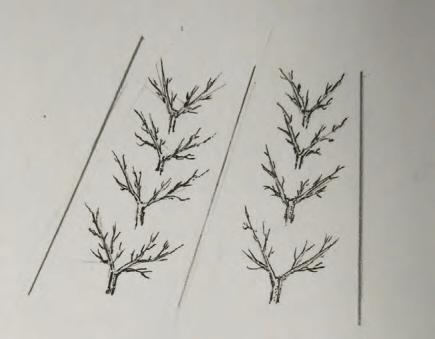
When designing a peach orchard, the author recommends planting at a row spacing of 4 m and a plant spacing of 2 m, with 83 trees per mu; on poor, thin mountain land the density can be somewhat greater. Wide row spacing and narrow plant spacing give the fruit trees ample light, high and quality yields, favour mechanised operations, and also make field operations such as spraying pesticides, flower and fruit thinning, and harvesting easier (see Figure 1); green manure crops such as white clover and flat-stem milkvetch can also be intercropped between the rows.
Figure 1 A peach orchard with wide rows and close planting
2. Peach tree form: the two-main-branch natural open-centre form
1. Training the two main branches
In order to use space rationally, every peach tree should be trained with two main branches. Pruning method: after the young seedlings are planted in spring at a plant and row spacing of 2 m x 4 m, head the tree by cutting back at about 60 cm above the ground, but about 20 cm below the cut there must be good, plump buds to serve as the training zone; after the buds of the young tree sprout, first remove all the sprouts below the training zone, then within the training zone select two new shoots that are staggered in position, balanced in vigour and extending left and right towards the row middles, and train them as main branches; the two main branches should be pinched back promptly to encourage secondary shoots, and the orientation of the two main branches should be adjusted well. The opening angle of the two main branches can be achieved by the branch-bending method, with an opening angle of 40-45 degrees (see Figure 2).
Figure 2 Opening the angle by the branch-bending method
2. Pruning the two main branches and training the side branches
During winter pruning, cut back the extension shoot at the tip of each of the two main branches, and among the secondary shoots below it select one side branch and cut it back, leaving it slightly shorter than the main branch extension shoot. Of the remaining branches, excessively vigorous ones should be removed, while the thinner, weaker ones should all be cut back and retained. In the summer of the second year, maintain the growth vigour of the extension shoots of the main branches and side branches, and at the same time arrange the second side branch; the remaining branches can be pinched back several times to control their growth and encourage the formation of fruiting branches.
After 3 years of the above training and pruning, the canopy of the two-main-branch natural open-centre form is basically complete. Each peach tree has two main branches extending towards the row middles, and each main branch has 3-4 side branches growing in a staggered arrangement above, below, left and right (see Figure 3).
Figure 3 The two-main-branch natural open-centre form
3. Training fruiting branch groups in peach trees
Young peach trees generally bear fruit on individual fruiting branches; by the time the peach tree is mature, the fruiting branches are grouped together to form fruiting branch groups, distributed around the main and side branches.
1. Arrangement of fruiting branch groups
Fruiting branch groups grow on the main branches and side branches, and their arrangement must be reasonable. Usually large fruiting branch groups can be arranged on the lower part of the main branches, medium fruiting branch groups on the middle part of the main branches and on the side branches, and more small fruiting branch groups on the upper part of the main branches and on the side branches.
2. Training fruiting branch groups
(1) Cutting back. When training fruiting branch groups, many fruit trees are first left unpruned to grow freely, and only after flower buds form are they cut back; peach trees, however, mainly use cutting back. When cutting back, the length of branch left produces different effects. Taking the cutting of long fruiting branches as an example, there are three cases: first, long cutting back, for example leaving 30-40 cm, which generally sets 2-3 fruits, and produces many but weakened shoots (generally not used, to avoid the fruiting branch group weakening quickly); second, medium cutting back, for example leaving 20-30 cm, which generally sets 1-2 fruits, and the shoots produced can maintain the ability to continue growing and bearing fruit (this achieves both fruiting and growth, and is the main means of training fruiting branch groups); third, heavy cutting back, for example cutting back to leave 2-3 buds at the base, which does not flower or set fruit but can produce 2-3 long fruiting branches that bear fruit the following year (used when enlarging or renewing fruiting branch groups).
(2) Renewal pruning by cutting back. To keep fruiting branch groups close to the scaffold branches, renewal pruning by cutting back must be used in pruning: remove the extension shoots far from the scaffold branches, retain the branches at the base, and cut back the lower branches to serve as branches. As for the length to which the various fruiting branches are cut back, in the initial fruiting stage a longer length can be left to promote the expansion of the fruiting branch group; in the full fruiting stage the cutting back should be shorter to control excessively rapid growth of the fruiting branch group.
The main task of pruning is to regulate the contradiction between growth and fruiting. This is shown in the fruiting branch groups: in the early fruiting stage, the various branches grow vigorously, so fruiting should be brought on early to control growth; in the full fruiting stage, growth is relatively moderate and the fruit-setting rate is high, so the growth amount and fruiting amount of the branches must be maintained to achieve a balance between growth and fruiting; once the tree enters the ageing stage, the life of the fruiting branches should be extended as far as possible.
4. Renewal pruning of peach trees
After a peach tree enters the ageing stage, because there are few surviving latent buds on the old branches, if a major renewal cut is made back to the old branches, new shoots often fail to sprout and the tree dies. Therefore, the key point of peach tree renewal is to renew the fruiting branch groups.
1. Cutting back and thinning out aged fruiting branch groups
When a peach tree enters the ageing stage, the long fruiting branches on the fruiting branch groups become medium fruiting branches, the medium fruiting branches become short fruiting branches, and the short fruiting branches become bouquet branches, after which the small branches die. To restore tree vigour, the aged fruiting branch groups must be cut back and thinned out; bouquet fruiting branches must be thinned out, and during the flowering period a large number of flowers and fruits must be thinned so that bouquet fruiting branches transform into short fruiting branches and short fruiting branches transform into long fruiting branches, completing the renewal of the fruiting branch groups.
2. Making full use of water sprouts
After a peach tree bears a large amount of fruit, the phenomenon of fruit weighing down the tree occurs, that is, the front end of the branch bends downwards, weakening apical dominance and causing an arched-back shape (that is, a bulge at the rear part of the branch), which shifts apical dominance towards the rear part and easily produces water sprouts in the middle part. Water sprouts must be fully utilised to achieve the effects of canopy renewal, control and transformation.
5. Top grafting to change varieties in peach trees
The peach tree is a fruit tree that bears early and heavily; it generally begins to bear fruit 2-3 years after planting, then has a high-yield period of about 10 years, after which it enters the ageing stage. However, measures such as strengthening soil and water-fertiliser management, controlling pests and diseases, and rational pruning can appropriately prolong the full fruiting stage. Peach tree scaffold branches have no ideal latent buds, and major renewal pruning cannot produce good new shoots, so multi-head top grafting can be used to renew the branches and develop improved varieties.
1. Grafting
The grafting period is during bud break in spring. The scions are collected half a month before grafting and stored in a refrigerator at 1-3 degrees C. After the rootstock buds sprout, select a dozen or so grafting points on each main branch and side branch of each tree and graft them by the bark-insertion method, with 2 scions grafted at each grafting point. After grafting, first bind with plastic strips, then put on a plastic bag, which can maintain the humidity of the scions and the wounds. About half a month after grafting, the scion buds sprout; at this time a small opening should be cut in the plastic bag for ventilation, and when the scions unfold leaves and put out shoots, remove the plastic bag.
2. Management after grafting
Strengthen management, promptly remove rootstock suckers, and promote scion growth; the tree can flower and bear fruit in the second year after grafting.