Investigation on the Control Efficacy Against Major Diseases and the Effects on Fruit Quality of Grape Cultivation Under Rain-Shelter Canopies
Investigation on the Control Efficacy Against Major Diseases and the Effects on Fruit Quality of Grape Cultivation Under Rain-Shelter Canopies
Chencang District is located at the western end of the Guanzhong Plain in Shaanxi, with mountains, rivers and tablelands throughout its territory, making it suitable for the growth of many kinds of fruit trees such as apple, kiwifruit, grape, cherry and honey peach. Especially in recent years, with the advancement of the construction of the Chencang National Modern Agriculture Demonstration Zone, a large number of table grape demonstration orchards led by new-type business entities have flourished in the Weibei tableland area, becoming a model for leading the transformation and upgrading of the Chencang fruit industry. However, because Chencang District has a continental warm temperate monsoon climate, with frequent spring drought, hot summers and autumn waterlogging, and uneven distribution of rain and heat, more than 75% of the annual rainfall is concentrated in June to September each year. The rainy season overlaps with the season of grape growth and ripening, often causing outbreaks and epidemics of grape downy mildew, white rot, gray mold and other diseases, posing a serious threat to grape production. Drawing on the successful experience of some forerunners of rain-shelter cultivation in southern China and within the province, we selected the grape base of Jinxiang Breeding and Farming Professional Cooperative in the Weibei tableland area of our district to carry out a demonstration of rain-shelter canopy cultivation, and focused on a detailed investigation and summary of the occurrence of major grape diseases and fruit growth and ripening under the rain-shelter cultivation model, in order to provide guidance for table grape cultivation and disease prevention and control in rainy summer-autumn regions.
I. Materials and Methods
1. Basic information of the demonstration site
The demonstration site is located at the table grape base of Jinxiang Breeding and Farming Professional Cooperative in Yicun Village, Zhouyuan Town, in the Weibei tableland area of Chencang District, at an altitude of 735 m, with flat terrain, deep soil, an average annual temperature of 13°C, an annual rainfall of 650 mm, and 2100 hours of sunshine. In January 2017, we selected two grape varieties, Red Balado and Shine Muscat, at this base for a rain-shelter canopy cultivation demonstration, with a total area of 20 mu, using double cross "V"-shaped trellis training, a planting density of 2.8 m × 0.8 m, and 300 plants per mu. Both the demonstration orchard and the open-field cultivation orchard were managed with conventional management methods.
2. Rain-shelter canopy design
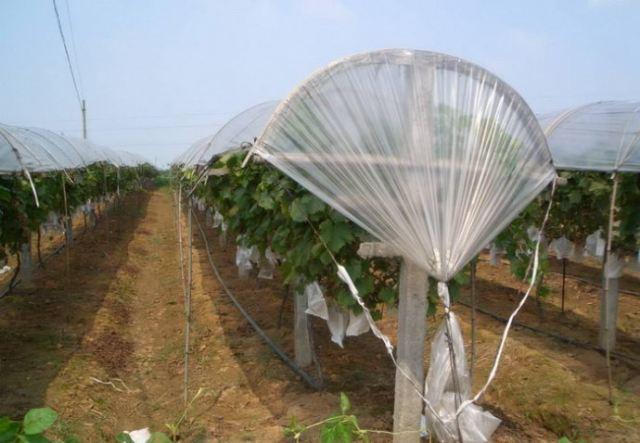
The rain-shelter canopy adopts a steel-bamboo structure, with an arched shed 2.4 m wide and 1 m high (the height and width of the shed can be adjusted according to the cultivation specifications of the grape trellis), and the arched shed is covered with 2.5 m wide plastic film. When building the shed, first fix each pre-made stainless steel pipe arch beam with a bottom crossbar onto the concrete posts, then tightly stretch 1 wire at each of the two ends, the middle and the top of the stainless steel pipe arch beams along the row to connect them, and evenly fix 5 bamboo strip arch beams between the stainless steel arch beams within the row through these 5 wires, forming a small steel-bamboo arched shed covering along the grape row, and then cover it with film (the time is after bagging, around June 25). Drainage ditches are built on both sides of the plants outside the shed, and rainwater flows directly from the sides into the drainage ditches.
3. Disease investigation
On the day before the arched shed was covered with film, the disease base levels of the major grape diseases (grape downy mildew, white rot, gray mold) in the rain-shelter cultivation and open-field orchards were uniformly investigated. Starting from August 14, the disease incidence on leaves and fruit clusters of plants in the treatment and control orchards was investigated once every 20 days (for each variety, 10 grape plants were randomly selected, 4 new shoots were randomly fixed on each plant, and 10 leaves were investigated from top to bottom on each shoot, and then the diseased leaf rate was calculated; at the same time, the disease incidence of the fruit clusters of the selected plants was investigated, and the diseased fruit cluster rate was calculated), until the fruit clusters ripened and around leaf fall, with a total of 5 investigations, and finally the disease occurrence was statistically analyzed.
4. Determination of the effects on grape growth and quality
After the fruit clusters ripened, 10 grape plants were randomly selected from each plot for each variety, and 3 fruit clusters were randomly selected on each plant, to determine the cluster weight, berry weight and soluble solids content of the fruit of each variety, and at the same time observe the berry color and the integrity of the bloom. The 30 fruit clusters of each variety were weighed separately with a balance; 100 berries (with uniform berry size and maturity) were randomly selected from the 30 fruit clusters, and the 100-berry weight was weighed separately with a balance; another 30 berries were selected, juiced and mixed, and then the soluble solids content was determined with a handheld sugar meter; the average values of all the above items were calculated. In early November, the leaf abscission rate of plants in the rain-shelter canopy and open-field cultivation orchards was determined by variety.
II. Results and Analysis
1. Control efficacy of rain-shelter (canopy) cultivation against grape diseases
According to the demonstration investigation results in Table 1, whether for Red Balado or Shine Muscat grapes, rain-shelter canopy cultivation has good control efficacy against leaf and fruit diseases such as downy mildew, white rot and gray mold, and with the increase in rainy days, the disease prevention and control effect becomes more and more obvious. Among them, the results of the two investigations on August 14 and September 4 showed that because there had been very few rainy days and very little rainfall before, the difference in disease prevention effect was not significant, but with the increase in continuous rainy days and the increase in rainfall in the later period, the disease prevention and control effect of the rain-shelter canopy on grape diseases became prominent. The results of the last investigation on November 3, 2017 showed that the leaf and fruit disease incidence of Red Balado under rain-shelter canopy cultivation was only 11.3% and 12.7%, while that of the open-field cultivation orchard was as high as 98.7% and 97.2% respectively; the leaf and fruit disease incidence of Shine Muscat grapes under rain-shelter canopy cultivation was 10.5% and 9.5% respectively, while that of the open-field cultivation orchard was 26.8% and 24.8%, which were 255% and 261% of that under rain-shelter canopy cultivation respectively.
Table 1 Investigation on the control efficacy of rain-shelter canopy cultivation against major grape diseases
Table 2 Table of determination results of grape fruit traits under the rain-shelter canopy cultivation model
2. Effects of rain-shelter (canopy) cultivation on grape growth and quality
The investigation results in Table 2 show that for the two grape varieties Red Balado and Shine Muscat under rain-shelter canopy cultivation, there was no obvious difference in fruit size, color and berry weight compared with the open-field cultivation orchard, but in the open-field cultivation orchard, due to severe leaf and cluster diseases, the cluster weight and soluble solids were significantly lower than those under rain-shelter cultivation, while the leaf abscission rate (early November) was significantly higher than that under rain-shelter cultivation. At the same time, after rain-shelter cultivation, due to film covering and bagging, the light is weaker than that under open-field cultivation, which can delay harvesting, and in addition, after ripening the fruit is not affected by climate factors such as rainfall, so the fruit can continue to hang on the tree for about 60 days without loss, which is conducive to flexibly grasping market demand and increasing the selling price of grapes.