How to Tell Succulent "Chemical Variegation" Apart? Learn the Identification Methods to Avoid Being Cheated
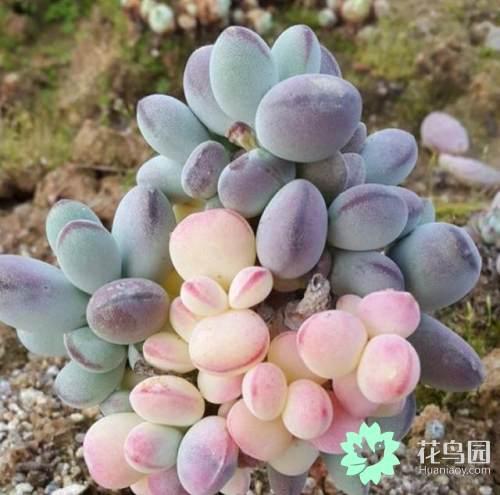
Many beginner succulent growers have been misled by chemically variegated succulents. With their bright, changeable colors and exquisite, refined appearance, it is hard to resist buying them, never suspecting they might be chemically variegated. So how exactly do you tell chemically variegated succulents apart from naturally variegated ones? Uncle Hi tells you:
First, let me explain the essence of variegation. When succulent cells, due to internal genetic factors or the influence of external environmental factors, cannot synthesize chlorophyll, the resulting color change is generally called variegation. Externally, it shows as the succulent's color losing its green, turning white in part or entirely (no chlorophyll), yellow (the effect of carotene), or red (the effect of anthocyanins).
The succulent will choose to isolate some of the cells that cannot synthesize chlorophyll, so after a succulent leaf becomes variegated, the colors are distinct. But it is not that new leaves and old leaves, or leaf stalks and leaf tips, differ in color; rather, the color on each leaf has an even variation.
Chemically variegated, as the name suggests, means using chemicals to make a succulent produce a variegated effect; the principle is also to affect chlorophyll synthesis. However, because it is mass-produced artificially with chemicals, the color is usually uneven, with only some new leaves changing color while old leaves do not. There is no natural beauty, nor any value of true variegation, and after new leaves grow out they will not carry the variegation.
In fact, apart from the ornamental aspect, whether natural variegation or chemical variegation, neither is good for the succulent's health. Variegated succulents require extra care when being grown, because some cells cannot synthesize chlorophyll, they are more easily burned by ultraviolet rays, so do not expose them to strong sun. Fully variegated succulents in particular are extremely weak, with a high mortality rate, and generally chemical variegation is not made into full variegation either.
Because variegated succulents have the characteristics of rich color variation, low numbers, and high difficulty of care, their price is higher. Pursuing succulent variegation is a matter of individual opinion, but be careful not to be deceived by chemical variegation.