Application of the Grape-Shiitake Mushroom Three-Dimensional Circular Cultivation Technique in Jinhua, Zhejiang
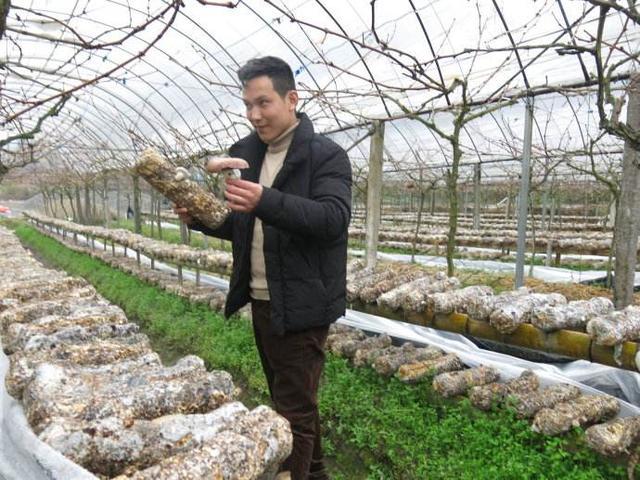
Grape-Shiitake Mushroom Three-Dimensional Circular Cultivation Technique in Jinhua, Zhejiang
Fund project: Zhejiang Provincial Science and Technology Program Project (2015C32130); Zhejiang Provincial Fruit Industry Technology Team Project (Regional Trial Station).
In recent years, the grape planting area in Zhejiang Province has continuously grown at a rate of 15%-20%, making it one of the faster-developing fruit categories in Zhejiang Province and one of the leading varieties in the province's fruit industry. However, for a long time it has been a single planting model, and the large expanse of land and space under the grape trellis has remained idle and unutilized. Most of the light under the grape trellis is scattered light, which suits the light requirements of edible fungi; at the same time, photosynthesis releases a large amount of oxygen, providing raw material for the respiration of edible fungi. In addition, once the leaves have grown, the degree of shading increases and surface evaporation decreases, which plays a role in moisture retention and cooling, creating a relatively ideal environment for the growth of edible fungi. Practice has proven that the efficient combination of grape cultivation and shiitake mushroom cultivation can not only improve the utilization rate of land resources and increase economic income, but also enable efficient circular utilization of resources. This three-dimensional cultivation model is worth promoting. Under the grape-shiitake mushroom three-dimensional circular cultivation model, about 3,000 sq m of shiitake mushrooms can be cultivated within 1 hm2 of vineyard, with 15 fungus sticks placed per sq m. The price of fungus sticks is 2 yuan each, requiring approximately 90,000 yuan/hm2 in shiitake mushroom fungus stick costs. On average, one shiitake mushroom fungus stick can yield 0.75 kg of shiitake mushrooms, with an average unit price of 10 yuan/kg, so shiitake mushroom income can reach 337,500 yuan/hm2. After deducting the costs of shiitake mushroom fungus sticks, depreciation of building materials, disinfection and other expenses totaling 150,000 yuan/hm2, that is, under the grape-shiitake mushroom three-dimensional circular cultivation model, the vineyard can increase income by 187,500 yuan/hm2.
In addition, the grape-shiitake mushroom three-dimensional circular cultivation model not only improves the utilization rate of land resources and increases farmers' economic income, but also achieves multi-level circular utilization of materials and promotes a virtuous cycle of agricultural ecology. It is of great and far-reaching significance for creating a conservation-oriented society and establishing a circular, ecological and efficient new type of agriculture. The grape-shiitake mushroom three-dimensional circular cultivation technique is summarized as follows.
1 Construction of the Spatiotemporal Layout of the Three-Dimensional Planting Model
In terms of spatial structure configuration, the upper layer of grapes consists of vine plants, mainly taking into account the issue of height differences among the populations; the lower layer of shiitake mushrooms is planted because the presence of the upper layer of plants causes partial shading, making it suitable for planting crops adapted to scattered light. In terms of temporal structure configuration, early-maturing grape varieties can be selected, so that after harvesting is completed there is sufficient time to prepare for shiitake mushroom cultivation. For shiitake mushrooms, winter-type shiitake mushrooms are generally selected, and the planting time is generally chosen after grape pruning is completed and orchard clearing work is finished, in order to reduce the occurrence of shiitake mushroom diseases and pests [1-2].
2 Optimized Integration of Supporting Techniques for the Three-Dimensional Cultivation Model
2.1 Vineyard Clearing
In order to prevent overwintering insect eggs from remaining, dead grass and residual branches and rotten leaves in the vineyard should be removed. For vineyards where the soil is too dry, water should be applied between the rows during bed preparation to retain moisture. After the water has drained down, lime powder should be evenly spread on the soil surface for disinfection, and the soil should be deeply plowed to about 15 cm, so as to sterilize and save labor during bed preparation.
2.2 Cultivation Bed Treatment
When cultivating shiitake mushrooms under the grape trellis, consideration must be given to the convenience of managing both grapes and shiitake mushrooms. Shiitake mushroom cultivation beds should be made in alternate rows. Generally, the bed width is about 1 m, slightly raised in a turtle-back shape, with ditches left on both sides of the bed for irrigation and drainage. One 1 m-long steel pipe should be fixed at each end of the bed and reinforced with ropes. Using the steel pipes as fixing points, 3 wires of gauge 16 or above should be strung, with each wire spaced 20 cm apart and the wires 28-30 cm above the ground. After the cultivation beds are prepared, the ground needs to be disinfected to prevent diseases.
2.3 Construction of Small Arch Sheds
Bamboo strips 3 m long should be used to make arches at 1 m intervals, with a span of about 1.6 m and the highest point about 80 cm from the ground. The arch sheds should be covered with agricultural film, and whether shade netting is needed should be determined according to the shading conditions of the grapes.
2.4 Placing the Sticks
Shiitake mushroom sticks are generally placed in the beds after being patted, leaning obliquely against the wires, with the fungus sticks forming an angle of about 65° with the bed surface and a stick spacing of about 10 cm, allowing about 15 sticks per sq m. When white cracks appear on the fungus sticks, choose a cloudy day without dry hot wind for bag removal, to prevent contamination caused by high temperature and excessive water loss from the fungus sticks. During bag removal, try not to damage the mycelium, and delay bag removal for mushroom sticks that turn color slowly. After bag removal, special attention should be paid to insulation, moisture retention and ventilation [3].
2.5 Mushroom Fruiting Management
2.5.1 Environmental management. ① Temperature management. During the fruiting period, the temperature is best controlled between 10-22 °C, with the day-night temperature difference controlled between 5-10 °C, to facilitate mycelial knotting and pinhead formation and normal development of the fruiting bodies. ② Humidity management. In order to meet the water requirements of the fruiting bodies, the relative air humidity during the shiitake mushroom fruiting period should preferably be maintained between 85%-90%; after the mushroom buds form, the relative air humidity should be gradually reduced until it reaches about 70% at harvest time, which is beneficial for making the fruiting bodies firm and plump, improving mushroom quality and taste, and can also prevent and reduce the occurrence of diseases and pests. ③ Light management. During the period of mushroom bud formation, weak light should predominate to facilitate the development of the fruiting bodies; after the mushroom buds form, light can be increased, but direct sunlight must be prevented. Shade netting can be hung in midair to facilitate robust growth of the fruiting bodies and improve mushroom quality; in addition, ventilation and air exchange should be strengthened to meet the normal growth needs of the fruiting bodies.
2.5.2 Water management. When the fruiting bodies are forming, relatively high humidity is required. When the temperature is between 5-25 °C, water should be sprayed 1-2 times per day; after the temperature rises, water should be sprayed 2 times per day; on cloudy and rainy days, the frequency should be reduced; do not spray water before harvesting mushrooms. If the fungus sticks are severely short of water in the middle and late stages, heavy spraying or water injection can be adopted. After water injection, primordia will successively form after 3 d, and water should continue to be sprayed every day. If the problem of insufficient water still cannot be solved, the number of sprayings can be increased, or water can be applied through the irrigation ditches on both sides of the cultivation bed to soak the bed surface, so that the fungus sticks can fully absorb water and ensure the normal growth of shiitake mushrooms.
2.6 Disease and Pest Control
Disease and pest control follows the plant protection principle of "prevention first, with prevention more important than cure." To ensure the safety of shiitake mushroom production, biological pesticides should be chosen as much as possible. For mild green mold, the area can be washed with a water pipe; for severe green mold, it can first be removed cleanly with a blade, then sprayed with 3% lime water, while watering should be controlled and ventilation strengthened. For disease and pest control in the later period, on the one hand, physical and agricultural measures should be used to replace chemical control, and ozone water should be used instead of chemical pesticides to control late-stage grape fruit diseases, sprayed once every 3-7 d, with 5 d being most suitable; on the other hand, some low-toxicity, low-residue pesticides should preferably be selected for disease and pest control, and when spraying pesticides, the small arch sheds for shiitake mushroom cultivation must be tightly covered to avoid spraying onto the fungus sticks. In addition, by planting clover and allowing natural grass growth within the facility, and planting flowering plants in the surrounding area, a good habitat can be created to foster natural enemies and control diseases and pests.
2.7 Harvesting
When the fruiting bodies grow to 80% maturity, that is, when the edge of the cap is clearly curled inward and the partial veil just begins to break, they can be harvested; during harvesting, no residual roots should be left in the substrate, and harvested mushrooms should be stored separately by size to avoid sorting again. Care must be taken to strictly prevent impurities from mixing into the mushroom bodies, and harvested shiitake mushrooms should be sold promptly or sent to a fresh-keeping cold storage facility.
2.8 Follow-Up Management
After the first flush of mushrooms is harvested, spraying and watering in the shed should be stopped for 5-7 d to let the mycelium rest and recover; the temperature in the shed should be regulated to about 22 °C, and the spatial humidity should be reduced to about 70%; the dark environment in the shed should be restored. After 7-10 d, water injection management should be carried out on the fungus sticks so that the weight of the fungus sticks is slightly lower than the original weight, in order to meet the water requirements of the next flush of fruiting bodies, but the fungus sticks must not reach or exceed the original fungus stick weight. Subsequent management can then follow that of the first flush.
3 Circular Utilization of By-Products of the Three-Dimensional Cultivation Model
3.1 Grape Branch Sawdust
Using grape branch sawdust to replace part of the miscellaneous wood sawdust in making shiitake mushroom fungus sticks not only reduces environmental pollution from waste, but also turns waste into treasure, lowers the production cost of shiitake mushrooms, provides a new pathway for the resource-oriented development and utilization of agricultural waste, enriches the sources of raw materials for edible fungus cultivation, and is conducive to the sustainable development of the edible fungus industry [4].
3.2 Shiitake Mushroom Fungus Sticks
Discarded shiitake mushroom fungus sticks are applied to the vineyard as base fertilizer in October each year, which can effectively promote the vegetative growth of grapes and the growth of new roots, improve grape yield and quality, increase the content of organic matter and available nitrogen, available phosphorus and available potassium in the soil as well as the soil pH value, and reduce soil bulk density [5].