Research on Off-Season Hydroponic Technology for Aralia elata
Research on Off-Season Hydroponic Technology for Aralia elata
Fund project: Basic Research Project of the Education Department (2016-KYYWF-0576); Jiamusi University Student Science and Technology Innovation Project (xsyd2016-04).
Aralia elata, also known as ci lao ya and ci nen ya, is a perennial woody plant of the genus Aralia in the family Araliaceae. Aralia elata is a deciduous tree with extremely strong cold resistance and a wide range of adaptation. In China it is mainly distributed in the Northeast region, mostly growing in coniferous or mixed coniferous and broad-leaved forests.
The tender buds that sprout from the tips of Aralia elata branches are rich in nutrients and have a fresh flavor. They contain protein, fat, crude fiber, carbohydrates, vitamins, trace elements and many other nutrients, and are regarded as a treasure among wild mountain vegetables. The whole plant of Aralia elata can be used as a medicinal plant. It has effects such as anti-cancer, replenishing qi and calming the mind, promoting blood circulation and removing blood stasis, and promoting diuresis and reducing swelling. It can be used to treat diseases such as rheumatoid arthritis, diabetes, chronic gastritis, hepatitis and myocardial ischemia, and has extremely high medicinal and health-care value.
The tender buds of Aralia elata can be harvested twice in spring, and the yield is not high. Because the area of natural forest has decreased year by year in recent years, and in addition some areas carry out destructive, predatory harvesting of multiple crops year after year, or even cut the stems and transplant them, the resources of Aralia elata have sharply declined and in some areas it is already facing the danger of extinction. Therefore, more and more farmers have begun artificial cultivation through seed propagation and other methods. However, traditional artificial cultivation methods can only meet the demand for seasonal products. For a long time the tender buds have only been picked in April to May for personal consumption or sale, which is far from meeting market demand. Using hydroponic technology to carry out off-season production has advantages such as low cost input, simple operation process, saving labor and effort, easy promotion, quick results and remarkable benefits. It can meet people's demand for the product in winter, and the development of hydroponic production of Aralia elata has very broad development prospects.
1 Materials and Methods
1.1 Experimental Materials
The test materials were 2-year-old Aralia elata plants grown in the experimental field of Jiamusi University in Heilongjiang Province.
1.2 Experimental Methods
1.2.1 Collection and treatment of stem segments. In mid-November, branches that were robust, with intact outer bark and plump terminal buds were cut. Two buds were retained at the top of each branch to await the sprouting of new buds. The branches were cut into 45 cm lengths and divided into 3 groups according to branch diameter: 0.8, 1.0 and 1.2 cm, with 15 branches bundled into one bundle. Different concentrations of gibberellin were used to soak them for different durations in order to break dormancy and promote the sprouting of tender buds.
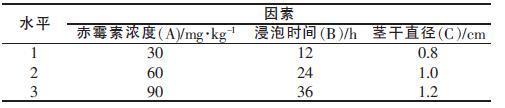
1.2.2 Selection of the best treatment method. Using the orthogonal test method, gibberellin concentration, gibberellin soaking time and stem diameter were taken as 3 factors, and 3 levels were selected for the test. An L9(33) orthogonal test design was adopted, with soaking in clear water as the control. The specific factors and levels are shown in Table 1.
Table 1 Orthogonal test factors and levels
1.3 Investigation Content and Methods
The indoor temperature was controlled at 18 °C and the humidity at 80%, and the water was changed once every 3 d. The sprouting time of tender buds was observed, and the time when 50% of branches sprouted was recorded as the sprouting time. When the number of sprouted branches no longer changed, the sprouting rate was calculated. After 30 d of hydroponics, 5 branches were randomly taken from each treatment and the length of tender buds was measured. Ten branches were taken from each treatment, the terminal buds were picked, and their weight was measured after mixing.
1.4 Data Processing and Analysis
Excel 2003 was used for calculation and graphing of the data, and SPSS 16.0 software was used for statistical analysis.
2 Results and Analysis
2.1 Effects of Different Treatments on the Sprouting Time of Branch Tender Buds
After the branches were hydroponically cultured, the sprouting time of the tender buds on the branches was observed every day, and the results are shown in Table 2. From the range analysis results, RB > RA > RC, indicating that the order of influence of the 3 factors on sprouting time was soaking time (B) > gibberellin concentration (A) > stem diameter (C). Among the 3 factors selected in the test, gibberellin soaking time had the most significant effect on sprouting time, followed by gibberellin concentration. The best treatment combinations were A2B2C3 and A3B2C1, namely gibberellin concentration 60 mg/kg, soaking time 24 h, stem diameter 1.2 cm, and gibberellin concentration 90 mg/kg, soaking time 24 h, stem diameter 0.8 cm. These 2 treatments had the fastest sprouting time, 7 d; the sprouting time of the control treatment was 17 d. It can thus be seen that the use of gibberellin played a very significant role in breaking branch dormancy and accelerating the sprouting of tender buds.
Table 2 Effects of different treatments on the sprouting time of branch tender buds
2.2 Effects of Different Treatments on the Sprouting Rate of Branch Tender Buds
After 15 d of hydroponics, the number of sprouted branches in each treatment was investigated and the sprouting rate was calculated. The results are shown in Figure 1. It can be seen that at 15 d of hydroponics, except for treatment 4 and treatment 6, the sprouting rate of all treatments was 100%; the sprouting rate of treatment 4 was 93.33%, and that of treatment 6 was 86.67%. This indicates that the factors set in the test had no significant effect on the sprouting rate. The sprouting rates of treatment 4 and treatment 6 were lower than those of the other treatments, which may have been caused by conditions such as the terminal buds of the branches not being plump enough or insufficient nutrients stored in the branches themselves.
Figure 1 Sprouting rate of branches under different treatments
2.3 Effects of Different Treatments on the Length of Branch Tender Buds
After 30 d of hydroponics, the length of the tender buds was measured, and the results are shown in Table 3. From the range analysis results in Table 3, RB > RC > RA, indicating that the order of influence of the 3 factors on tender bud length was soaking time (B) > stem diameter (C) > gibberellin concentration (A). Among the 3 factors, gibberellin soaking time had the most significant effect on tender bud length, followed by stem diameter. The best treatment combination was A3B2C1, namely gibberellin concentration 90 mg/kg, soaking time 24 h, stem diameter 0.8 cm. This treatment had the greatest tender bud length, 16.9 cm. The tender bud length of the control treatment was 24.67 cm, higher than that of each test treatment, indicating that the use of gibberellin limited the growth of tender buds.
2.4 Effects of Different Treatments on the Fresh Weight of Branch Tender Buds
After 30 d of hydroponics, 10 sprouted branches were taken from each treatment, cut at the base of the buds, and weighed together after mixing. The results are shown in Table 4. From the range analysis results, RC > RA > RB, indicating that the order of influence of the 3 factors on tender bud fresh weight was stem diameter (C) > gibberellin concentration (A) > soaking time (B). Among the 3 factors in the test, stem diameter had the most significant effect on tender bud fresh weight, followed by gibberellin concentration. The best treatment combination was A3B1C3, namely gibberellin concentration 90 mg/kg, soaking time 12 h, stem diameter 1.2 cm. This treatment had the greatest tender bud fresh weight, 79.63 g. The tender bud fresh weight of the control treatment was 31.54 g, lower than 6 treatments in the test, indicating that if appropriate levels of the test factors are adopted, this is beneficial to increasing fresh weight.
Table 3 Tender bud length under different treatments
Table 4 Tender bud fresh weight under different treatments
3 Conclusion and Discussion
During winter hydroponics of Aralia elata branches, the 3 factors of gibberellin concentration, soaking time and branch diameter all had a certain effect on the sprouting time, tender bud length and fresh weight of the tender buds. The sprouting rate of tender buds mainly depended on the condition of the branches themselves and was unrelated to the 3 factors set in the test.
The factor with the greatest effect on sprouting time was gibberellin soaking time, followed by gibberellin concentration. This indicates that gibberellin has a significant effect on breaking branch dormancy and can accelerate the sprouting of tender buds. The factor with the greatest effect on tender bud length was soaking time, followed by branch diameter. The use of gibberellin had a certain inhibitory effect on tender bud length. Considering that in production it is more suitable to harvest when the tender buds are 10-15 cm long, the inhibitory effect of gibberellin on tender bud length is within an acceptable range. The factor with the greatest effect on tender bud fresh weight was branch diameter, followed by gibberellin concentration. Based on the comprehensive test results, in order to quickly obtain high-yield Aralia elata tender buds, branches with a diameter of 1.2 cm can be selected, soaked in 90 mg/kg gibberellin for 24 h, and after 30 d of culture, harvested when the tender buds are about 15 cm long.