Key Technical Points for High-Yield and Efficient Cultivation of Jinsi Huangju (Golden Silk Imperial Chrysanthemum) in Xiushui County
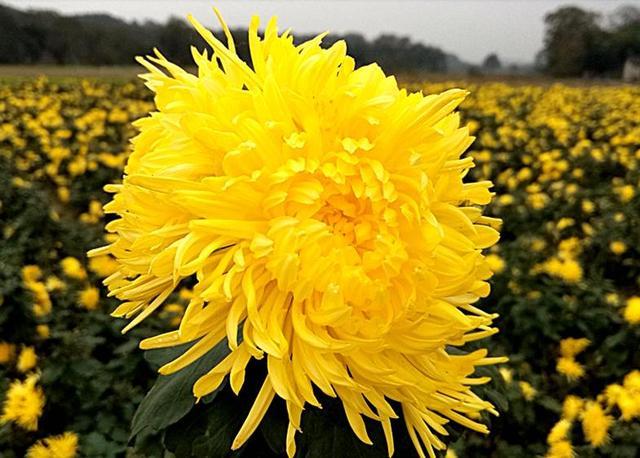
Jinsi Huangju in Xiushui CountyHigh-Yieldand Efficient Cultivation Techniques
Jinsi Huangju has health-promoting effects, and Xiushui County has a long history of cultivating Jinsi Huangju. The unique local environmental conditions produce Jinsi Huangju of excellent quality. In recent years, with the improvement of people's living standards, the demand for Jinsi Huangju has surged, and the cultivation benefit is about 10 times that of ordinary grain crops, so farmers' enthusiasm for planting has been high. The high-yield and efficient cultivation techniques for Jinsi Huangju are summarized below for the reference of growers.
1 Selection of Planting Plots
The suitable growing conditions for Jinsi Huangju are a cool climate with good ventilation and light transmission. The most suitable planting plots are sandy loam with a loose soil structure, good aeration and drainage, high organic matter content, and a pH value of 6.2-6.7. Jinsi Huangju dislikes moisture, so clay soil and low-lying land are not suitable for planting. When soil moisture is high, growth is poor; if water accumulates for a long time, roots easily rot and the plants die. Jinsi Huangju is not suitable for continuous cropping. If planted in the same plot year after year, pests and diseases are numerous, and yield and quality decline significantly.
2 Planting
2.1 Seedling Selection
Transplanted seedlings of Jinsi Huangju are divided into 2 types: cutting-propagated seedlings and division-propagated seedlings. Cutting-propagated seedlings can maintain the excellent characteristics of the mother plant, with well-developed new roots, robust growth, high survival rate, strong branching ability, and relatively high yield; their disadvantage is that they require more labor. Division-propagated seedlings grow quickly in the early seedling stage, but they easily transmit viruses from the mother plant and reduce yield, so they are not recommended when conditions permit.
2.2 Planting
The summer climate in Xiushui County is characterized by high temperature and abundant rain, while chrysanthemums fear moisture and waterlogging, so high-ridge planting is required. Before planting, deep plow about 25 cm, and during land preparation apply 7,500 kg/hm2 of commercial organic fertilizer and 600 kg/hm2 of high-efficiency compound fertilizer, plowing them into the soil as base fertilizer. Rake the soil fine and make ridges with a bed width of 90 cm, ditch width of 30 cm, and depth of 30 cm. After the plot is leveled, cover the bed surface with 1.2 m wide silver-gray film (the upper side is white and reflective, increasing light and absorbing less heat; the lower side is black and prevents weed growth). The film should be laid flat, compacted with soil around the edges, and must not be torn. To reduce the harm of pests and diseases to Jinsi Huangju, while applying base fertilizer, broadcast 50% carbendazim wettable powder at 7.5 kg/hm2 + 3% phoxim granules at 22.5 kg/hm2 for soil insect control and disinfection, which can control root rot, stem rot, white grubs, cutworms, and other pests and diseases.
Jinsi Huangju likes sunlight and dislikes shade; ventilation and light transmission are among the important factors for high yield in chrysanthemums. Adjust the plant and row spacing appropriately according to soil fertility, planting method, and time differences. The suitable density for cutting seedlings is about 30,000 plants/hm2, with a maximum of no more than 36,000 plants/hm2. Choose a sunny day or the evening of a cloudy day, make holes on the bed surface and transplant, planting 2 rows per bed, 1 plant per hole. After transplanting, cover the planting holes well with soil so that air cannot pass through, to prevent hot air in the high-temperature season from scorching the chrysanthemum seedlings.
3 Fertilizer and Water Management
3.1 Scientific Formula Fertilization
Jinsi Huangju has a relatively well-developed root system and a high fertilizer requirement, and is a fertilizer-loving crop. From the nutrient absorption of Jinsi Huangju and its distribution in the plant body, Jinsi Huangju has a relatively high demand for potassium. Throughout the entire growth period of Jinsi Huangju, attention should be paid to balanced fertilization. To prevent excessive vegetative growth and infection by diseases, nitrogen fertilizer should not be excessive in the early stage; the purpose of topdressing is to promote rooting and increase flowering branches, and it should be applied mainly after pruning. Reasonably increasing phosphorus fertilizer can make chrysanthemums form buds earlier, produce more buds, and bloom earlier [Jishan Huayao].
Fertilization should follow the principle of giving priority to organic fertilizer, applying nitrogen, phosphorus, and potassium fertilizers in combination, and supplementing with trace element fertilizers. First, base fertilizer. Apply sufficient base fertilizer before transplanting, mainly rapeseed cake, tung cake, and commercial organic fertilizer, appropriately apply high-efficiency compound fertilizer, and supplement with trace element fertilizer. Second, topdressing. For open-field cultivation of Jinsi Huangju, after rain in mid-August, make holes beside the seedlings and apply 375 kg/hm2 of high-efficiency compound fertilizer. For fields with sufficient base fertilizer and film-covered transplanting, branching fertilizer may be omitted. If fertilizer is lacking later, in mid-to-late August during light rain or after rain, broadcast 375 kg/hm2 of high-efficiency compound fertilizer in the ditches. From early September before budding, every 7 d, spray with 0.3% potassium dihydrogen phosphate solution for foliar topdressing 3-4 times. This method has a very obvious effect on producing more flowers and larger flowers.
3.2 Water Management
Jinsi Huangju fears waterlogging. During the rainy season, pay attention to clearing ditches and draining water. Check before and after each rain to ensure drainage is unobstructed and prevent waterlogging and root rot. Jinsi Huangju must not lack water during the budding and flowering stages, and should be watered promptly during drought.
4 Pinching and Staking
Pruning seedlings and pinching is an important part of Jinsi Huangju production management, as it can inhibit apical growth, increase crown width, and raise yield [5]. For earlier transplanted Jinsi Huangju, it is suitable to prune seedlings once during the entire growth period. The retained seedling height should not exceed 3 cm, and this should be completed by early June and no later than June 15. Seedlings emerging from the soil are of good quality, with thick stems and strong wind resistance. After sprouting, retain 3-5 robust seedlings and remove the rest, which helps ensure flowering time and quality. For later transplanted cutting seedlings, only 1 pinching is needed, and it must be completed before the end of July. Each operation should be carried out on a sunny day; do not prune seedlings when it rains, and all removed parts should be taken out of the chrysanthemum field and burned.
Plants that have undergone 1 pruning of seedlings have many branches, and at flowering time the number of flowers is large and concentrated at the top. In rainy weather they easily lodge, affecting ventilation, light transmission, and flower quality. Therefore, when plant height reaches a certain level, stakes should be set up on the bed surface with netting, wooden sticks, and rope to fix the plants and prevent lodging.
5 Control of Diseases, Insects, and Weeds
Jinsi Huangju is a shallow-rooted plant. After transplanting, it enters normal growth after a 7-10 d seedling recovery period. Open-field cultivated chrysanthemums should be cultivated and weeded in time. Cultivation should not be too deep; only shallow loosening of the surface soil by 3-5 cm is suitable, so that the surface soil is dry and loose while the lower layer is slightly moist, promoting roots to grow downward, and controlling water and fertilizer so that aboveground growth is slow, commonly known as "seedling hardening," which benefits chrysanthemum seedling growth. A total of 4-5 cultivations and weedings are needed throughout the year. In the later growth stage, combine cultivation and weeding with earthing up around the base of the plant's root crown to promote root growth. For film-covered transplanting, do not weed the bed surface; pull weeds beside the chrysanthemum seedlings by hand, and use Roundup plus Dual in the ditches for weed control. Do not spray if it will rain within 3 d, otherwise leaves and roots are easily damaged.
Before transplanting Jinsi Huangju, if disinfection of seedlings and soil is done thoroughly, pests and diseases generally rarely occur. Common pests and diseases of Jinsi Huangju include fusarium wilt, phytophthora blight, root rot, black cutworm, tobacco cutworm, white grubs, aphids, and others. Control methods include disinfecting chrysanthemum seedlings and planting holes before transplanting; draining field water promptly during the rainy season after transplanting; removing diseased plants promptly when found; and using biological pesticides in a timely manner according to the occurrence of pests and diseases.
6 Harvesting and Processing
Jinsi Huangju has a relatively long flowering period, but the harvest time is relatively concentrated, mainly in early November. When the flowers are 3/4 open, choose a sunny day after the dew has dried for picking. Do not pick dew-covered flowers or rain-soaked flowers. When picking, place good flowers and inferior flowers separately, take care to keep the flower shape intact, remove muddy flowers, insect-damaged flowers, and diseased flowers, and do not mix in foreign matter. After harvesting, process promptly to prevent rotting and discoloration.