Effects of Trace-Element-Type Macroelement Water-Soluble Fertilizer on Yield Increase and Quality Improvement of Citrus
Effects of Trace-Element-Type Macroelement Water-Soluble Fertilizer on Yield Increase and Quality Improvement of Citrus
Macroelement water-soluble fertilizer refers to liquid or solid water-soluble fertilizer made with the macroelements nitrogen, phosphorus and potassium as the main components, with an appropriate amount of secondary elements or trace elements added; among these, those with at least 1 trace element from boron, iron, manganese, zinc, molybdenum and copper added are called trace-element-type macroelement water-soluble fertilizers. Macroelement water-soluble fertilizer has multiple effects such as promoting crop growth and development, enhancing leaf photosynthesis, increasing yield and improving quality. To verify the application effects of this fertilizer, the author conducted foliar spraying trials of trace-element-type macroelement water-soluble fertilizer on citrus trees in Longhui County, Hunan Province in 2015 and 2016. The trial situation is summarized as follows:
I. Materials and Methods
The tested trace-element-type macroelement water-soluble fertilizer (hereinafter referred to as macroelement water-soluble fertilizer) was produced by Shaoyang Liuchuang Agricultural Chemical Co., Ltd., a solid product, with macroelement (N+P2O5+K2O) content ≥50.0% (10-10-30) and trace element (boron) content ≥1.0%. In 2015, a field plot trial was carried out during the citrus fruit-swelling stage to explore the yield-increasing and quality-improving effects of spraying macroelement water-soluble fertilizer on citrus. The tested citrus was 'Longyuanzao' Satsuma mandarin at the citrus orchard of Zihe Village, Sangesi Town, Longhui County, on trifoliate orange rootstock, planted in 1982, with a spacing of 3.0 m × 3.5 m (about 63 trees/mu), and basically consistent tree size, tree vigor and fruit set. The soil was red soil, flat terrain, medium and uniform fertility, with good drainage, irrigation and light conditions. The treatment was spraying 300-fold dilution of macroelement water-soluble fertilizer once each on July 8 and July 15 during the citrus fruit-swelling stage; Control 1 was spraying an equal amount of clear water at each period, and Control 2 was no spraying at all. Randomized block arrangement, each replicate (plot) had 6 trees, an area of 63 sq m, with 3 replicates. The spray volume was based on uniformly wetting branches, leaves and fruit without dripping (the same below). The treatment and controls were completely identical in other cultivation management measures such as soil fertilization, pest and disease control, and intertillage weeding. On September 16, 50 spring leaves were randomly picked, leaf thickness was measured with a vernier caliper, and leaf weight was weighed with a trip balance. Harvest was on September 29, fruit yield was counted, representative fruits were picked to determine quality, and the soluble solids content of the fruit was measured with a handheld sugar meter. Analysis of variance was carried out on the yield-increasing effect to compare the significance of differences.
In 2016, a demonstration comparison trial was carried out during the two physiological fruit-drop stages and the fruit-swelling stage of citrus to further study the effects of this fertilizer on citrus fruit set, yield and quality. The tested citrus was 'Longyuanzao' Satsuma mandarin at Shaping Village, Sangesi Town, Longhui County, on trifoliate orange rootstock, planted in 2002, with a spacing of 3 m × 3 m (about 74 trees/mu), medium flower quantity, and basically consistent tree size and tree vigor. The soil was red soil, flat terrain, medium and uniform fertility, with good drainage, irrigation and light conditions. A plot of about 420 sq m was selected and divided into two halves, each 210 sq m (20 trees). The treatment was spraying 300-fold dilution of macroelement water-soluble fertilizer once each at 2/3 petal fall (April 23), before the second physiological fruit drop (May 31), and the fruit-swelling stage (July 9). Spraying an equal amount of clear water at each period was used as the control. On April 23, 3 observation trees were selected to investigate the number of young fruit, and the fruit set rate was calculated based on this as the base number. On July 9, leaf thickness and leaf weight were investigated. Harvest was on October 1, and fruit yield and quality were investigated.
II. Results and Analysis
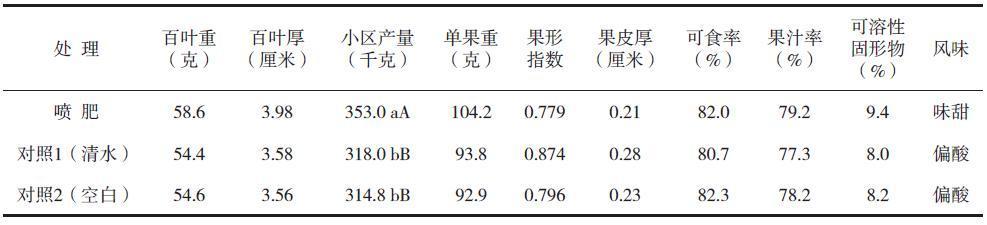
1. Effects of macroelement water-soluble fertilizer on citrus physiological fruit drop and yield. Through field investigation, it was found that whether spraying macroelement water-soluble fertilizer during the citrus fruit-swelling stage or starting from 2/3 petal fall, there were no side effects; the spraying effects were shown as leaves becoming greener, heavier and thicker, tree vigor becoming stronger and more robust, and yield significantly increased. Spraying starting from 2/3 petal fall of citrus could also significantly reduce the first and second physiological fruit drops. From Table 1 and Table 2, it can be seen that for citrus trees sprayed with macroelement water-soluble fertilizer, the weight of 100 leaves increased by 4.2-13.5 g compared with the clear water control, the thickness of 100 leaves increased by 0.40-0.45 cm, and yield increased by 11.0%-15.9%; when spraying started from 2/3 petal fall of citrus, the fruit set rate was 0.32 times higher than the clear water control, reaching 7.0%, and the difference reached a significant level. In the 2016 trial, the single fruit weight of the clear water control was significantly higher than that of the fertilizer-spraying treatment, which was related to its lower fruit set.
2. Effects of macroelement water-soluble fertilizer on citrus fruit quality
Spraying macroelement water-soluble fertilizer on citrus trees advanced fruit maturity by 4-6 days, increased sugar content, made the peel thinner, and significantly improved quality. From Table 1 and Table 2, it can be seen that the soluble solids content of the fruit was 0.8%-1.4% higher than that of the clear water control, the flavor became stronger and sweeter, and the other quality changes were not large.
Table 1 Effects of spraying macroelement water-soluble fertilizer during the citrus fruit-swelling stage on leaf growth and fruit yield and quality (2015)
Note: In multiple comparisons, different lowercase letters in the same column indicate significant differences (P < 0.05), and different uppercase letters indicate extremely significant differences (P <
Table 2 Effects of spraying macroelement water-soluble fertilizer during the citrus physiological fruit-drop stage and fruit-swelling stage on leaf growth and fruit set, yield and quality (2016)
Note: ① The number of young fruit investigated refers to the number of young fruit investigated at 2/3 petal fall (including open unpollinated flowers on the tree and flower buds not yet opened). ② The means were compared for differences; different lowercase letters in the same column indicate significant differences (P < 0.05), and different uppercase letters indicate extremely significant differences (P < 0.01).
3. Effects of macroelement water-soluble fertilizer on the economic benefits of citrus
Whether spraying macroelement water-soluble fertilizer during the citrus fruit-swelling stage or starting from 2/3 petal fall, significant economic benefits could be obtained (see Table 3), with an input-output ratio of 1:6.5-8.0.
Table 3 Effects of spraying macroelement water-soluble fertilizer on the economic benefits of citrus
III. Conclusion
The results of this trial show that after trace-element-type macroelement water-soluble fertilizer is dissolved in water and diluted, spraying it on citrus trees makes leaves greener, heavier and thicker, increases chlorophyll content, enhances photosynthesis and growth vigor, has good effects on reducing citrus physiological fruit drop and increasing the soluble solids content of fruit, and significantly improves yield and quality. It is also convenient to use, has no side effects, no pollution and no public hazard, and is low in cost. Spraying combined with pest and disease control can further reduce labor. The economic benefits are significant, and it is suitable for promotion and application as a citrus foliar fertilizer.
It is recommended to spray macroelement water-soluble fertilizer 3 times throughout the year, that is, once each at 2/3 petal fall of citrus, after the end of the first physiological fruit drop and before the start of the second physiological fruit drop (late May), and during the fruit-swelling stage (July), using a 300-fold dilution. Before spraying, stir fully and use immediately after mixing. Choose a windless sunny day (before 10 a.m. and after 4 p.m.) or a windless cloudy day, and spray the liquid fertilizer evenly on both the front and back sides of the leaves. The spray volume should be based on fully wetting the branches, leaves, flowers and fruit of the canopy without dripping. Macroelement water-soluble fertilizer is a multi-element fully water-soluble fertilizer that can completely dissolve in water. It dissolves quickly in water and has comprehensive nutrition. When used for citrus foliar spraying, it has high absorption and utilization rate, takes effect quickly and has remarkable effects. However, it cannot replace soil fertilization. In production, the cultivation management of citrus trees should be strengthened to give full play to the yield-increasing and quality-improving effects of this fertilizer. Macroelement water-soluble fertilizer can be mixed with pesticides and fertilizers that are not strongly acidic or strongly alkaline. If rain occurs within 6 hours after spraying, it should be reapplied; it should be sealed and stored in a cool, dry and ventilated place, and attention should be paid to moisture-proofing, sun-proofing and preventing package rupture to improve the efficacy.