Production technology for lignified bearing shoots of jujube trees can increase yield and benefit
Using lignified bearing shoot production technology to increase the yield and benefit of jujube trees
Chaoyang County is a key jujube production area in Liaoning Province, with a long history of jujube cultivation and rich experience. The current jujube planting area is about 330,000 mu, producing 80 million kg of fresh jujubes, and it has become the leading industry for the majority of jujube farmers to get rich. Within the county, hills undulate, valleys alternate, and gullies crisscross, with mountains, rivers, hills, ridges, and plains distributed in an interlaced pattern. Jujube trees are mostly planted in hilly and mountainous areas, with a few planted on plains. Due to poor production conditions and insufficient technical and financial input, the yield of ordinary orchards is relatively low, with per-mu yield mostly below 500 kg and per-mu income mostly 1,000-2,000 yuan. In recent years, jujube prices have declined. In 2017, during the harvest season, the purchase price of Pingding jujube was only about 0.4 yuan per kg. Picking more than 50 kg of jujubes in a day was still not enough to cover labor costs, which severely dampened jujube farmers' enthusiasm for jujube cultivation.
Faced with the current state of jujube production, as a member of the Liaoning Provincial Science and Technology Special Mission Team, the author felt very anxious and kept working hard to summarize the local high-efficiency jujube cultivation experience as soon as possible. In 2017, two tasks were carried out: first, testing lignified bearing shoot production technology; second, summarizing local production experience.
1 Significance of cultivating lignified bearing shoots
The bearing shoot is the fruiting branch of jujube, generally 10-25 cm long, with thin branches,automatically shedding in winterso it is called a deciduous branch. It bears 1-4 jujubes, which are relatively small, but the total number on the whole tree is large. Each jujube spur (fruiting mother branch) can produce 2-7 bearing shoots. The jujube spur grows larger year by year and becomes a large protruding structure. Its age is perennial, with older ones over 8 years, but the older the jujube spur, the more senescent it becomes, the weaker the bearing shoots, and the fewer the bearing shoots. The early flowering period on bearing shoots occurs during high temperatures, and flower scorching often occurs. Fruit set is relatively low, and because the branches are short and weak, the jujubes produced are relatively small. Lignified bearing shoots are very different from ordinary bearing shoots. First,lignified bearing shoots are thick and long, 3-4 times those of ordinary bearing shoots. Second,lignified bearing shoots do not drop in winter, remaining firmly on the jujube spur. The significance of cultivating lignified bearing shoots is:
1.1 Increasing yield
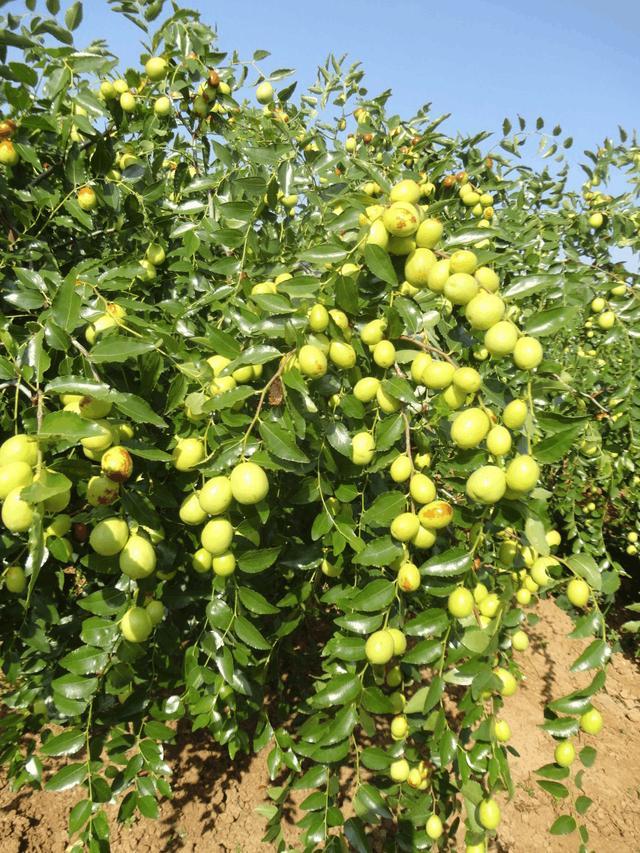
Ordinary bearing shoots set about 2 fruits per branch on average, while lignified bearing shoots can set 7-10 fruits, with a maximum of 19; single-branch yield can reach 1 kg. The author randomly surveyed 7 representative trees in the orchard. Each tree had an average of 108 lignified bearing shoots, and each tree averaged 20.3 kg of fruit. Calculated at 55 trees per mu, the per-mu yield would be 1,115.7 kg. Calculated at the local Lingdang jujube price of 10 yuan/kg, the per-mu output value would be 11,157.1 yuan.almost 3-5 times that of local ordinary jujube orchards(Figure 1).
Figure 1 Fruit-bearing state of lignified bearing shoots (Ling jujube, September 13, 2017)
1.2 Can avoid spring drought and prevent flower scorching
Lignified bearing shoots are about 1 month later than ordinary bearing shoots, and the initial flowering period is delayed until after mid-June, when there is more rain and the temperature is suitable. They bear jujubes at the 10th-30th node positions, which is beneficial for fruit set.
1.3 Preventing fruit cracking
Before maturity, if there is too much rain, fruit cracking and rot can occur, but because the jujubes on lignified bearing shoots are not yet mature, they can avoid pre-maturity fruit cracking.
1.4 Fruits are storage-resistant
Because the jujubes on lignified bearing shoots mature later and accumulate more nutrients, they can be stored 20-30 days longer than jujubes from ordinary bearing shoots, and the storage benefit is significantly improved.
1.5 Dwarfing the tree body and facilitating field management
Through heavy pruning of the tree, cutting it back to about 1 m high, plus the height of the lignified bearing shoots, the total tree height is only 1.5-2.2 m. At harvest, people can reach the fruit while standing on the ground, which improves labor efficiency and is more conducive to tourism and picking.
1.6 Saving nutrients and leaving fewer branches
Heavy pruning in spring stimulates the sprouting of a certain number of jujube heads (fruiting branches). After timely and moderate pinching, lignified bearing shoots can be produced. Because nutrients are sufficient, it is beneficial for strong branches to bear fruit. By giving full play to the advantages of vegetative growth, the fruits are high-quality and large, and dense planting, high yield, and high-efficiency cultivation can be achieved.
2 Technology for cultivating lignified bearing shoots
2.1 Selection of trial site and test materials
The author selected two trial sites at [Jishan Huayao]: the former had 10-year-old trees, variety Pingding jujube. The latter had 4-10-year-old trees, also variety Pingding jujube. The initially selected test materials were relatively few: 12 trees at the former and 17 trees at the latter. The site conditions were hilly and mountainous areas, with ordinary management level, but both had irrigation conditions.
2.2 Technology for cultivating lignified bearing shoots
2.2.1 Heavy pruning of scaffold branches For jujube trees, because they sprout late in early spring, pruning is generally delayed untilafter Qingming begins. On April 27, 2017, the author assisted specialized households in pruning the trial trees. The main pruning method was heavy renewal pruning of perennial scaffold branches, cutting back heavily 1.2-1.5 m above the ground. For the jujube head portion, generally 2-3 basal nodes were retained in heavy pruning. Generally, no secondary branches were retained on scaffold branches, so that more jujube heads could develop (Figure 2).
Figure 2 Heavy pruning of scaffold branches
2.2.2 Inducing jujube heads Control the number of jujube heads. Jujube heads (i.e., water sprouts) have extremely strong growth vigor and are the basic parts for growing lignified bearing shoots. Because heavy pruning causes an imbalance between the aboveground part and the root system, jujube heads emerge from latent buds, adventitious buds, or shriveled buds. How many jujube heads to retain on a tree depends on tree age and crown size. If too many are retained, the crown becomes dense and nutrients are dispersed; if too few are retained, it is not conducive to high yield. Generally, with increasing age, one more is retained each year. Jujube heads do not sprout all at once but emerge successively, so excessive sprouting jujube heads should be removed at any time.
The workload of removing newly emerged jujube heads is quite large. This work lasts from mid-May to mid-August and cannot be neglected.
2.2.3 Pinching of jujube heads and secondary branchesThis work is extremely critical. If they are allowed to grow naturally,lignified bearing shoots will not be induced. When the jujube head grows to 7-8 nodes, pinch it back to 4-5 nodes; this is around mid-May. When the secondary branch grows to 5-6 nodes, pinch the secondary branch, around early June.
2.2.4 Emergence of bearing shoots Lignified bearing shoots emerge from the node positions of secondary branches. Their growth vigor is relatively strong, and they emerge in rows (Figure 3).
Figure 3 Lignified bearing shoots sprouting on secondary branches
2.2.5 Management of flowering and fruit set of lignified bearing shoots Locally, flowering of lignified bearing shoots lasts from mid-June to early August. During the flowering period, 920 and other substances should be sprayed on the trees to increase fruit set. But the most important thing is to carry out girdling on the trunk or main branches in late June. This is the most effective method for increasing fruit set in many jujube varieties. In Yang Fuping's orchard, the trial trees were not girdled at first. After finding that fruit set was too low, 4 trees were girdled in time, and fruit set was better (4). On August 30, the author conducted a survey.
Figure 4 Good fruit set after girdling (Sanxing jujube, August 15, 2017)
Under high-level management and timely girdling, the lignified bearing shoots of Lingdang jujube can reach 77.3 cm in branch length, with an average of 11.9-13.4 fruits per branch, and a maximum of 19.
In terms of yield, trees without girdling had almost no yield. In Yang Fuping's orchard, 3 girdled trees had fruit numbers of 300, 208, and 409 respectively, with estimated yields of 3.5 kg, 2.5 kg, and 5 kg respectively. This fully demonstrates the effect of girdling and girdling.
Because lignified bearing shoots are long and thick, the individual fruits borne on them are relatively large. On September 10, the author surveyed the single-fruit mass of Wang Fengqi's Lingdang jujube. Ten representative jujubes were randomly selected, and their single-fruit masses were: 22.9, 23.7, 25.5, 26.0, 28.5, 31.3, 34.3, 34.8, 43.1, 45.0 g. The average single-fruit mass was 31.5 g, about 10 g more than the single-fruit mass in ordinary orchards.
3 Summary
In 2017, this was only a preliminary trial in lignified bearing shoot production. Although the above results were achieved, there was not much experience, and much field management was not in place. For example, girdling to improve fruit set was not carried out in time, and no other fruit-setting agents were sprayed, so the yield of the trial trees was not high. However, it can already be seen that cultivating lignified bearing shoots is the future production direction for jujube trees. Research and development should be strengthened to facilitate extension and play a greater role in production.