Medicinal Resources of Bletilla striata and Quality Grading of Seeds and Seedlings
Medicinal Resources of Bletilla striata and Quality Grading of Seeds and Seedlings
(I) Seed Testing and Quality Grading
1. Sampling
The maximum mass of a seed lot is 10 kg. The experimental sample is taken by the hand-halving method. The minimum submitted sample is 3 g, and the minimum purity analysis sample is 0.3 g.
2. Purity Analysis
Pass the sample obtained by sampling through a 20-mesh sieve to remove larger impurities, then divide the experimental sample into pure seeds, other plant seeds, waste seeds, residual calyx, pericarp fragments, fruit stalks and petals, mud and sand, and other impurities, and determine the weight of each component. The experimental sample and each component are weighed in "g", retaining 4 decimal places, and the seed purity is calculated. If the sum of the weights of all components differs from the original sample weight by more than 5% of the original sample weight, the test must be redone. If the difference is less than 5% of the original sample weight, the percentage of pure seeds is calculated.
3. Weight Measurement
After purity analysis, mix the seeds thoroughly and evenly, divide them into 4 portions by the quartering method, randomly count 1000 seeds from each portion of pure seeds as 1 group, repeat 5 times, and record the 1000-seed weight separately. Weighing is retained to 4 decimal places. Calculate the standard deviation and coefficient of variation. The coefficient of variation must not exceed 4%.
4. Germination Test
Mix the pure seeds thoroughly and evenly, randomly select an appropriate amount of seeds, and use a petri dish lined with 2 layers of moistened filter paper as the germination bed. Place 100 seeds in each petri dish and culture them at 30°C with a light intensity of 2000 lx. Observe daily, replenish water, and record the number of germinated seeds from the 4th to the 20th day.
5. Authenticity Identification
Randomly take 100 seeds, with 3 repetitions, and observe the seed morphology, color and surface features one by one under a stereomicroscope, and measure the seed size. Identification basis: the seeds are extremely small, mostly long spindle-shaped, a few crescent-shaped, 0.62-2.69 mm long, 0.11-0.36 mm in diameter; the seed coat is yellow-brown, semi-transparent, with a metallic luster.
6. Moisture Determination
Take 0.5 g of mixed pure Bletilla striata seeds, place the whole seeds into a clean, constant-weight aluminum box, weigh, retaining 4 decimal places, with 4 repetitions. Place the sample box into an oven, and when the oven temperature is maintained at (133±2)°C, start timing. The drying time of the sample is 3 hours. Take it out, cool to room temperature, and weigh again. Calculate the moisture content according to the formula: Seed moisture content = [(weight of sample before drying - weight of sample after drying) / weight of sample before drying] × 100%.
7. Viability Determination
Randomly count about 100 seeds, soak them in clean water at room temperature for 4 hours, then remove them. Stain them in 1% TTC (2,3,5-triphenyltetrazolium chloride) solution at 40°C for 7 hours. Remove the seeds and rinse the embryos with clean water, observe the staining. Embryos (without endosperm) stained red are viable seeds.
8. Health Inspection
Use the direct inspection method to check seeds infected with diseases and insect pests; use the petri dish culture method to detect fungus-carrying seeds. ① Direct inspection: randomly count 400 seeds and place them on white paper or glass, inspect with the naked eye, remove seeds infected with diseases and insect pests, calculate their numbers respectively, and calculate the infection rate. ② Petri dish culture method: sterilize the petri dishes and PDA medium; randomly select 100 seeds, place them into petri dishes with 15-20 ml of medium added, place 5 seeds in each petri dish, culture in a 25°C incubator for 3-5 days with timely observation; pick the relatively pure part of the fungus onto another new medium for culture; pick the purified fungus, stain it with methyl blue stain, then observe under a microscope, photograph, record and identify. Calculate the fungus-carrying rate and isolation rate.
(II) Quality Grading of Seed Tubers
Dig out tubers cultivated for two years as seed tubers, remove the fibrous roots, and use mass as the index to divide them into grades I, II, and III (Table 1).
Table 1 Quality Grades of Seed Tubers
(III) Quality Grading of Capsules
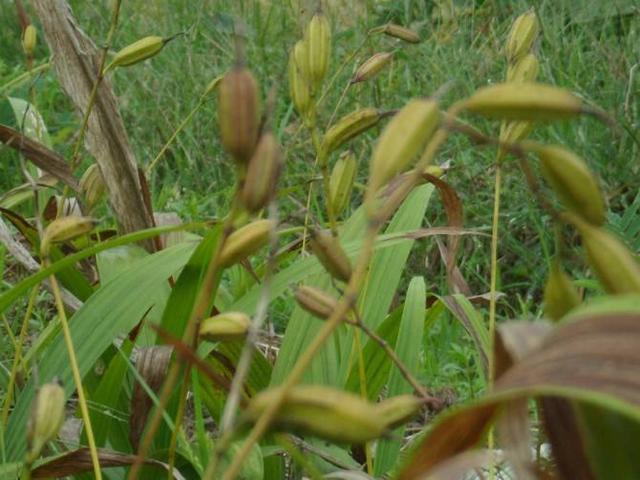
The capsule of Bletilla striata is cylindrical, 1.6-4.5 cm long, 0.5-1.2 cm in diameter, slightly pointed and narrow at both ends, with 6 longitudinal ribs. Take Bletilla striata capsules, select clean ones and remove impurities, and use mass as the index to divide them into grades I, II, and III (Table 2).
Table 2 Quality Grades of Capsules
(IV) Quality Grading of Tissue-cultured Tubers
Wash off the medium from tissue-cultured tubers, remove the fibrous roots, and use mass as the index to divide them into grades I, II, and III (Table 3).
Table 3 Quality Grades of Tissue-cultured Tubers
(V) Quality Grading of Tissue-cultured Plantlets
Wash off the medium from tissue-cultured plantlets with tubers, and use mass as the index to divide them into grades I, II, and III (Table 4) [Jishan Huayao].
Table 4 Quality Grades of Tissue-cultured Plantlets