How is the linear beauty of bonsai expressed? A few examples
The linear beauty of bonsai, with a few examples
All creation in the visual arts is based on points, lines and planes. Among these, lines are especially important, as anyone who has studied sketching will surely know well. Bonsai art likewise uses lines to shape artistic form; if the lines lack beauty, then no matter how it is arranged, the final result will not be an excellent work and will not stand up to repeated viewing. The linear beauty of bonsai is expressed in the roots, the trunk and the branches.
The linear beauty of root forms
Roots are the foundation of standing; exposed-root bonsai has an even more ancient feel, and a section of powerful, vigorous root better sets off the sturdiness of the bonsai. Common forms include the raised-root style and the connected-root style.
Plants commonly used for raised-root bonsai include Serissa japonica (snowbush), Ficus microcarpa (Chinese banyan) and Sageretia thea (Chinese sweet plum). The exposed roots have strange and unusual postures, like eagle claws, like coiled dragons, vigorous and antique, with a distinctive wild charm.
The connected-root style is generally made into a forest-style dry bonsai, with materials generally using Vitex negundo (Chinese chaste tree), Serissa japonica and Syzygium buxifolium. Among these there is a suspended-root, exposed-claw style, whose curved trunk has a light and elegant beauty.
The linear beauty of trunk forms
There are many types of trunk: straight or curved, slanting or lying, and also dead-wood trunks and shari trunks, each with its own linear beauty.
The straight-trunk type includes single-trunk, double-trunk and multi-trunk; the trunk has a momentum of towering into the clouds. Pines and cypresses, boxwood and Murraya paniculata (orange jasmine) are generally used to make them; the Guest-Greeting Pine of Huangshan is a representative. The majestic, upright form gives viewers a sense of striving upward. Paired with a suspended-root, exposed-claw root form, it has an even greater majestic, steady beauty.
The slanting-trunk type has a sense of dynamic beauty; generally the main branch extends in the opposite direction from the trunk, forming a cascading branch, displaying a kind of flowing elegance. In this type, the slanting side of the trunk rarely exposes roots; generally the roots are appropriately raised on the other side to increase the stability of the overall form. Combined with coiled roots and a long cascading branch, it has the momentum of Chang'e flying to the moon.
The lying-trunk type is generally made into cliff-style bonsai, with a beauty of strange peril. The trunk lies horizontally, while the other branches rise proudly; paired with a suspended-root, exposed-claw root form, it has the dynamic beauty of a dragon emerging from the water.
The curved-trunk type mostly displays the beauty of curves and, comparatively, appears softer; it is relatively common in the Hui and Ru schools. When making curved-trunk bonsai, one must not deliberately pursue the bending of the branches and trunk; it is best if it can also carry a bit of vigor, so that the resulting bonsai combines hardness and softness and does not appear too delicate or too rigid.
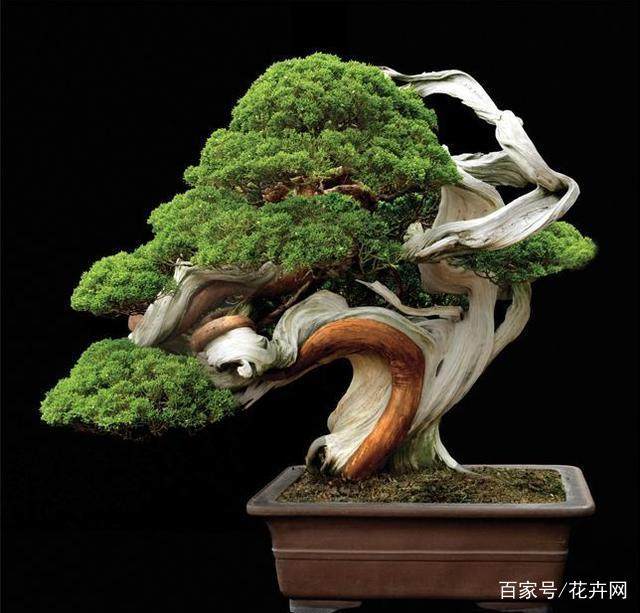
The dead-wood trunk type generally gives a sense of the vicissitudes of time, mainly displaying the age of the tree. The shari type rose in recent years; compared with the dead-wood type, it combines withering and flourishing, life and death coexisting, and has an even greater beauty of tenacity.
The linear beauty of branch forms
Twisting, rising branches can give a sense of ascent; hard-angled branches can give a sense of neither servility nor arrogance; soft-footed branches can give a sense of gentleness and elegance; inward-gathering and outward-stretching branches have a sense of dynamic movement, like tai chi; combining hard angles with soft angles gives a perfection that blends hardness and softness.