Pomegranate Bonsai Summer Care Tips and Pruning Precautions
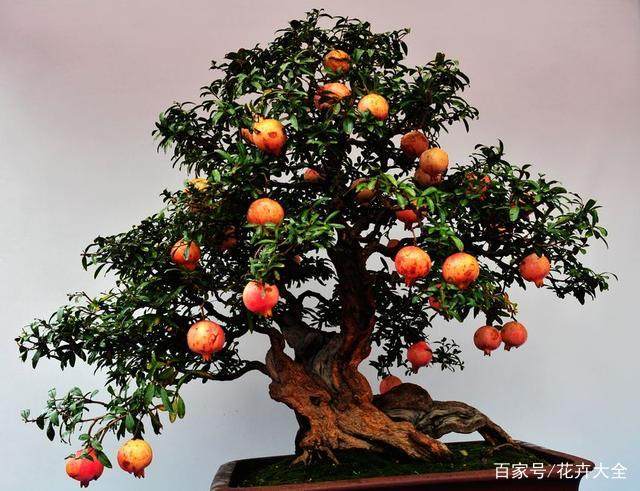
Pomegranate is a fruit that many people love to eat, and its growing conditions are obviously more demanding than those of a common fruit like the apple. If we want to know why it bears fruit the way it does, we should first understand its care techniques; only when it is growing well and healthily can it possibly bear more fruit.
We often say that pomegranate should not be eaten in excess, as eating too much can cause internal heat, which shows that pomegranate is a yang plant, so pomegranate bonsai is also yang. Like most yang plants, it loves sunlight. To let a pomegranate bonsai grow healthily, it must receive a certain amount of time in the sun each day, and we generally consider at least six hours to be acceptable. If we want the pomegranate to bloom and fruit more, it must be placed in the sunlight; if it often stays in a shady place, it will undoubtedly be unable to carry out certain processes, and the fruit it bears will certainly be very few.
Give the pomegranate bonsai water and fertilizer in appropriate amounts at the appropriate times. This can be said to be the foundation on which the pomegranate bonsai depends for survival. This is like a person who, without water and nutrients, cannot survive; by the same reasoning, a pomegranate bonsai is actually the same. For some beginners, we cannot grasp the amount of watering and fertilizing. Generally, we commonly view watering this way: it is enough to try to keep its potting soil moist. In spring and summer, with this kind of growth, fertilizing only once every half month can basically be considered up to standard.
Since the fruit borne by the pomegranate bonsai is meant for people to eat, when people come to pick it they will certainly glance at the fruit tree itself from time to time. So we must give it a perfect pruning, so that when others are picking, they can still be in the mood to admire our pomegranate bonsai.
Pruning is not a matter of doing exactly what I say in a blind way; in fact, it does not apply to every household's bonsai, so this requires us to rely on our own experience, combine it with its growth conditions, and make timely adjustments according to our own aesthetic needs. If it is pruned well, then it is a step up; but if, while passing by, you accidentally make a slip of the hand or cut crookedly, that will affect the beauty of the pomegranate bonsai. People who are especially prone to fiddling may, because of excessive pruning, cause an obstacle to the growth of the pomegranate bonsai. It seems we have no choice but to push ourselves to be clever and skillful. Some inexperienced beginners can learn from others' pruning experience to get it done.
If we can follow some of the above care techniques for pomegranate bonsai, I believe that on the basis of our pomegranate bonsai growing healthily, it will certainly bear more fruit.