High-Yield Cultivation Techniques for Ruby Seedless Grapes in Xishui County
High-Yield Cultivation Techniques for Ruby Seedless Grapes in Xishui County
Ruby Seedless is a late-maturing seedless variety bred in California, USA, from a cross between Emperor and Pirovan075. It belongs to the Vitis vinifera species and was introduced to China in 1987. Xishui County Jinteng Grape Manor began trial planting in 2014, and it performed outstandingly with good market returns, having become one of the leading varieties for autumn picking in the Xishui area.
Its introduction performance and high-yield cultivation techniques are summarized as follows.
1 Introduction Trial Overview
The introduction trial was arranged at Jinteng Grape Manor in Maqiaogang Village, Lanxi Town, Xishui County, located in the central part of eastern Hubei, at the southern foot of the Dabie Mountains, on the north bank of the Yangtze River. The site has flat terrain, good irrigation conditions, no industrial pollution, and convenient transportation. It has a typical subtropical continental monsoon climate, with cold winters and hot summers, four distinct seasons, abundant sunshine, and ample rainfall. The average annual precipitation is about 1,370.8 mm, with rainfall mostly concentrated in June to July, often causing severe flooding disasters. The average annual sunshine hours are 1,895.6 h, the average annual temperature is 16.9 °C, the extreme maximum temperature is 41.2 °C, the extreme minimum temperature is -12.5 °C, and the frost-free period is 230-258 d. The vineyard's grape planting area is 23.33 ha, the soil is fertile, the pH value is 5.3, and the soil contains 23.1 g/kg of organic matter, 119 mg/kg of alkaline hydrolyzable nitrogen, 7.8 mg/kg of available phosphorus, and 51 mg/kg of available potassium.
Jinteng Grape Manor began trial planting of Ruby Seedless in 2014, with a planting area of 3.47 ha. The vineyard uniformly adopted a rain-shelter cultivation model, with a shed height of 3.5 m, using galvanized steel pipes with a diameter of 50 cm, and the covering film was 0.07 mm white film; a T-shaped trellis was used, with concrete posts of 2.5 m x 8 cm x 8 cm specifications, spaced 6 m apart, buried 50 cm underground for fixation, 2 m above ground, and steel wires were used to pull and fix them to each other at 1.2, 1.5, and 1.8 m above ground respectively. The topmost steel wire was 8 mm in specification, and the other 2 layers were 4 mm in specification. The plant spacing was 2 m, the row spacing was 2.5 m, and the planting density was 1,650 plants/ha.
2 Introduction Performance
2.1 Phenological Performance
According to introduction observations, Ruby Seedless grapes in the Xishui area have a budbreak period of March 15, a flowering period of May 10, a first fruiting period of May 22, a maturity period of August 6, and an optimal harvest period of August 21. The maturity period coincides with the cool climate of late August to early September, making it an excellent leisure-picking grape variety [1-2].
2.2 Growth Trait Performance
Ruby Seedless grapes have vigorous growth, and are suitable for pergola or "Y"-shaped trellis training with medium and short cane pruning. This variety's trial performance shows beautiful clusters and excellent quality, but the berries are somewhat small; methods such as gibberellin treatment and girdling can be used to enlarge the berries. It matures relatively late and has somewhat poor disease resistance, especially susceptible to black pox and downy mildew, so early prevention and control should be noted in production. Its cluster rachis and berry pedicels are somewhat brittle, so care should be taken during harvest. Ruby Seedless grapes have bright, lustrous color, are crystal clear, and have good taste.
Ruby Seedless grapes have strong growth vigor and a high budbreak rate, with an average of 1.5 inflorescences per fruiting cane, and begin bearing fruit in the second year after planting, with good fruit set. Most clusters are borne on nodes 4-5. It has relatively strong adaptability, is not demanding regarding soil quality, fertilizer, and water, and the fruit has moderate storage and transport tolerance. It requires about 150 d from budbreak to maturity, making it a late-maturing seedless variety. Its young shoot is purplish-red with no fuzz; the young leaf is thick, yellow-green, glossy, and has no fuzz on either the upper or lower surface; the mature leaf is relatively thick, dark green, heart-shaped, with the leaf margin slightly upturned, forming a funnel shape, 5-lobed, with medium-deep upper and lower lateral sinuses [3]. The upper surface of the leaf is smooth with little fuzz, the leaf underside has no fuzz, the veins are yellow-green, the petiole is purplish-red, the petiolar sinus is closed and oval-shaped, and the leaf margin serrations are large and somewhat blunt. The internodes are relatively long, and the one-year-old mature cane is yellow-brown. Tendrils are alternately borne, bifurcated or trifurcated, and the flowers are bisexual.
2.3 Economic Trait Performance
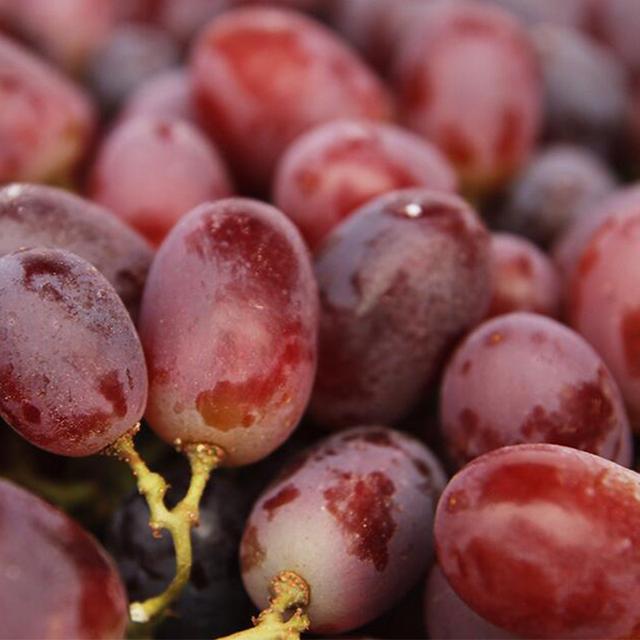
Ruby Seedless grape clusters are relatively large, generally weighing about 700 g, with the largest cluster at 1.2 kg, conical in shape, and compact. The berries are relatively small, oval-shaped, with an average berry weight of 4 g, and the berries are neat and fairly uniform in size. The skin is bright red-purple, relatively thin, and difficult to separate from the flesh; the fruit color is deep red and easy to color; the flesh is crisp, with a soluble solids content of 17%, an acid content of 0.6%, a sugar content of 20%, relatively firm, seedless, sweet and refreshing in taste, with good mouthfeel. It has a high fruit set rate, relatively little fruit cracking, and is relatively high-yielding, with an average yield of 22.5 t/ha.
3 High-Yield Cultivation Techniques
3.1 Training, Pruning, and Orchard Cleaning
Winter pruning is carried out from December 15 to the end of December, with medium cane pruning at 8 buds, leaving 4 fruiting mother canes per 1 m, maintaining 15,000 canes/ha and 120,000 buds/ha. After winter pruning, the orchard should be carefully cleaned, with all residual branches cleared out and taken outside the orchard for burning.
3.2 Removing and Covering the Shed Film
The film is covered in late February each year, and the top film is removed in mid-to-late October. After the grapes are sold, there is no need to use pesticides against downy mildew.
3.3 Fertilizer and Water Management
This variety has a relatively high fertilizer requirement, and fertilizer and water management need to be strengthened during the growth process.
First, base fertilizer. From late October to November, apply 15 t/ha of bio-organic fertilizer (or 15.0-22.5 t/ha of chicken manure) and 60 kg/ha of boron fertilizer, and deeply plow the entire orchard (20 cm), applying deeply into the soil. Second, budbreak fertilizer. Apply about 150 kg/ha of urea or compound fertilizer, 60 kg/ha of borax, and 375 kg/ha of magnesium sulfate, applied in shallow trenches opened beside the trees. Third, vine-strengthening fertilizer. At the seven-leaf stage (new shoots 30-40 cm long), apply fertilizer according to tree condition, using 75-150 kg/ha of urea, watered on. Fourth, fruit-swelling fertilizer. Apply twice in total; the first time about 18 d after flowering, apply 150 kg/ha of urea + 300 kg/ha of high-nitrogen, low-phosphorus, high-potassium compound fertilizer; the second time about 28 d after flowering (about 10 d after the first fruit-swelling fertilizer), apply 300 kg/ha of compound fertilizer + 225 kg/ha of potassium fertilizer, opened in trenches 50 cm to one side of the plant, then covered with soil and watered to ensure the fertilization effect. Fifth, coloring fertilizer. Applied at the hard-pit stage; since Ruby Seedless is a mid-to-late-maturing variety, the coloring fertilizer should be applied twice, the first time about 55 d after flowering, and the second time after an interval of 20 d, mainly with potassium fertilizer, using about 180 kg/ha of potassium sulfate each time, all applied through the orchard's drip irrigation system with integrated water and fertilizer. Sixth, post-harvest fertilizer. It can be applied immediately after the fruit is harvested, with the amount determined according to tree vigor [Jishan Huayao].
3.4 Flower and Fruit Management
After flowering, promptly tidy the inflorescences, thin the fruit, and cut off small and deformed berries to ensure about 80 berries per cluster.
3.5 Pest and Disease Control
The main grape diseases in the Xishui area include gray mold, anthracnose, rachis blight, black pox, and downy mildew, among others. In control, prevention should be given priority, field management should be strengthened, winter orchard cleaning should be done well, pruned dead branches and fallen leaves should be removed to reduce overwintering sites for pests and diseases, and during the growing season, shoot pinching should be done promptly to ensure ventilation and light penetration in the orchard and improve the orchard's microclimate. In mid-February, apply lime sulfur mixture comprehensively to spray the plants and the ground to kill overwintering pathogens and scale insects and mites. If scale insects (mealybug type) occurred the previous year, after fruit drop is finished, select 1,000-fold diluted dichlorvos or 800-fold diluted Yamanjing for control; if they have not occurred, no control is needed [5].
To control gray mold and rachis blight, before flowering spray the inflorescences 1-2 times with 1,000-fold diluted pyrimethanil (Shijiale) or similar; at the beginning of flowering, spray the inflorescences with 1,000-fold diluted Shijiale; on the 8th day after flowering, spray again with 1,000-fold diluted Shijiale. To control diseases such as fruit white rot, after flowering and fruit set, spray the canes, leaves, and fruit comprehensively once with 1,500-fold diluted copper quinoline (Bilv), then spray again after 15-20 d, for a total of 3 sprays, also controlling anthracnose. If powdery mildew occurs on the berries after fruit set, spray the clusters once with 1,500-fold diluted triadimefon (Fenxiuning); if no disease occurs, no control is needed. At the same time, after harvest, delay removing the top film until mid-to-late October.
The occurrence of insect pests varies greatly among orchards. For example, for green plant bug damage at the 2-4 cm new shoot stage, spray 1,000-fold diluted dichlorvos or 2,000-fold diluted Jianmie for control; for leafhopper, red spider mite, and mite damage from June to August, use acaricides, imidacloprid, or Yamanjing for control; for longhorn beetle damage from August to September, use a disposable syringe to inject 500-fold diluted dichlorvos into the insect holes to kill the longhorn beetle larvae inside the canes.