Detailed Explanation of Simplified Cultivation Techniques for Shenfu No. 6 Apple
Simplified Cultivation Techniques for Shenfu No. 6 Apple
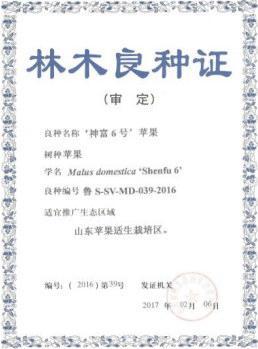
Yantai Modern Fruit Industry Development Co., Ltd. selected and bred Shenfu No. 6, an excellent late-maturing apple variety with double bud mutations (short-branch and red), from bud mutation varieties of the Fuji series. It has now passed examination and approval and obtained a certified superior variety certificate (Figure 1). This variety requires no branch bending, no bud notching, and no girdling; it flowers easily and is simple to manage, so it is also called "Lazy Fuji." It has a high sprouting rate, strong branching ability, is not prone to premature decline, and has excellent fruit quality, high yield, and strong disease resistance. It is a highly promising excellent variety in the Fuji series. With the supporting simplified training and pruning techniques and related measures, it is entirely possible to achieve: standard and dwarfing trees planted in one year, flowering in the same year, fruiting in two years, yielding in three years, and high yield in four years, with a yield of 2,560 kg per mu (Figures 2-4). The simplified cultivation techniques are described below.
Figure 1 Certified superior variety certificate for Shenfu No. 6 apple and its fruit
Figure 2 One-year-old tree with vigorous growth
Figure 3 Two-year-old tree with strong fruiting
Figure 4 Fruiting state of a three-year-old tree
1 Sapling Planting
1.1 Planting Method
In areas with poor soil and water shortages, standard (tall) cultivation is suitable, with a spacing of (1.5-2) m x 4 m. In areas with good soil, fertilizer, and water conditions, dwarfing and close planting is suitable, with a spacing of (1.2-1.5) m x 4 m. According to the determined spacing, first dig holes or trenches, mix bio-organic fertilizer (2-3 kg per tree) with soil outside the hole, then fill it into the hole. After placing the sapling into the planting trench or hole, spread out all the roots, then cover with soil up to the original soil mark on the sapling. Then water heavily 2-3 times to settle the sapling, and cover the tree disk with black plastic film to raise temperature and preserve moisture, improving the survival rate of planting.
1.2 Trunk Heading After Planting and Promoting Sprouting on the Central Leader
Head the trunk immediately after planting. For saplings over 1.5 m tall, head at a height of about 1.2 m; for saplings 1.2-1.5 m tall, head at a height of about 1.0 m. In principle, cut off the upper part that is not well developed with plump buds, and head at a plump bud. Immediately after heading, apply branching agent to the buds from the cut down to 60 cm above the ground.
2 Training, Pruning, and Flower and Fruit Management Techniques
2.1 First Year Training and Pruning Management
2.1.1 Spring Management. Train the first bud below the central leader cut as the central leader. When other new shoots grow to 15-20 cm, use a double-pointed toothpick to prop open the base angle to over 95 degrees.
2.1.2 Branch Stroking to Promote Sprouting and Flowering. When new shoots grow to over 30 cm, branches can be stroked manually, and stroked again after about 15 days, with the new shoot opening angle reaching 110 degrees. From mid-June to late July, spray the current year's new shoots with branching agent at 50 times concentration plus organosilicon at 2,000-3,000 times concentration to promote secondary shoots and form medium and short fruiting branches. Because it flowers easily, flower buds form in the same year of planting.
2.2 Second Year Training, Pruning, and Flower and Fruit Management
2.2.1 Early Spring Pruning. In February and March, if the tree height reaches 2.5 m, no longer cut the extension branch of the central leader. If less than 2.5 m, cut the extension branch of the central leader to promote its growth. Perform clean-head pruning on the extension branches of all branches to maintain single-axis extension.
2.2.2 Promoting Sprouting. In mid-March (around the Spring Equinox), apply branching agent to the one-year-old central leader to promote sprouting. Areas on the central leader where branching was unsatisfactory the previous year can also be re-applied at this time. When new shoots grow to 15-20 cm, use a toothpick to prop open the base angle to over 95 degrees. From mid-June to late July, continue spraying the current year's new shoots with branching agent to promote medium and short fruiting branches.
2.2.3 Appropriate Fruit Retention. To maintain vigor, do not retain fruit on weak trees; retain 2-4 fruits on the central leader of vigorous trees. For vigorous branches over 70 cm long, each branch can retain 3-4 hanging fruits, which can control vigor and weigh down branches to open the angle. Retain 10-15 fruits per tree [Jishan Huayao].
2.3 Third Year (and Beyond) Training, Pruning, and Flower and Fruit Management
2.3.1 Training and Pruning Management. Small branches are mainly left unpruned; excessively dense or thick large branches should be appropriately thinned out. After harvest, remove branches that interfere with operations or are thicker than 2 cm by cutting with leaves on.
2.3.2 Flower and Fruit Management. By the third year, there is already a certain yield. For excessively dense branches, competitive branches, and low-position branches, retain more flowers and more fruit (remove after harvest). For branches with development space, appropriately retain fewer fruits, synchronizing with flower bud cultivation. Do not retain flowers on the back, and do not retain fruit with irregular shape or damage.
3 Strengthening Soil, Fertilizer, and Water Management and Pest and Disease Control
Because of early fruiting and high yield, soil, fertilizer, and water management is very important. Apply organic fertilizer early and heavily. In autumn, apply base fertilizer mainly composed of organic-inorganic bio-fertilizer, trace element fertilizer, and microbial fertilizer to build soil fertility and strengthen tree vigor. Before July, apply water-soluble fertilizer mainly high in nitrogen and phosphorus and rich in trace elements such as zinc and iron. After July, apply high-potassium water-soluble fertilizer, combined with trace element fertilizers such as silicon, calcium, and magnesium.
Pest and disease control should focus on prevention, combining prevention with control. Young trees have fewer pests and diseases; apply pesticides promptly according to occurrence conditions, strive to keep leaves intact, and focus on controlling aphids and early defoliation disease. For fruiting trees, be sure to apply trunk and branch sprays well, and pay attention to pre-bloom and post-bloom sprays. After the flood season, focus on disease prevention to ensure high yield, quality, and high efficiency.