The US's status as the world's top soybean producer may be replaced by Brazil
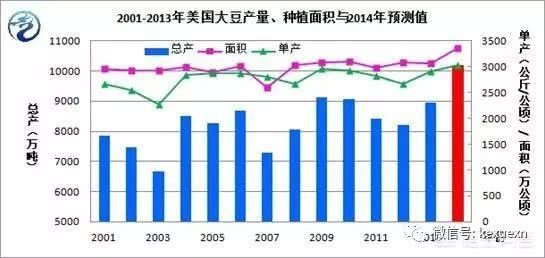
The US being the world's number one in soybean production is now a thing of the past. According to forecasts, the US, once the world's top soybean producer, is about to lose its crown, and Brazil's soybeans are expected to take the throne as the world's number one in production. According to the US Department of Agriculture's forecast, this year US soybean production is 113 million tons, while Brazil's soybean production has been revised upward to 119 million tons. Although the gap is not large, Brazil's soybean takeoff is self-evident.
Although US soybeans may soon fall behind, there is no doubt that US soybeans are still at the forefront of the world. The US soybean planting industry can be said to be full of legend, and the reason for saying so stems from its rapid development over nearly a century.
There was once a little story: American agricultural researchers found a few soybean plants outside a granary in the Northeast, so they took them back to the US, and after improvement they developed rapidly in the US. Whether the story is true or not can no longer be verified! But from it we can also see one point: the US soybean germplasm resources came from China.
A hundred years ago, China was once the world's largest soybean producer and exporter, while at that time US soybean production was almost zero. Now, a hundred years later, the American eagle has become a leading soybean producer among the world's top ranks and a trading nation second in the world in export volume.
From the history of US soybean development, the rise of soybeans should be attributed to the right timing, the right place and the right people!
The so-called right timing coincided with the trend of economic and trade globalization; the right place was that soybeans are suited to the US climate; and the right people lay in the US pulling together to drive the development of the soybean industry from the perspective of scientific research and technology.
The beginning of US soybeans can be traced back to 1765, when a sailor of the East India Company brought Chinese soybeans from China to London and then to the US state of Georgia, where soybeans first took root on the American continent.
In 1882, Dabney of the North Carolina Agricultural Experiment Station conducted a comprehensive nutritional assessment of soybeans, pointing out that soybeans contain no starch and are rich in oil and protein, with a unique composition. Because soybean seeds are hard and their composition is unique, at that time no American would have thought they could be used as food; they were merely used as feed for animals, and this situation continued until the 1920s.
The turning point came with Morse, known as the father of US soybeans, who devoted his life to soybean cultivation and the popularization of soy products. In the 1920s he traveled to East Asia for investigation, covering countries with more soybean cultivation such as China, Japan and South Korea. During his time in East Asia, he not only investigated the food-processing uses of soybeans but also collected 4,451 soybean germplasm resources. It can be said that the takeoff of the US soybean industry happened at this very moment!
By the 1930s, the US had already become an indispensable protagonist in world soybean trade. In 1931 US soybean production surpassed Japan for the first time, in 1934 it surpassed South Korea for the first time, and by 1941 US soybean production surpassed China's Northeast region (then Manchukuo), and in 1942 it surpassed the soybean production of all of China.
At the beginning of the 20th century, a Japanese company exported Chinese soybeans to Europe, and the export volume grew for two years. However, after the early 1940s, Northeast soybean exports fell sharply, largely because European soybean companies were dissatisfied with the quality of soybeans from China.
As you can see, it took US soybeans less than 20 years to surpass Chinese soybeans! Yet to this day many Chinese people still believe that the backwardness of China's soybean industry is due to China's large-scale imports of US soybeans. It is time for us to reflect on this: the difficulties of Chinese soybeans cannot be blamed on others developing too fast, but only on ourselves developing too slowly.
The outbreak of World War II made the demand for soybean oil urgent in various countries. In early 1942, the US Department of Agriculture issued a pamphlet to farmers titled: Soybean Oil and the War, Plant More Soybeans to Help Win the War! In just one year, US soybean planting area increased from 6 million acres to 10 million acres. To encourage people to plant more soybeans, the US government also provided a soybean support program, not only with purchase price subsidies but also offering to help farmers harvest soybeans, and formulated a series of plans to reduce the risks for farmers planting soybeans.
With the development of the biotechnology industry in recent years, agricultural seed companies led by the US company Monsanto have greatly promoted the rapid development of the soybean industry. Insect-resistant, disease-resistant and herbicide-resistant soybeans have appeared one after another, and some data indicate that 95% of US soybeans are biotechnology soybean varieties.
Today's US soybeans not only supply the country's own soybean demand but also solve shortages for other countries around the world, while also earning considerable foreign exchange for the US.
This is Science and Agriculture, welcome to add a follow and learn together with us.