Masson's pine is a rare and excellent material for making bonsai
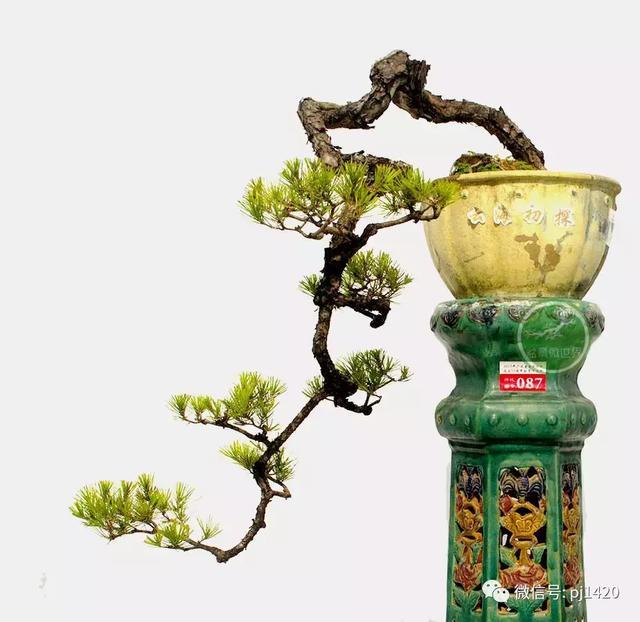
▲ "First Glimpse of the Sea of Clouds" Mountain pine, work by Su Guqiang
Mountain pine, also known as Masson's pine, due to shortcomings such as slow growth, difficulty surviving transplanting, overgrown branches, and low sprouting rate, is rarely used for bonsai, but in recent years through bonsai enthusiasts' continuous improvement, these have been gradually overcome, and the advantages of mountain pine bonsai material have gradually emerged, now becoming a rare and excellent material for Lingnan bonsai making.
▲ "Red Pine Branch Dance" Mountain pine, work by Li Huiquan
Mountain pine is evergreen all year round and does not shed leaves; once established it has a long lifespan, grows slowly and easily maintains its shape, and has strong adaptability. Except for the North and South Poles, it can grow anywhere, tolerating drought, waterlogging, heat, cold, and poor soil. All of these are advantages that other tree species cannot possess.
▲ "Azure Dragon Emerges from the Ravine" Mountain pine, work by Li Junhong
Key production points:
Collecting the stump: Carry out around the Beginning of Spring before the resin begins to flow, take it with a soil ball and protect the fibrous roots well; the soil ball must not crumble (this is the key to survival). Seal the root ends and wounds, remove two-fifths to one-half of the foliage, and maintain a balance between roots and foliage.
▲ "Layered Green Pine Charm" Mountain pine, work by Peng Yongxian
Planting: Use a wide, large soil pot; planting in a wooden box or directly in the ground is best. In the early stage, to prevent prolonged rainy weather, a circle of plastic film can be wrapped around the slightly raised mound of earth, just enough to cover the pot or the planting hole. Place in a wind-sheltered, warm, sunny spot.
▲ "Majestic Spirit of the South" Mountain pine, work by Huang Zhurong
Management: In the early stage, provide appropriate shade, spray water on the foliage frequently each day, maintain good ventilation, and let the potting soil alternate between dry and moist, slightly on the dry side. Once established, give full sun, which helps the mountain pine's branches and leaves grow faster and encourages many new roots.
▲ "Fortune and Prosperity Complete" Mountain pine, work by Chen Chang
Precautions:
Don't believe too much in the saying "dry pine, wet cypress"; during the growing season, as long as drainage is good and the soil is breathable, watering every day is fine.
Mountain pine is a full-sun plant, but it must not be exposed to blazing sun in summer. Insufficient sunlight will cause poor growth.
Regularly clean away old and dead needles, and maintain an appropriate amount of needles to facilitate ventilation and light.
Keep the maintenance position relatively fixed; do not move it frequently.
Pruning and grafting wounds must be sealed promptly to prevent resin bleeding.
Mountain pine is a shallow-rooted tree species and should not be planted deeply.
Mountain pine has relatively high soil requirements and must be treated with care.
When there are no branches or leaves on a mountain pine branch, it easily contracts its nodes and dies.
▲ Work by Huang Zeming
▲ "Vigorous Pine, Deep Green" Mountain pine, work by Han Xuenian
▲ Mountain pine, work by Li Shuzhou
▲ "Thirsty Steed Races to the Spring" Mountain pine, collection of Tan Guangyi
▲ "Huairong Shines Upon the World" Mountain pine, work by Chen Chang
▲ "Charm of Roots" Mountain pine, work by Han Xuenian
▲ Work by Zheng Yongtai
▲ "Heaven-Sent Pixiu" Mountain pine, work by Chen Mingquan
▲ Mountain pine
▲ Work by Xiao Zhuohua
▲ Work by Zhou Xixiang
▲ "Crouching Dragon Pine" Mountain pine, work by Peng Shengcai
▲ "Looking Back, Spreading Green" Mountain pine, work by Wu Weidong
▲ "Graceful Beauty Displayed" Mountain pine, work by He Zhuoguang
▲ "Layered Shadows of the Green Dragon" Mountain pine, work by Huang Haitao
▲ Mountain pine, work by Luo Hansheng