Key Technical Points for Intercropping Cultivation of Aralia elata (Japanese Angelica Tree) under Forest Canopy
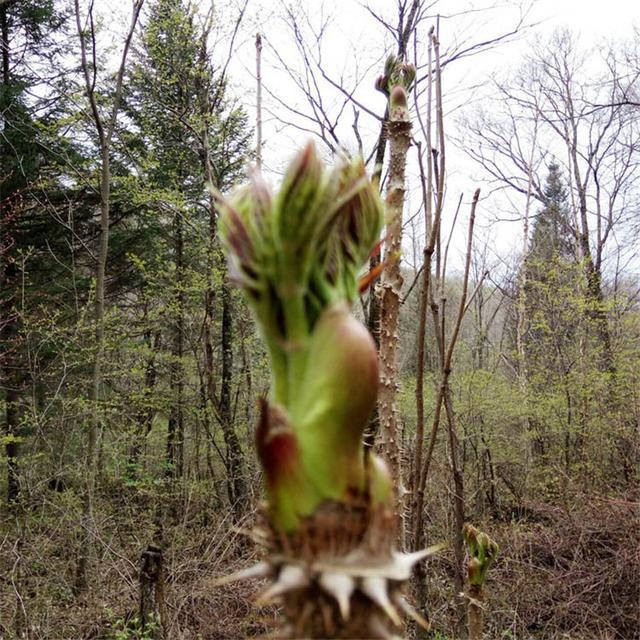
Cultivation Techniques for Intercropping Aralia elata under Forest Canopy
1 Planting Techniques
1.1 Site Selection for Planting
The planting site should preferably be sunny slopes, semi-sunny slopes, or semi-shaded slopes, with good drainage, slope ≤30°, located on the middle-lower part of the slope, and avoid sites at wind gaps.
1.1.1 Planting under canopy. Suitable for natural secondary forests after middle age, larch plantations (most suitable for deciduous trees in winter), with upper canopy closure ≤0.6. When light is insufficient, take measures such as tending or pruning the upper canopy trees (prune to the "vigorous branch") to adjust canopy closure.
1.1.2 Planting in forest gaps. At different stand ages, ensure there are gaps (forest windows) of more than 20 sq m in the forest for planting Aralia elata. When plant growth is negatively affected, pruning measures can be taken on the side trees [Ji Shan Hua Yao].
1.1.3 Planting at forest edges. At different stand ages, the plantable forest edge portion can extend from the forest edge to 10~20 m into the forest. When the growth of some trees within the forest is negatively affected, prune the trees above; timely remove shrubs at the forest edge that affect the growth of Aralia elata.
1.1.4 Intercropping (mixed planting). Intercropping can be implemented in newly planted forests of Korean pine, larch, etc. It is especially recommended to intercrop in Korean pine nut and timber dual-purpose forests established by grafting. The planting density of Korean pine can be designed as 5 m×5 m to extend the cultivation period of Aralia elata. Young forest tending adopts the full-cut method. The cultivation period lasts until the stand canopy closes and Aralia elata can no longer grow healthily [3].
1.2 Planting
1.2.1 Seedling selection. Select Grade I seedlings (seedling height >10 cm, ground diameter >0.6 cm) or Grade II seedlings (seedling height >8 cm, ground diameter >0.4 cm) for afforestation.
1.2.2 Planting time. Bare-root seedling planting time: mid-to-late April in spring, when soil thawing depth is ≥25 cm; October to November in autumn, after Aralia elata defoliation until before soil freezing. Container seedling planting time: spring or rainy season.
1.2.3 Seedling treatment. Before planting bare-root seedlings for afforestation, carry out technical treatments such as root trimming, mud dipping, and moisture-retention agent dipping. Water container seedlings thoroughly once 2 d before afforestation.
1.2.4 Planting method. Adopt the "three burials, two tampings, one seedling lift" afforestation method. When planting, the seedling stem should be vertical, the root system should be spread out, and the depth should be appropriate. After filling 1/2 of the soil, lift the seedling and tamp firmly, then fill soil again and tamp firmly, and finally cover with a layer of topsoil 1~2 cm thick. The planting hole size is 30 cm×30 cm×30 cm. The planting density under canopy is 1.8 m×0.6 m, avoiding the roots of upper canopy trees by more than 1 m when planting; the planting density in forest gaps is 1.0 m×0.6 m; the planting density at forest edges is 1.5 m×0.6 m or 1.5 m×1.0 m; for intercropping (mixed planting), plant in alternate rows between rows in newly planted forests, with a plant spacing of 0.6 m.
2 Tending and Management
2.1 Brush cutting and weeding
In the first year after afforestation, tend twice, in early June and late August respectively. Cut shrubs, weeds, and vines twining around the plants, with stubble height preferably ≤10 cm. In the second year, expand the planting hole once in spring and tend twice, at the same times as above. In the third year, tending shall be carried out in accordance with the "Forest Tending Regulations".
2.2 Pruning and trunk determination
2.2.1 Pruning time. After planting, let it grow freely. In December of the second year (2 months after autumn defoliation), prune the tree body.
2.2.2 Pruning method. Cut at 20~40 cm above the ground, retaining 4~6 buds. In the spring of the third year, after new buds sprout, retain 2~3 vigorous buds on the retained trunk and cut off or remove the remaining buds. After autumn defoliation of that year,
2 months later, cut at 20~40 cm from the branching point. In the fourth year, prune according to the above method until the plant dies or the upper canopy closes [5-6].
2.3 Renewal and rejuvenation
2.3.1 Renewal and rejuvenation method. Starting from the fourth year, retain 1~2 root sprout seedlings around the original plant. In the fifth year, repeat the cultivation of 1~2 plants. Generally, in the spring of the sixth year after harvest, cut down the old plant. The retention period may also be extended according to the specific condition of the old plant. Normally, each plant can retain 3 vigorous branches; when planting density is relatively high, retain 2 branches; when density is relatively low, retain 4 branches.
2.3.2 Root cutting and sprout removal. Retain new sprout plants that are thick and free from pests, diseases, and mechanical damage. In principle, they should be more than 30 cm away from the original plant. Root cutting can be done at 10~15 cm from the old plant. After root cutting, cut the other root sprout seedlings flat at ground level.
3 Commercial Bud Harvesting
3.1 Harvesting time
The first crop of Aralia elata buds is harvested from late April to mid-May, and the second crop of buds is harvested in late May.
3.2 Harvesting standards
When Aralia elata shoots grow 8~15 cm, individual buds have a fresh weight of 10~35 g, and the tender bud portion has not fully unfolded, and the prickles on the tender stem have not yet hardened, harvesting can be carried out.