By the latrine, a golden fruit: 20 years ago it rotted on the ground unwanted, now it sells for 12 yuan per jin, eaten for its skin, not its flesh
Friendly reminder
Hemu Report aims to share and popularize information about various plants and their uses, for reference only. If medicinal use is needed, it is advisable to consult a professional physician to avoid problems!
Every year after June arrives, for farmer friends in rural areas who grow crops and run orchards, it counts as a busy month. First there is Mangzhong, when they must hurry to harvest the previous season's crops, and then they must hurry to sow the next season's crops. For fruit growers, June is also the season when all kinds of fruit ripen, such as jackfruit, banana, lychee, sugar apple, dragon fruit, wampee, mangosteen, and so on, all of which ripen and come to market this month. And in June, not only do fruits ripen, but many wild fruits also ripen at this time of year. Below, the author will introduce a curious fruit to everyone, which many friends may like very much.
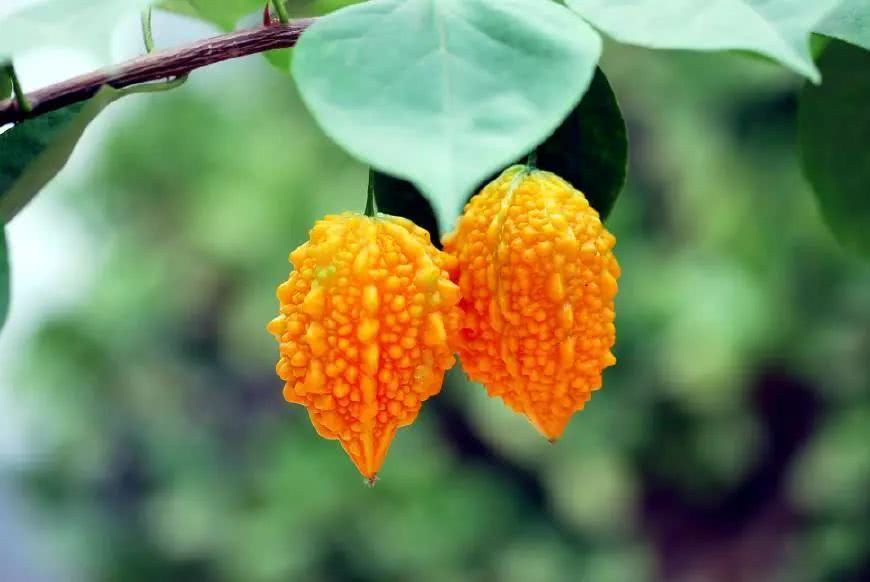
This wild fruit looks very strange, because at first glance one would think it is a bitter melon, but it differs from bitter melon in one way: bitter melon is green, while this wild fruit is golden. In the author's hometown area, this wild fruit is called "lai grape," or "golden lai melon," "golden melon."
The name lai grape is meant to correspond to water grape. At that time, ordinary grapes were called water grapes. They were also grown in rural areas, but not in large numbers, and they were relatively hard to tend, requiring pruning, topdressing, and so on, so in the eyes of farmer friends they counted as a precious fruit.
The lai grape, however, is different. Casually toss a few seeds into a corner, leave them alone, and the following summer you will find the vine already covered with clusters of fruit. First they are green, then gradually they turn yellow and become lai grapes. This lai grape seems to have come into the world bearing a "lai" nature, so it is often found together with morning glory and henna, belonging to the category of rustic flowers and fruits.
Moreover, the closer it is to places like latrines and pigsties, the better it grows and the more fruit it bears. Aside from children paying it some attention, many farmer friends pay it no mind. And compared with grapes, its appearance is much uglier, so farmer friends also leave it to rot on the ground with no one wanting it.
Actually, although the lai grape looks ugly, it is in fact a very good wild fruit, and moreover a wild fruit that can serve as both a vegetable and a fruit.
According to records, the scientific name of the lai grape is golden luffa (Momordica charantia var. abbreviata), and its nutritional value is very rich. It contains saponins, fat, crude fiber, vitamin C, calcium, phosphorus, iron, and 17 kinds of amino acids, among other nutrients. In particular, its amino acid content is very rich, reaching as high as 6.99 grams/100 grams.
What must be mentioned here is that its dietary fiber is also very rich, which can do a good job helping the human body digest food. In addition, it also has the effect of clearing heat and detoxifying, and is also very useful for dispelling liver fire in the body, so in summer it brings quite a few benefits to the body.
It is precisely because the lai grape has these values that it has gone from the former situation of rotting on the ground unwanted to becoming a fruit loved by many farmer friends and city friends today. In the morning, the author even saw an old farmer friend setting up a stall in town selling lai grapes. According to what the old farmer friend selling lai grapes said, nowadays this lai grape costs 12 yuan per jin. Compared with common fruits such as apples and bananas, it also counts as a rare item.
The author reminds: lai grapes must be ripe before they can be eaten. Once ripe, the skin of the lai grape is orange-yellow, the pulp is red, and the taste is sweet. However, inside the lai grape there is no fruit flesh, only pulp and seeds, so it is a fruit that is eaten only for its skin, not its flesh.
Dear friends, have you ever eaten "lai grape"? You are welcome to leave a message and share.
Text/Hemu Report, images/Internet
If you like Hemu's articles, you are welcome to follow.