The Metamorphosis of a Multi-Trunk Old Privet Stump: The Complete Process of Bonsai Creation
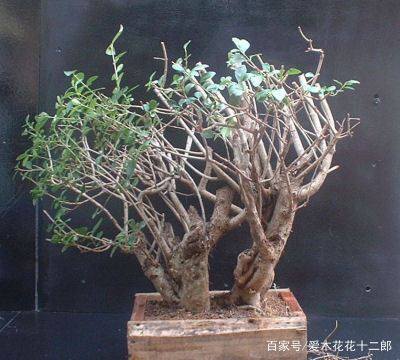
Lately I've been talking about this bonsai artist who makes privet bonsai. He digs up old privet stumps everywhere. I reckon he'll spend his whole life just playing with privets. One time it's from a friend's house, another time from a neighbor's. This one, like the one I mentioned before, was also dug up in August 2004 from the border between England and Wales.
Privet trees easily grow into this kind of single-base multi-trunk form. The part above ground isn't much to look at, but the old stump below ground is quite interesting. This tree is also a single-base multi-trunk one, and because it was buried a bit deep, you can't see the stump base underneath. Four or five trunks, with the primary branches all leaning to one side, giving a bit of a wind-swept feel.
Bonsai creation emphasizes following the shape and working with its nature. A good bonsai is seventy percent destined by heaven and thirty percent by human effort. A slightly lesser one is fifty-fifty, and an even poorer one is seventy percent artificial and thirty percent innate. Truly poor ones can only rely on artificial work. The bonsai artist planned to make this tree into a multi-trunk wind-swept style based on its innate conditions. In early 2005, he did the initial styling. He changed the pot, and it looked a bit more comfortable.
A year passed in the blink of an eye, and this wind-swept privet had begun to take shape, and he had done carving work on several of its trunks. One reason was to cover the saw cuts, and the other was to create tapered main trunks. Done this way, it had basically taken form.
Snowfall in March
Another year passed, and by March 2007, the bonsai artist felt the wind-swept style was too contrived and too unnatural, so he restyled it. He planned to make it into a multi-trunk large-tree style. So he bent all the branches that had once leaned to one side into new directions.
After a year and a half of care, this tree had transformed from a wind-swept style into a large-tree style. Still, I have to say the bonsai artist's decision was right. This way it really does look much more natural than the wind-swept style.
Side angle
Carving details on the trunk. This guy really has a knack for carving old privet trunks, making them incredibly true to life.
After nearly 5 years of cultivation, this privet large-tree-style bonsai finally took shape. At the end of 2008, after the leaves fell, the chicken-claw roots were revealed. Then he found another cracked pot. Although it was a tiny bit too big, the effect was still quite good, making it look very rustic.