When a newborn addax is born, will its horns tear through its mother's belly?
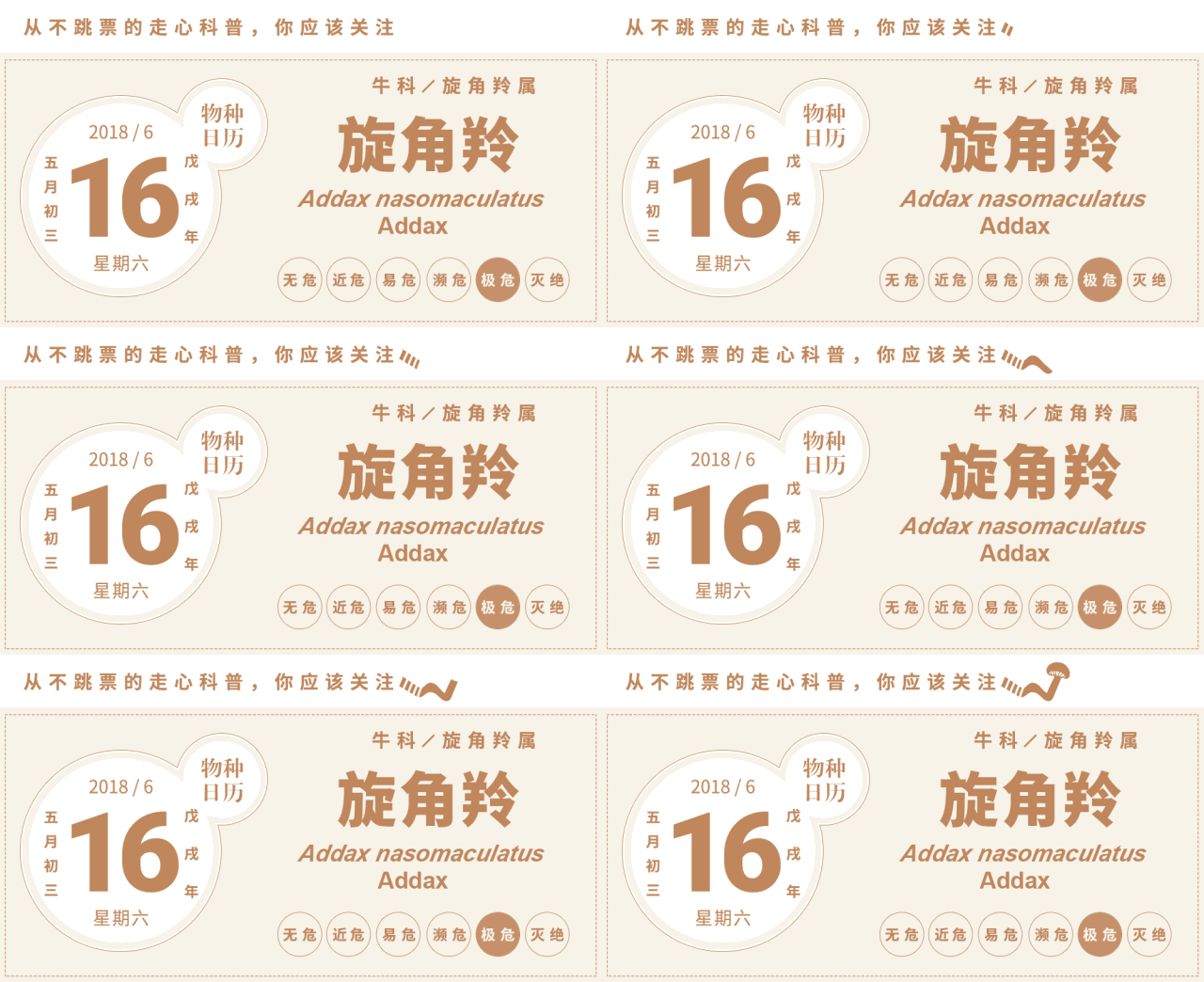
For today's calendar star, the addax (Addax nasomaculatus), most people will likely find it quite unfamiliar. Compared with the African antelopes that frequently appear on television, such as the sable antelope, Thomson's gazelle, and black wildebeest, the addax is undoubtedly somewhat obscure. This antelope, ordinary yet slightly unique, hovers at the edge of people's vision, leaving an impression without being well understood.
Do you remember this pair of long horns? Image: Haytem93 / Wikipedia
Unique long horns, yet an ordinary face
As mentioned earlier, the addax is ordinary yet slightly unique. Its uniqueness lies in its one-of-a-kind appearance among antelopes: truly spiral-shaped long horns. The addaxBoth sexes have spiral-shaped long horns, and the male's horns are slightly longer than the female's. The horns measure 55-85 cm in length, form 1.5-2.5 spirals, have a circular cross-section, and bear dense ridged rings on the surface,overall resembling a twisted piece of rebar。
The addax's horns bear dense ridged rings. Image: MathKnight & Dr. Zachi Evenor / Wikipedia
The addax has a body shape like a donkey, but is more stocky. Its coloration is also fairly easy to distinguish among antelopes: overall it is an extremely pale whitish color in summer, while in winter most of the coat turns grayish-brown, with only the limbs and rump retaining a lighter color. On the front of the wrist joint of the forelegs, there is a dark brown patch. The top of its head is dark brown,with an obvious white patch between the eyes, extending to in front of the eyes, forming an H shape when viewed from the front. This isthe most striking mark of the addax. Although the addax has many unique features that make it unmistakable, it is also hard to leave a deep impression.
Catastrophe began with humans
Africa is the habitat of the vast majority of antelope species, and the addax is no exception. In ancient times, the addax was once distributed in the Arabian region outside Africa, as well as across the vast areas of the Sahara Desert in North Africa. But today their range has shrunk dramatically, and wild addax are found only in a very small area of Niger and Chad.
As early asin ancient Egyptian paintings from 2500 BC, addax tied to posts with ropes appear, showing that humans were already trying to domesticate them at that time. However, with the collapse and decline of ancient Egypt, the addax ultimately never became livestock, but instead headed toward a more tragic fate. After 1800, addax populations declined sharply, not only disappearing from the Arabian Peninsula, but also completely vanishing from Egypt in the 1960s.
Human activity is undoubtedly one of the reasons for the sharp decline in addax numbers.Because the addax has a relatively fixed range, is easy to track and easy to capture, it has long been heavily hunted by humans, becoming a source of meat and leather for people.
A herd of addax. Image: Mike Hill / gettyimages.com
In addition, human activity has also severely damaged its habitat, which not only brought catastrophe to the addax, but also affected other animals sharing the same range, such as the Cuvier's gazelle, dorcas gazelle, scimitar-horned oryx, and Arabian oryx, and even affected lions and cheetahs in North Africa.
Hard to survive in the desert, but with clever tricks
As a typical desert animal,the addax has a series of features adapted to the harsh desert environment. Its pale body color blends with the surrounding environment, serving as good camouflage. In addition, the light color can reflect part of the intense sunlight, helping it maintain body temperature and avoid overheating in the exposed desert.
The addax'sfour hooves are relatively enlarged compared with other antelopes, and the larger contact surface makes it less likely to sink when walking on loose sand.
The addax's enlarged hooves. Image: Wikipedia
In the desert, water sources are extremely scarce, and the addax can onlyrely on the small amount of moisture in its food to sustain life activities. The plants it feeds on are quite diverse, ranging from low grasses to taller shrubs and various parts of trees, all on its menu. However, these desert plants also do not contain much moisture, so they must reduce water loss in the body as much as possible.
The addax'sstomach lining has pouch-like structures for storing water, which can help them get through long droughts. In order to better absorb moisture from food and reduce loss, their digestion time is longer than that of other antelopes, and their urine is also quite concentrated.
The addaxis usually active at night, especially in the scorching summer, during the daytime they dig pits in shaded places and hide in them to avoid being exposed to the sun.
An addax resting on the sand. Image: Cyril Ruoso / Biosphoto
The addax is a social animal and is consideredhighly socialized. They form small groups of 5-20 individuals roaming around in search of food, with the group led by the oldest female, while males are responsible for guarding and protecting the territory. They are able to migrate following rainfall, constantly seeking areas with richer vegetation.
The addax can breed year-round, but the breeding peak is at the turn of winter and spring, with 1 calf per litter,and the calf is born without horns. The addax reaches sexual maturity in only 2-3 years, by which time the individual already has perfectly spiraled horns. Captive addax can live up to 20 years, but wild individuals rarely live to 10 years.
A newborn calf has not yet grown horns. Image: Ingrid van den Berg / Animals Animals
A member of the Bovidae, with a moderate build
In 1816, the addax was named by Blainville. It was initially named Antilope nasomaculatus and placed in the genus Antilope. It was not until 1842 that Laurillard established the genus Addax and placedthe addax as the only member of the genus。
The addax's genus name comes from Arabic, referring to an animal with curved horns, which is probably the addax, while its specific name nasomaculatus comes from Latin nasus (nose) and maculatus (spotted), referring to the white patch across the bridge of the nose on its cheeks. As for its English name addax, the genus name was simply used directly.
The addaxbelongs to Bovidae, the largest family in the order Artiodactyla. The family contains more than 140 species, with significant differences in morphology, habits, and body size, ranging from the massive ton-scale giant Indian bison to the tiny royal antelope, which is as small as a rabbit.
An adult royal antelope weighs only 2.2 kg, making it the smallest antelope in the world. Image: Brent Huffman / UltimateUngulate
The addaxis medium-sized within Bovidae, with males standing 105-115 cm at the shoulder and weighing 100-125 kg, while females are smaller, standing 95-110 cm and weighing 60-90 kg.
The addax belongs to the subfamily Hippotraginae within Bovidae. Unlike the small antelopes of the subfamily Antilopinae,antelopes of the subfamily Hippotraginae do not have the ability to run fast, so they often seem powerless when dealing with larger predators. As a smaller species among them, the addax has even more natural enemies, with lions, leopards, hyenas, and other animals being its main predators. In addition, its young individuals also face threats from caracals and servals.
Spiral horns are rare, but not unique to it
The addax is named for its spiral horns, butit is not the only bovid with spiral horns. There are also the blackbuck (subfamily Antilopinae), the markhor (subfamily Caprinae), the greater kudu and the lesser kudu (subfamily Bovinae). Because of the similarity in their names, the two kudu species are often mistakenly called addax, but apart from both having spiral horns, kudus and addax have no other similarities. Even the similarly spiral horns of kudus differ: they do not have the clear ridged rings of the addax, but instead have obvious longitudinal ridges, and their cross-section is never circular. In addition, female kudus have no horns.
Although several bovid species have spiral horns, their relationships are quite distant, belonging to different subfamilies. This is also a very interesting phenomenon in Bovidae:species with similar morphology are not necessarily closely related, while those with greatly different appearances may instead be close relatives. For example, the muskox and takin, which look alike and have ox-like builds, both belong to the subfamily Caprinae but are very distantly related.
The muskox is named for its strangely scented urine. Click to learn about the muskox > Image: Wild Wonders of Europe / Munier / naturepl.com
It is precisely these "you within me and I within you" relationships among cattle, sheep, and antelopes that make the concepts of cattle, sheep, and antelope a muddled account. As for the question of exactly what kind of animal is called an antelope, one can only say that except for the single-species family Antilocapridae, Antilocapra americana,all bovids that are not called cattle or sheep are called antelopes。
Critically endangered, but fortunately being saved
As an animal that was once widespread in West Asia and North Africa, the addax's current situation can be described as precarious. Its formerly vast range has now shrunk to a few small dots on the map, with fewer than 500 individuals in the wild population, and it has been assessed as Critically Endangered (CR) by the IUCN.
Fortunately, the addax is very easy to keep and breed. There are as many as 1700 captive individuals, scattered among zoos around the world. In Morocco and Tunisia, there are also free-ranging addax. The countries where existing wild populations are distributed have also taken protective measures for them.The future of this species is still full of hope。
Captive-bred addax released into the wild. Image: Oliver Bern / Biosphoto
Calendar Girl's today's profile picture
Bovidae: Royal antelope