A roundup of fifteen perennial plants with a heat tolerance rating of four stars or above
A roundup of fifteen perennial plants with a heat tolerance rating of four stars or above
Muggy heat, high temperatures, torrential rain, drought, and frequent insect invasions make summer the most troublesome season for gardeners in the south.
But no matter how harsh the conditions, there are always some excellent plant babies that can grow healthily under pressure, and some that can bloom with flowers that move you.
Today, based on their performance during summer in Shanghai, I will count down those heat-defying perennial plants that bloom in summer.
First, let me stress a concept: perennial plants must above all be cold-hardy enough to survive winter, so those heat-tolerant plants that cannot survive winter are not within the scope of today's discussion.
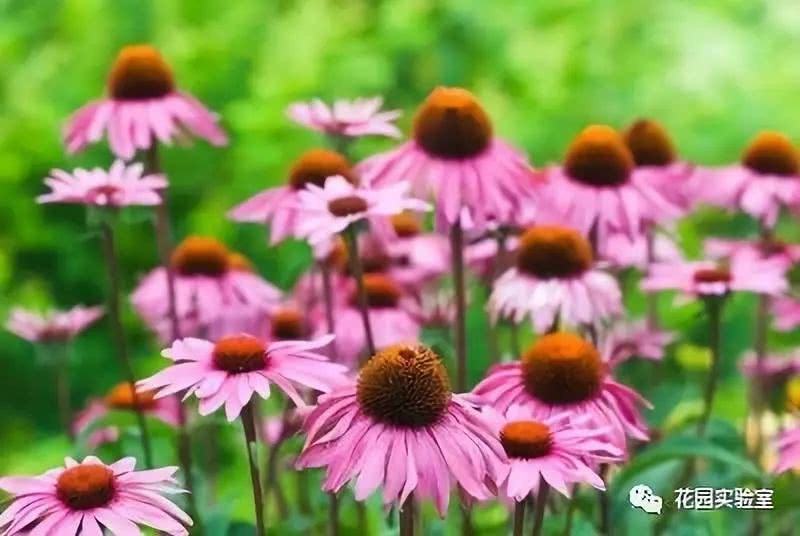
1. Purple coneflower (Echinacea). Heat tolerance rating: ☆★★★★
It starts blooming in late spring. Traditional varieties are pink and tall. In recent years, many dwarf potted varieties have appeared, with richer colors as well. It can keep blooming through summer; be careful to prune the spent flowers, because once it sets seed, flowering will decrease.
In my attempts, the double-flowered varieties seem to have weaker heat tolerance, though this may also be related to having been grown for only a short time.
2. Heat-tolerant salvias. Heat tolerance rating: ★★★★
This includes sky-blue sage (Salvia azurea), deep-blue sage, and cherry sage (Salvia greggii), among others.
They generally begin blooming in early summer. Sky-blue sage is slightly weaker in heat tolerance; after flowering, prune it back to about half its height, and it will bloom again in autumn.
Deep-blue sage keeps blooming, and the hotter it gets, the more it blooms. It is very robust. It has one drawback: although not as severe as mint, it also likes to spread.
Cherry sage has habits similar to sky-blue sage; it also blooms a little less in summer and blooms again in autumn.
3. Black-eyed Susan and black-eyed coneflower (Rudbeckia). Heat tolerance rating: ★★★★★
Traditional heat-tolerant varieties, very robust, capable of blooming without stopping. Sometimes the leaves get scorched by the sun; remove them promptly to prevent disease. Cut off the flowers promptly too.
In recent years, many varieties have appeared, including double-flowered ones and deep red ones. Cattail coneflower (Rudbeckia occidentalis) also belongs to this family.
4. Gaura (Gaura lindheimeri). Heat tolerance rating: ☆★★★★
A very graceful variety, it starts blooming in May. Cut it back after each flush of bloom, each time cutting about half of the stems. It blooms again about 2 months after pruning. Very robust and easy to grow.
5. China pink (Dianthus chinensis, 'Jintuan' type). Heat tolerance rating: ☆★★★★
There are many varieties of Dianthus. To choose a heat-tolerant one, be sure to look for the Jintuan type: the leaves are relatively broad, the plant is tall, and the flowers bloom into a ball. It is sometimes also called cut-flower Dianthus. The recent Perfect series is especially recommended.
Dianthus also gets cut back after blooming. As long as you cut it, the next flush will bloom, and it will bloom without fail even at 40 degrees.
The groundcover Dianthus used for landscaping, the fringed pink (Dianthus superbus), and some other low-growing Dianthus are not as heat-tolerant as the Jintuan type.
6. Wild bergamot (Monarda). Heat tolerance rating: ☆★★★★
A variety that thrives year after year in my garden, one of those good things where you sow once and benefit for a lifetime. The leaves are very fragrant, and even without blooming they can be brewed as tea. It has many flowers but only blooms for one season in early summer; whether you cut it back after blooming or not does not matter. In the north it can bloom for a long time. After flowering, the seed pods can be kept for autumn interest.
7. Balloon flower (Platycodon grandiflorus). Heat tolerance rating: ☆★★★★
The color is very cooling and full of Eastern beauty. Its carrot-like roots fear waterlogging, so the planting site should be kept dry. Although balloon flower is a perennial, its lifespan is not long; it will not grow into an old balloon flower like a thousand-year-old ginseng.
It needs to be resown and replaced every three or four years. In recent years there have been potted varieties, which are well worth buying.
8. Daylily (Hemerocallis). Heat tolerance rating: ☆★★★★
Many flowers, many varieties, and the leaves are a bit messy, so it suits a large plot of ground. Cut off the flower stalks after blooming. I rather like the traditional edible type. The flowers are slender, pale yellow, and delicate, and most importantly, they can also be eaten.
Daylily flowers are toxic, so before eating they must be blanched in boiling water. Remember this.
9. Fine-leaved verbena (Glandularia tenuisecta). Heat tolerance rating: ☆★★★★
There are many varieties of verbena, but only this one is especially heat-tolerant; the broad-leaved varieties with many flower colors are not heat-tolerant.
Another variety in the same genus, purpletop vervain (Verbena bonariensis), is tall and magnificent and can also bloom continuously. Plant a few beside ornamental grasses, and the effect is very hazy and soft.
10. Hollyhock and mallow. Heat tolerance rating: ☆★★★★
Actually, in the south hollyhock can only be called an early-summer bloomer, and its flowering period coincides with the plum rain, so double flowers easily fail to open. In the north, especially in the dry northwest, it can bloom continuously. In my garden, single-flowered forms perform better than double-flowered ones.
Mallow is easier to grow than hollyhock and will self-sow. It has a very wild style. A must-have for farmhouse-style gardens.
Both varieties are very easy to sow, sown in autumn and blooming in spring, very suitable for beginners.
11. Aster. Heat tolerance rating: ☆★★★★
Aster flowers are small and numerous, and they very easily bloom into a ball.
Most asters also bloom in two seasons, such as New York aster and Dutch aster: they bloom once in early summer, then are pruned immediately, and bloom again in early autumn.
If asters are not pruned, the flowering period is long and they keep blooming without fading. If left unattended, the autumn flowers will be much worse. So after watching them for a while, prune them before the plum rain.
12. Perennial phlox (Phlox paniculata). Heat tolerance rating: ☆★★★★
A must-have for northern gardens; in the south, performance depends on the planting position and also on the variety.
Among the several varieties in my garden, 'Miss Pepper' performed better than the popular 'Miss Holland', and the traditional large purple-red one performed better than 'Miss Pepper'.
As the saying goes, the uglier the flower color, the more robust the plant.
13. Dahlia. Heat tolerance rating: ☆★★★★
Large flowers and brilliant colors. Although its main flowering period is in spring and autumn, it also performs very well in summer. Prune after flowering, and it will keep producing new flower heads. It likes dryness and dislikes dampness, otherwise it easily gets powdery mildew. Occasionally it also attracts pests such as aphids, but compared with its dazzlingly gorgeous big face, these are nothing.
In the Shanghai area, plant the tubers a bit deeper, and in winter you do not need to lift the tubers; they can overwinter in the open ground.
When planting, pay attention to three things: prevent waterlogging, prevent pests, and prevent neighbors.
14. Wild-grass types. Heat tolerance rating: ☆★★★★
Although most wild grasses are not very heat-tolerant, the following few have no pressure getting through summer and can even manage to bloom a little in my garden.
Meadow rue (Thalictrum): no need to say anything about the flowers, everyone can refer to the various internet-famous beautiful photos. It also blooms in early summer and is unexpectedly heat-tolerant.
Salad burnet (Sanguisorba): the red ball-like flowers are rich in wild-flower charm and it is very robust.
Ladybell (Adenophora): quite heat-tolerant, with small bell-shaped flowers, though it tends to lodge a bit. Once I bought a jin of Adenophora for stewing old duck, and it bloomed a whole patch of blue bellflowers.
15. Perennial ornamental grasses. Heat tolerance rating: ★★★★★
Ornamental grasses are simply grasses. Perennial varieties include fountain grass (Pennisetum), silvergrass (Miscanthus), pampas grass (Cortaderia), and job's tears grass (Coix), among others.
Fountain grass blooms in midsummer, and job's tears grass flowers can last almost the whole summer. Pampas grass blooms in early autumn. All are masters of heat tolerance.
Note that ornamental grasses have very developed root systems. If there is prolonged drought, they may wilt from lack of water, especially in pots, so pay attention.
Finally, I wish everyone the choice of a correct heat-tolerant perennial, to get through a summer that is no longer just death, death, death.