This wild weed, commonly known as "sweat-repelling grass," can be rubbed under the armpits to get rid of body odor. Remember to dig it up and take it home when you see it.
Friendly reminder
Hemu Report aims to share and popularize information about various plants and their uses, for reference only. If medicinal use is needed, it is recommended to consult a professional physician to avoid problems!
In the old days in rural areas, living conditions were not as good as they are now. At that time, farmers in many areas did not have enough to eat or wear, and they could not afford to see a doctor when they got sick. So what did they do? Many old farmers who lived through those days would say, "Eat wild grasses and wild vegetables, and use wild grasses to treat illnesses." I remember that when I was a child living in the rural mountains, I often followed my parents and uncles to dig up all kinds of wild grasses in the mountains to eat and to treat illnesses, so I have always been especially fond of wild grasses.
However, as living standards in rural areas have improved, many people have gradually overlooked the uses of these wild grasses, so much so that many people cannot even name many of them.
Every year when spring arrives, all kinds of wild grasses grow in the rural outdoors, and by late spring and early summer, many wild grasses bloom one after another. At this time, many farmer friends, in their spare time, also take walks along the roadside to look at these flowers and grasses, but quite a few farmer friends no longer recognize them.
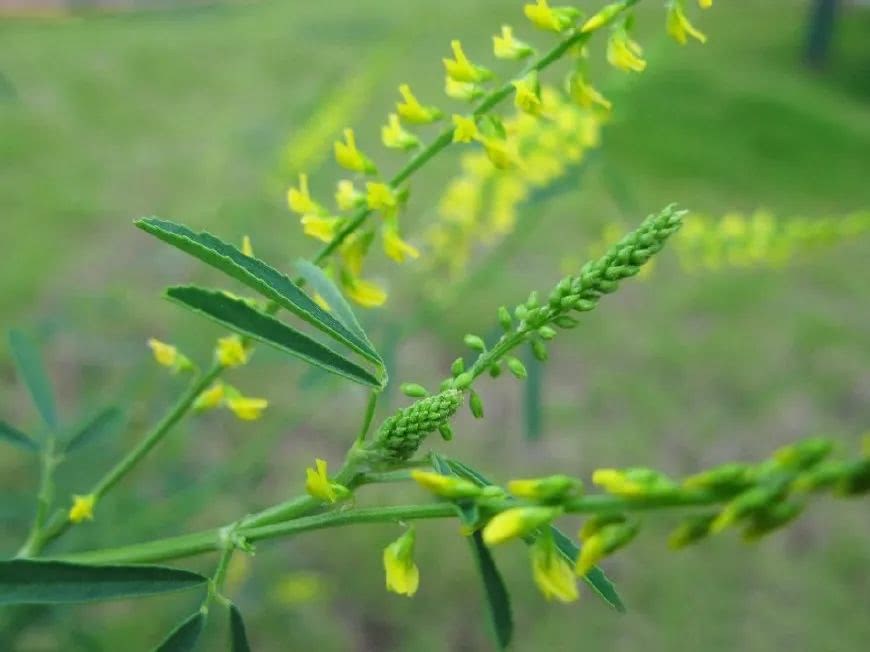
Along the roadside there is a small wild grass with yellow flowers; its flowers resemble rapeseed flowers, and when it blooms it gives off a strange fragrance. This wild grass is "sweat-repelling grass."
Speaking of sweat-repelling grass, many friends may not recognize it. It has different local names in different places, with as many as a dozen or more alternative names, including wild alfalfa, Pinchuan lespedeza, iron broom, blood-dispersing grass, head-refreshing grass, wild groundnut, cockscomb flower grass, chicken louse grass, yellow sweet clover, stinking alfalfa, detoxifying grass, fragrant horse fodder, and snake-retreat grass. Sweat-repelling grass is also a fairly common wild grass in rural China, found in rural areas of almost every province and city across the country, and can be seen everywhere in mountain gullies, by streams, or along roadsides.
It is precisely because this wild grass is so common that many farmer friends overlook its value. In fact, sweat-repelling grass has been a very good Chinese herbal medicine since ancient times. According to the "Chinese Materia Medica," the whole plant of sweat-repelling grass can be used as medicine. It is pungent and sweet in taste, cool in nature, and slightly toxic. It has the effects of clearing summer heat and resolving dampness, and strengthening the stomach and harmonizing the middle. It can be used to treat symptoms such as summer-dampness chest tightness, head distension and headache, dysentery, malaria, strangury, leukorrhea, mouth sores, bad breath, sores and ulcers, damp sores, scabies and tinea, and lymphatic tuberculosis. Therefore, in the past when rural living conditions were poor, many old farmer friends would use sweat-repelling grass to treat illnesses, so old farmer friends who lived through that era are also very fond of it.
Moreover, in summer, sweat-repelling grass has a rather special use: because of its strange fragrance, it can remove body odor. Simply grind up the flowers and leaves of freshly picked sweat-repelling grass and rub them under the armpits, and the underarm odor can be removed. Many friends surely like this use, so if you see sweat-repelling grass by the roadside in the countryside, remember to dig it up and take it home; you might just find a use for it.
Author's note: Because sweat-repelling grass is slightly toxic, I do not recommend taking it internally, but grinding it up and rubbing it under the armpits to remove body odor is still fine.
Dear friends, do you know "sweat-repelling grass"? Do you know any other uses of "sweat-repelling grass"? You are welcome to leave a message and share!
Text/Hemu Report, images/Internet
If you like Hemu's articles, you are welcome to follow.