Placing a potted plant in front of the computer can protect against radiation, and it also adds a touch of greenery before your eyes.
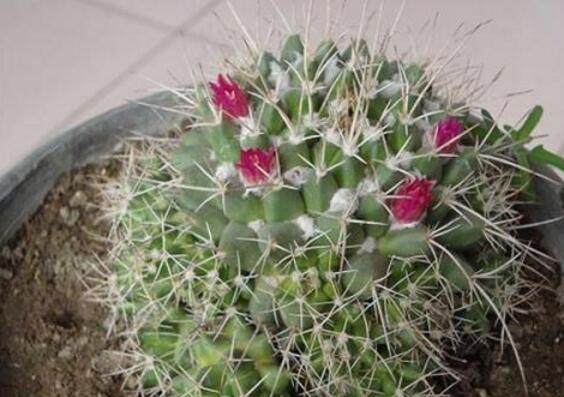
1. Mammillaria vetula (white dragon ball)
Mammillaria vetula belongs to the Cactaceae family and the genus Mammillaria. It is a succulent plant that grows in clusters. The stems are spherical to club-shaped and pale grayish-green, with white wool at the top of the ball; the tubercles are short and thick, with white wool and long white bristles in the axils; the areoles initially have white wool, which later falls off; there are mostly 4 spines, sometimes 5-7, with the lower spines curving outward and 2-7 cm long, while the other spines are shorter, initially red and later turning white or gray, with dark tips; the flowers are small, bell-shaped, borne at the top of the ball and arranged in a ring, 1-1.5 cm long, and pink. During cultivation, Mammillaria vetula produces small red flowers that contrast beautifully with the white wool at the top of the ball, making it very distinctive and commonly used as an indoor plant.
2. Echinocereus pulchellus (beautiful flower cactus)
Echinocereus pulchellus is a plant in the Cactaceae family and the genus Echinocereus. It blooms in spring and summer, with pink or rose-red flowers, and is cross-pollinated. This variety is fairly tolerant of full sun. During the growing season, water only after the soil has dried completely, and give mature plants as little water as possible, otherwise they tend to become leggy and grow very long. Propagation of Echinocereus pulchellus is mainly by sowing, and grafting is also used, but growth from seed is very slow, so you need to be patient.
3. Melocactus intortus (colorful cloud ball)
Melocactus intortus, also known as colorful cloud, is native to the West Indies in Central America. It prefers a warm, dry environment and plenty of sunlight. It is relatively cold-tolerant, drought-tolerant, and heat-tolerant. The best soil is fertile, loose, well-drained sandy loam. In winter, the temperature should not be lower than 5°C. It is native to South America and generally grows in hot, dry, and rain-scarce desert areas. The body of Melocactus intortus is spherical, and the stem can reach 30 cm thick, with a particularly well-developed cephalium at the top. Only 7-8-year-old plants can flower and set fruit. The rose-red fruit remains on the plant for a long time and is exceptionally beautiful. It is suitable for potted cultivation and for indoor display and viewing.
4. Mammillaria spinosissima (orangutan ball)
Mammillaria spinosissima belongs to the Cactaceae family and the genus Mammillaria. The plant is solitary and cylindrical, with wool and bristles in the axils of the tubercles. The flowers are light red to purple-red. It is relatively commonly cultivated and has extremely many varieties. Cactaceae, genus Mammillaria, plant solitary, cylindrical, 30 cm tall and 1O cm in diameter. The stem has no white milky sap. The axils of the tubercles have wool and bristles. There are 20-30 radial spines, often white, but also yellow, brown, or red; there are 7-15 central spines, needle-shaped, one of which is hooked. The flowers are light red to purple-red, 1.5 cm in diameter.