When moving into a new home, plant these potted varieties: they absorb formaldehyde and look beautiful too
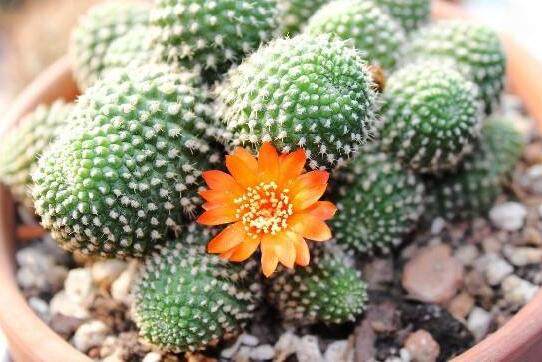
1. Mammillaria vetula subsp. gracilis
Mammillaria vetula subsp. gracilis is a short, flat, globe-shaped cactus; the base of the body readily produces offsets, often forming large clumping colonies. The body is green, with the base of the ribs made up of spirally arranged tubercles, and the tips of the tubercles are areoles bearing short, fine grayish-white spines. It bears many flowers, emerging from the middle and lower part of the stem, funnel-shaped, bright red. The flower language of Mammillaria vetula subsp. gracilis is: protection. Based on its name, on the market it can also be interpreted as family prosperity and many children and grandchildren.
2. Ferocactus emoryi
Ferocactus emoryi belongs to the Cactaceae family, genus Ferocactus. The plant is flat-round to spherical, later becoming cylindrical, with a gray-green body; the areoles bear white wool, and the flowers are orange-yellow, funnel-shaped. This variety is suitable for open-ground or potted ornamental display. Ferocactus emoryi has a large body with thick, sharp spines, imposing and sturdy, suitable for open-ground or potted ornamental display.
3. Kalanchoe marmorata
Kalanchoe marmorata is a succulent native to Mexico. It is a perennial herbaceous plant with much-branched stems, clump-forming, cylindrical, with short internodes, fleshy, bearing aerial roots. The leaves of seedlings are sapling-like; the leaves are thick, dusty ocher in color, covered with a white powdery bloom on the surface, with a slight purple tinge. Kalanchoe marmorata is mainly propagated by cuttings, carried out during the growing season; before cutting, let the cuttings dry for 1 to 2 days, and after planting prevent rain from hitting them and keep them slightly moist; they root very easily.
4. Echeveria pulidonis
Echeveria pulidonis is a summer-growing type of succulent. Echeveria pulidonis has both thick-leaved and thin-leaved forms. The leaves are spoon-shaped, with red edges at the tips, and the red edges are a gradient color going from light to deep. The whole plant forms a lotus-flower shape. Blooming season: spring. The flowers are bell-shaped, and the flower color is yellow. For leaf propagation, take a complete, plump leaf, place it in a cool, shaded spot for about 2 days, then place it on soil; the soil should not be too wet, just slightly moist, and it will slowly sprout.