Detailed Explanation of Research Progress on Introduction and Cultivation Techniques of Feijoa
Research Progress on Introduction and Cultivation Techniques of Feijoa
Fund project: Key Public Welfare Technology Research Project of Huzhou City, Zhejiang Province (2015C112027).
Feijoa is a perennial woody plant of the genus Feijoa in the Myrtaceae family, with alternative names including feijoa, feijoa, pineapple guava, pineapple guava, and Brazilian guava. Feijoa is an evergreen small tree, generally 2 to 3 m tall, native to Brazil and Uruguay. Its artificial cultivation first began in 1887 [Jishan Huayao], and it was successively introduced to Switzerland, France, the United States, Italy, New Zealand, and other countries. With large-scale introduction and cultivation, improved variety selection, and commercial cultivation production abroad, the fruit weight of feijoa has risen from less than 50 g in its place of origin to 260 g, appearing as an emerging fruit in foreign markets such as New Zealand and Australia. In recent years, some regions in China have also carried out introduction and cultivation of feijoa, but because domestic research and application of feijoa are still in the initial stage, seedlings are mainly obtained through imports, the market gap is extremely large, and seedlings are in short supply, thus limiting the promotion of feijoa in China. The author reviews the research progress on introduction and cultivation techniques of feijoa, in order to provide reference for the development and utilization of feijoa.
1 Current Status of Introduction and Cultivation of Feijoa in China and Prospects for Development and Utilization
At present, the main introduction areas of feijoa in China include Zhejiang Province, Jiangsu Province, Sichuan Province, Hunan Province, Tianjin Municipality, Shanghai Municipality, and others. The introduced feijoa varieties mainly
include Anatoki, Kakariki, Barton, Coolidge, Mammoth, Unique, Apollo, Gemini, Triumph, and others, covering early-, mid-, and late-maturing varieties. Feijoa has strong adaptability, prefers light, and is cold-tolerant, drought-tolerant, heat-tolerant, salt-alkali-tolerant, and waterlogging-tolerant, making it suitable for planting in South China and Southwest China.
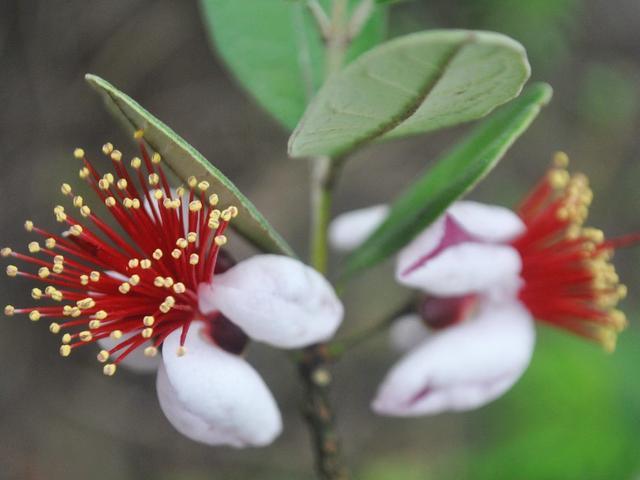
Feijoa is an evergreen tree in all four seasons. Its leaves can absorb dust and purify air, and the leaves are rich in phenolic substances, flavonoids, and VC, with strong antioxidant capacity, and can be used to develop natural antioxidants, anti-tumor drugs, anti-inflammatory drugs, and health products]; the branches are tolerant of pruning, and after pruning they emit a fresh scent, so they can be used for flower beds, hedges, courtyard landscaping, potted plants, landscape trees, etc., enriching the types of greening tree species; its flowers are brightly colored and fragrant, easily attracting insects such as bees, butterflies, and ants, facilitating pollination, and the flowers can be ornamental and are rich in anthocyanins, with multiple health functions, and can be eaten directly as well as developed into health products and medicines; the fruit is sweet and delicious, with a mixed aroma of pineapple and strawberry, often attracting birds and insects to feed, and the fruit is convenient to harvest. The iodine compound content in its fresh fruit is 1.65 to 3.90 mg/kg, the highest among all fruits, so it is called the "wisdom fruit." Fresh fruit contains VC 280 to 350 mg/kg, sugar 100 to 160 g/kg, organic acids 3 to 14 g/kg, protein 9 g/kg, fat 2 g/kg, potassium 1,660 mg/kg, sodium 50 mg/kg, calcium 40 mg/kg, magnesium 80 mg/kg, phosphorus 100 mg/kg, and iron 0.5 mg/kg. It has high nutritional value and can be used to develop fresh fruit, jam, canned goods, jelly, beverages, natural spices, food additives, and other products. It is an important economic tree species integrating greening, ornamental value, and edible use, with broad development prospects.
2 Propagation Techniques of Feijoa
The propagation methods of feijoa are divided into sexual propagation and asexual propagation. Sexual propagation is seed propagation, and asexual propagation is divided into tissue culture, cutting propagation, layering propagation, grafting propagation, and others.
2.1 Seed Propagation Seed propagation has low cost, a large propagation coefficient, and is simple and easy to carry out, and the resulting seedlings are robust, have well-developed root systems, and strong resistance. Studies by Gao Chao et al. found that storage time, seed soaking time, and the type and concentration of hormones have a certain effect on the germination rate of feijoa seeds. The seed germination rate decreases significantly with prolonged storage time. Soaking seeds for 36 h resulted in a relatively high germination rate of 86%. A 10 mg/L IAA solution and 150 mg/L GA3 can make seeds germinate earlier, accelerate germination speed, and increase the germination rate to a certain extent. Zhang Meng et al. also confirmed this, finding that after fruit harvest, if seeds are taken out immediately, rinsed in clean water for 24 h, seedlings can emerge in 11 d, with an emergence rate as high as 93%, and with prolonged storage time, the emergence rate decreases, and storing seeds in a 4 °C refrigerator is better than storing them in the fruit. The author's research found that after harvesting feijoa, if seeds are taken out immediately, washed clean, soaked in distilled water for 18 to 24 h, and grown at room temperature of 20 °C, seedlings can emerge in 10 d, reach the peak emergence period in 20 d, and the emergence rate can reach 95% in 30 d, without the need for hormone treatment to promote germination. When growing seedlings from seeds, a seedling tray needs to be prepared, and the tray should be sprayed and disinfected with 800-fold KMnO4.
The seedling substrate is evenly mixed with sand, fine soil, and peat soil at 1:1:1, sterilized by high temperature and high pressure, put into trays, watered thoroughly, and the treated seeds are evenly broadcast on the surface of the substrate, sprayed with an appropriate amount of 1,000-fold carbendazim solution, covered with film, and allowed to sprout in a greenhouse at 15 to 25 °C without direct sunlight. When the emergence rate reaches 50%, remove the film and move them under scattered light. When the seedlings are 3 cm tall and have grown 4 true leaves, they can be moved into plug trays or mesh bags to produce plug seedlings or mesh bag seedlings. Feijoa varies greatly, and seed propagation makes it difficult to maintain the excellent traits of the mother tree. To solve this problem, asexual propagation techniques have become a research hotspot.
2.2 Tissue Culture The leaves, stem segments, stem tips, seeds, stamens, pistils, flowers, etc. of feijoa can be used as tissue culture materials. Feijoa leaves and stem segment materials contain large amounts of polyphenolic substances, are very prone to browning, and have many endophytic bacteria. If disinfectants such as ethanol, mercuric chloride, and sodium hypochlorite are used for a slightly longer disinfection time, the materials are prone to browning; if the disinfection time is slightly shorter, the materials are very prone to contamination. This is a major technical difficulty in rapid tissue propagation. Zeng Yanling et al. used 1 to 2 lateral buds below the terminal bud as materials, rinsed them under running water for 30 min, rinsed them with distilled water 2 to 3 times, and then used ethanol and 0.1% mercuric chloride in a two-step disinfection method. The budding rate was 0, the contamination rate was 20% to 40%, the callus rate was 20% to 40%, and the browning rate was 20% to 80%. However, when using sterile seedling stem segments with buds cultivated from seeds as materials, the budding rate was 100%, with no contamination and no browning, and the optimal initiation medium combination was screened as MS + 6-BA 0.5 mg/L, the proliferation and strengthening medium combination as MS + 6-BA 0.2 mg/L + IBA 0.2 mg/L, and the rooting medium combination as 1/2 MS + IBA 0.5 mg/L. Deng Wentao [1] treated bud-bearing stem segments with 0.1% and 0.2% mercuric chloride for 6, 9, and 12 min respectively, and the contamination rate could be controlled at 6% to 22%, and the suitable medium combination screened was MS + 6-BA 2 mg/L + IBA 1.5 mg/L + NAA 0.2 mg/L. Using floral organs as explants to induce callus, the contamination rate was 0 to 6%, the browning rate was 0 to 9%, and the callus induction rate was 40% to 100%. The optimal medium for petal callus induction was screened as MS + 6-BA 0.5 mg/L + KT 1.0 mg/L + 2,4-D 1.0 mg/L; the optimal medium for ovary callus induction was MS + 6-BA 2.0 mg/L + KT 0.5 mg/L + 2,4-D 1.0 mg/L; the optimal medium for anther callus induction was MS + 6-BA 2.0 mg/L + KT 0.5 mg/L + 2,4-D 1.0 mg/L. When using feijoa seeds for somatic embryogenesis, the best method for seed sterilization was soaking in 1.0% NaClO for 12 h. Jiang Jianping et al. [21] first disinfected with 75% ethanol for 1 min, rinsed once with sterile water, then disinfected with 2% Jie'ermin for 15 min, rinsed once with sterile water, and finally disinfected with 5% NaClO plus several drops of Tween 80 for 13 min, and rinsed 4 times with sterile water. This method used for seed disinfection gave a contamination rate of 0, while used for stem segment disinfection the contamination rate was as high as 95% to 100%. The proliferation medium was MS + 6-BA 1.0 mg/L + IBA 0.1 mg/L, the proliferation coefficient was 2.15 to 3.50, and the rooting medium formula was 1/2 MS + IBA 0.5 mg/L. Liu Hongzhang et al. screened the best disinfection method for feijoa explants as moistening with 70% ethanol, disinfecting new shoots and stem segments with 0.1% mercuric chloride for 4 and 6 min respectively, and then inoculating them onto 1/2 MS + DTT 100 mg/L + VC 100 mg/L + streptomycin sulfate 100 mg/L + carbenicillin 250 mg/L, obtaining up to 95% normally growing explants. Wang Dan et al. found that the optimal media for callus induction from feijoa ovary, petals, calyx, and stamens were MS + 2,4-D 1.0 mg/L + KT 0.5 mg/L; MS + 2,4-D 1.0 mg/L + NAA 0.1 mg + KT 1.0 mg/L; MS + 2,4-D 1.0 mg/L + KT 1.0 mg/L; and MS + 2,4-D 2.0 mg/L + NAA 0.1 mg/L, respectively. Comparative experiments found that the above disinfection methods for stem segments and stem tips were all unsatisfactory. Terminal buds browned more easily than stem segments. Semi-lignified branches had a higher disinfection rate than fully lignified branches, but browned very easily, making it difficult to obtain materials free of browning and contamination that could sprout. Overall, using seeds as explants makes it relatively easy to obtain sterile seedlings. First soak the seeds in distilled water for 18 h, then disinfect with 75% ethanol for 30 s, rinse 5 times with sterile water, then treat with 0.1% mercuric chloride for 7 min, rinse 5 times with sterile water, and inoculate onto MS medium. Germination begins successively on the 12th day. The disinfection and anti-browning techniques for other explants still need further research, and the proliferation coefficient of sterile seedlings also needs to be further improved.
2.3 Cutting Propagation Feijoa is a tree species that is extremely difficult to root. In the cutting propagation process, a certain concentration of rooting agent is commonly used to promote rooting. Research reports show that the propagation method of the mother plant, the maturity of the cuttings, the type of rooting agent, the concentration of the rooting agent, treatment time, and cutting substrate all have a certain effect on the rooting rate of cuttings. Deng Wentao et al. used vermiculite as the substrate and semi-lignified softwood branches of feijoa as cuttings. Soaking in IBA 200 mg/L for 2 h gave the best rooting effect, with an average rooting rate of 88.60%, an average root number of 7.30, and an average root length of 17.40 cm. Zhang Meng et al. found that the rooting traits of semi-lignified cuttings from 2-year-old seedlings were significantly better than other treatments, with a rooting rate of 78.95%, an average root number of 6.67, and an average root length of 15.80 cm. Using perlite + leaf mold as the substrate and softwood feijoa cuttings soaked in IBA 1000 mg/L for 10 min gave the best rooting effect, with a rooting rate of 95.20%, an average root number of 4.40, and an average root length of 14.30 cm. Wang Chun et al. used vermiculite + reed residue + perlite as the substrate, adopted softwood cuttings, and after quick dipping in NAA 8 + ABT6 1,500 mg/L for 2 s, carried out cutting. Comparative experiments found that for feijoa cuttings, 2-year-old semi-lignified branches should be selected, with a cutting length of 5 to 10 cm, retaining at least 1 bud, trimming the upper part of the cutting into a flat cut and the lower part into a 45° slant cut, quickly dipping in 1,000 mg/L IBA or ABT solution for 10 s. The cutting containers are generally plug trays or mesh bags. Before cutting, disinfect the plug trays, mesh bags, and seedbed with 800-fold KMnO4. If conditions permit, the substrate can be sterilized by high temperature and high pressure; if conditions are limited, disinfect with KMnO4. Fill trays and bags with substrate, water thoroughly, first make holes in the substrate, then insert the treated cuttings into the holes, and gently compact the substrate so that the lower part of the cuttings fits closely with the substrate, then spray an appropriate amount of 1,000-fold carbendazim solution, cover with plastic film, water once every 10 d, and combine with disease prevention by spraying carbendazim, mancozeb, etc. An appropriate amount of foliar fertilizer may also be sprayed. After 60 d, well-rooted cutting seedlings are obtained. Plant them after 1 year, and they bear fruit after 2 years.
2.4 Other Propagation Methods Asexual propagation methods of feijoa also include grafting propagation, layering propagation, etc. There is very little domestic research on this aspect. Only Deng Wentao used two methods, cut grafting and bark-tearing grafting, for grafting. This method is suitable for the introduction and expansion propagation of new varieties. Comparison found that in mid-May, selecting healthy, pest-free, current-year semi-lignified branches with 4 to 6 buds as scions gave the highest survival rate, up to 34%. Layering propagation can be divided into low layering and air layering. Feijoa over 2 years old has a high degree of lignification and relatively hard branches, so low layering is prone to breaking the branches; therefore, air layering can be chosen, but there are also few reports on this at home and abroad. In 1890, the famous French botanist and horticulturist Edouard Andre introduced small seedlings from Brazil that were air-layered seedlings. Fachinello et al., through nearly 1 year of layering experiments, found that if branches are wounded 10 cm from the ground and covered with soil 2 months later, after cultivation, plants with well-developed root systems and good new shoot growth can be obtained. Mielke et al., by studying changes in multiple physiological indicators of layering, also confirmed the feasibility of layering propagation. Layering propagation can be carried out throughout the year, generally preferably in April to May. Select healthy, pest-free branches, gently girdle them 15 cm from the branch tip. To avoid phloem healing, the girdle can be 3 mm. Apply hormones to the wound to promote wound healing and rooting, then prepare plastic film 15 cm long and 10 cm wide, wrap it around the girdled area, tie the lower end tightly, fill the plastic film with substrate, and place the girdled area in the middle of the plastic film. After watering sufficiently, tie the upper end tightly and arrange it into a funnel shape for later watering. Layering treatment can also be carried out after the girdled area has healed. Although the air layering process is relatively cumbersome and the propagation cycle generally lasts as long as 5 to 6 months, compared with methods such as cutting and grafting, the survival probability is relatively high. If propagation can be expanded, it can also alleviate to a certain extent the current shortage of feijoa seedlings, so it is a feasible method.