Key Technical Points and Operation Methods for Top Grafting (Top Working) of Fruit Trees
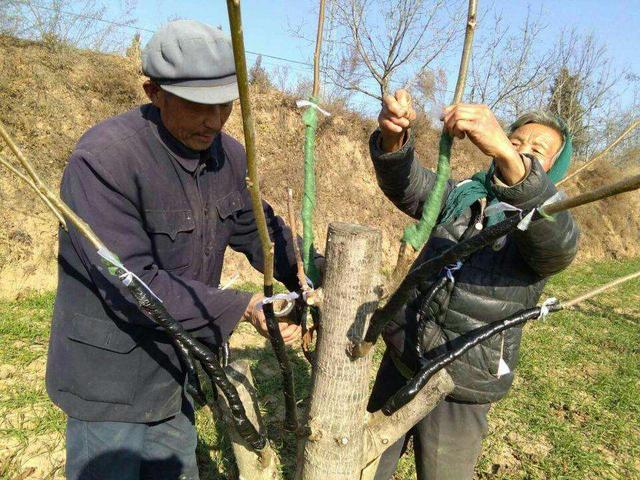
Top Grafting Technology for Fruit Trees
I. The Role of Top Grafting in Fruit Trees
1. Using rootstocks to improve resistance, such as using crabapple rootstock to improve the salt-alkali tolerance of apples, and using Beta rootstock to improve the cold resistance of grapes.
2. Replacing inferior varieties with superior ones, which can be applied on a large scale in production.
3. If the top-grafted variety is a pollinator variety, it can shorten the growth period relative to other varieties.
4. Reducing breeding procedures, allowing earlier observation and identification of new varieties.
5. It can be used for introduction and identification, allowing earlier fruiting.
II. Advantages of Top Grafting in Fruit Trees
1. The survival rate can reach as high as 90%-95%.
2. Fast tree formation and early fruiting; the tree can take shape 2 years after grafting and recover yield in 3 years.
3. Wide range of application; it can be applied to fruit trees such as apple, pear, peach, apricot, plum, grape, and Chinese chestnut.
4. Wide suitable range of tree age; trees 2 years old or older are all suitable, with 3-8 year old trees being the most suitable.
III. Key Technical Points of Top Grafting in Fruit Trees
1. Collection of scions. Scions can be collected from leaf fall to before bud break, and can be done in conjunction with pruning, collecting vigorous branches.
2. Top grafting method. (1) Determine the top grafting position; for 2-3 year old trees, graft at 10-20 cm near the branch axis. (2) Determine the number of top grafting points, based on tree age and the size of the original tree head, grafting as many as possible: 10-15 for 2-3 year old trees, 25-30 for 4-5 year old trees, and 40-50 for 6-7 year old trees. (3) In conjunction with shaping, adjust branch quantity, vigor, angle, and branch extension direction to make the tree structure more reasonable after top grafting. (4) Use scions about 10 cm long for top grafting, containing 3-4 bud segments, requiring the cut surfaces to be aligned. (5) After grafting, tie tightly with no air leakage to help improve the survival rate.
3. Factors affecting the survival rate of top grafting. Tree growth condition: young trees and vigorous trees survive easily; scion quality: scions collected from spring shoots and vigorous branches survive easily; scion-rootstock compatibility: for example, apples grafted onto crabapple and Malus baccata have high compatibility, and top grafting onto Ralls Janet apple has a higher survival rate than on other apple varieties; top grafting position: the survival rate is high on the back, back side, branch tip, and outer periphery; top grafting time: the best time for grafting is within 15 days after bud break; tools: pruning shears that are large and have smooth, sharp blades give good results; technical proficiency: a single successful cut gives good results.
4. Management of top-grafted trees. This includes removing sprouts, removing tying strips, tying support poles, pinching, promoting branching, bending branches to promote flowering, winter pruning, and strengthening fertilizer and water management, etc.