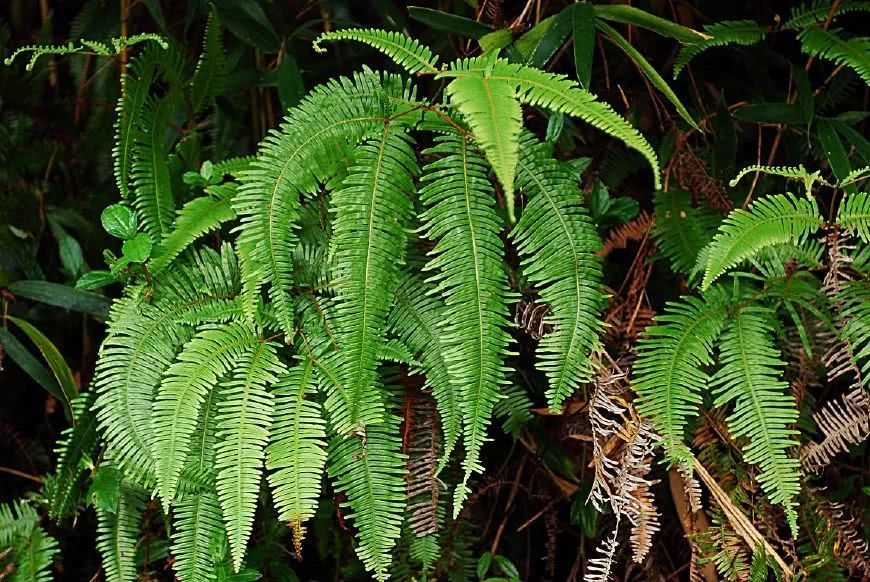
This wild grass in the mountains, known as the "gold-prospecting grass," is often mistaken for fiddlehead fern, and its roots can absorb gold.
Friendly reminder
Hemu Report aims to share and popularize information about various plants and their uses, for reference only. If medicinal use is needed, it is recommended to consult a professional physician to avoid problems!
The world is full of wonders, especially in rural wild areas, where there are all kinds of wild grasses and wild trees, and among these wild grasses and wild trees, there are quite a few peculiar ones. For example, the common Houttuynia cordata (fish mint) has beautiful flowers, but it gives off a strange fishy smell. Another example is the eucalyptus tree, which can absorb gold and store it in its leaves, making many people love and hate it at the same time.
Besides these wild grasses and trees, there are also many other peculiar plants in nature. Below, the author will introduce one kind of wild grass in the mountains that has a peculiar ability.
Farmer friends living in rural mountainous areas love most to go "treasure hunting" in the mountains, such as digging up some edible wild game and wild vegetables, or wild grasses that can cure diseases. However, there are also many wild grasses in the mountains that nobody pays attention to, and one kind of wild grass is like this. This wild grass is very common in the mountains and looks like the centipede fern. It is "Dicranopteris linearis" (iron fern).
Dicranopteris linearis is mainly distributed in the rural mountainous areas of the provinces and cities south of the Yangtze River in China. Basically, as soon as you enter the mountains, you can see this wild grass, especially in shady and damp places such as under trees and by streams, where it is most common.
In spring, when Dicranopteris linearis has just grown out, its young shoots actually look very much like fiddlehead fern and are often mistaken for fiddlehead fern. However, at this time you must be careful: the shoots that Dicranopteris linearis grows cannot be eaten, so do not mistake them.
When it comes to Dicranopteris linearis, in fact most farmer friends neither hate it nor like it. First, because it does no harm to crops or fruit trees; second, because it is too common and does not have much use, so farmer friends often ignore its existence, and thus nobody pays attention to it.
In fact, for many experienced old farmer friends, Dicranopteris linearis still has great uses. First, it can detect gold mines; second, it has medicinal value.
According to the introduction of experienced old farmer friends in the village, Dicranopteris linearis is also called "gold-prospecting grass." The reason it is called this is that the roots of Dicranopteris linearis can absorb gold from the soil, and places where Dicranopteris linearis grows extremely vigorously may hide gold mines. Therefore, among the people, Dicranopteris linearis is also called "gold-prospecting grass."
In addition, Dicranopteris linearis actually also has medicinal value. Its rhizomes and leaves can treat frostbite, and it can be collected and used throughout the year. Its branches and leaves have the effects of clearing heat and detoxifying, removing blood stasis and reducing swelling, and dispersing blood stasis and stopping bleeding. Among the people, it is also often used to treat hemorrhoids, uterine bleeding, epistaxis, high fever in children, traumatic injuries, carbuncles and swelling, rheumatic itching, venomous snake bites, scalds, burns, traumatic bleeding, and many other symptoms.
Therefore, in the rural mountainous areas of Hubei, Hunan, and Fujian, old farmer friends who are familiar with Dicranopteris linearis use it to make money. According to an old farmer friend in the author's village, Dicranopteris linearis generally sells for about 10 yuan per jin, and prices vary from place to place. He often goes into the mountains to dig some Dicranopteris linearis and sell it to supplement the household income.
Author's note: Although Dicranopteris linearis has certain value, the author still does not recommend picking it at will, to avoid damaging the ecological environment. What do you think?
Friends, do you know about "Dicranopteris linearis"? You are welcome to leave a message and exchange views!
Text/Hemu Report, images/Internet
If you like Hemu's articles, you are welcome to follow!