This tree in the mountains can't be smelled or touched, its sap doesn't rot for a thousand years, and selling it can make you a fortune
Friendly reminder
Hemu Report aims to share and popularize information about various plants and their uses, for reference only. If medicinal use is needed, it is recommended to consult a professional doctor to avoid problems!
As the saying goes: "Those who live by the mountain eat from the mountain, those who live by the water eat from the water." The delicacies and trees in the mountains, and the fish, shrimp and shellfish in the water, have brought farmers quite a bit of income. In the mountainous areas across northern and southern China, there is a tree with very high economic value, and what makes it special is that it is its sap that is valuable. Generally speaking, the most valuable part of a tree is its wood, but the wood of this tree is of little use; its sap, however, is a rare natural coating. On wooden items in ancient China, after being coated with the sap of this tree, they could remain unrotted for a thousand years.
But this tree has one major drawback: it very easily causes allergic reactions in people. Some people with allergic constitutions not only cannot touch it, but even a single sniff will make rashes break out all over their bodies. So what kind of tree is it exactly?
Farmers in mountainous areas should be familiar with this tree, especially many farmers in the mountainous areas of southern Fujian, who make a living by tapping its sap. This tree is called the lacquer tree (Toxicodendron vernicifluum), and its sap is commonly known as "daqi", also called "raw lacquer". It is a primitive paint coating, and after being applied to the surface of an object, it forms a lacquer film with very good water resistance, moisture resistance, corrosion resistance and durability.
The coffin and lacquerware of the Western Han Dynasty unearthed at Mawangdui in Hunan have a history of more than 2,000 years, and not only have they not rotted, but the colors of the lacquerware are still very bright and intact, fully demonstrating that raw lacquer can remain unrotted through a thousand years. It is precisely thanks to the quality of raw lacquer that China's lacquerware products are renowned worldwide and have become a traditional export commodity.
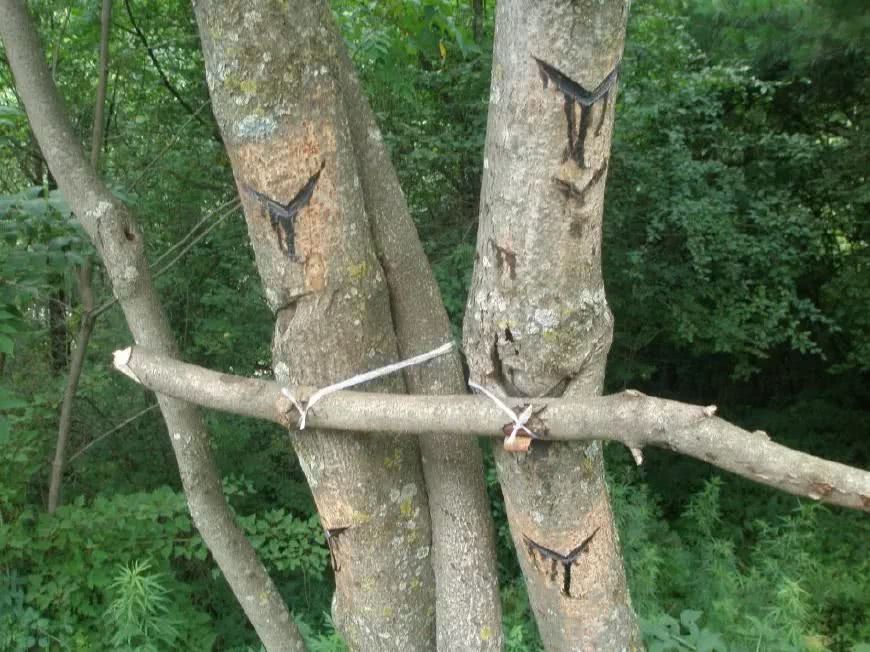
Every year from April to August is the season when the lacquer tree grows most vigorously, especially during the sanfu days, when there are more sunny days and fewer rainy days, which allows the water in the raw lacquer to evaporate quickly; at this time the raw lacquer produced by the lacquer tree is of the best quality. In the past, farmers tapped lacquer by using mussel shells to cut open the bark of the lacquer tree, then cutting it into the shape of a triangular arrow, and then inserting the mussel shell below the arrow to make it easier to collect the raw lacquer.
The raw lacquer that has just flowed out of the lacquer tree is milky white, and after oxidation by the air it gradually turns reddish brown, and finally turns black. "White as snow, red as blood, black as iron" describes the process of change of raw lacquer. The phrase people often use now, "pitch black", is also related to lacquer tapping in ancient times.
As a natural plant coating, raw lacquer has very high economic value. It is understood that the price of raw lacquer is about 180 yuan per jin, while raw lacquer produced in Enshi, Hubei, Chengkou, Chongqing, Bijie, Guizhou and other places is priced higher because of its superior quality, with the price per jin able to exceed 200 yuan. Therefore, many farmers go up the mountain to tap lacquer when they have free time, to supplement their household income.
However, raw lacquer does not come easily, and there is a folk saying that "a hundred li and a thousand cuts yield one jin of lacquer", so the work of tapping lacquer is still very hard. Some shrewd farmers contract mountain forests to plant lacquer trees, use more advanced tools to tap lacquer, and have made a fortune by selling the sap of the lacquer tree.
In rural areas, the elderly in the village will tell children not to touch the lacquer tree. The consequences of a lacquer tree allergy are no joke: most of the skin all over the body will become red, swollen and itchy, and blisters will form, both itchy and painful. Although it will eventually heal on its own, the process is extremely painful. So many rural people know that the lacquer tree cannot be smelled or touched. Readers and friends, have you ever seen a lacquer tree?
Text/Hemu Report, Images/Internet
If you like Hemu's articles, you are welcome to follow