How are combination-shaped plants made? Xiangmanlin has a clever trick
How "Xiangmanlin" masters combination-shaped plants
From 2001 to 2010, "ten years to sharpen one sword," was the founding period of the Xiangmanlin Nursery in Tianma Town, Dujiangyan City, Sichuan Province. We adopted three different methods for comparative experiments in combination-shaped plant cultivation: the "parallel trunk-to-trunk fitting style," the "crossed trunk mesh style," and the "twisted trunk braid style." As a result, four relatively ideal types of combination-shaped large plants were selected: flower hedge, flower pillar, flower vase, and flower ball, which were immediately put into mass production, achieving considerable economic benefits.
From 2011 to 2018, these eight years were the growth and development period of the Xiangmanlin Nursery. We promptly solved the following three major technical difficulties in combination-shaped plant cultivation, and the specific situations are introduced as follows.
(1) The issue of selecting tree species and varieties for combination-shaped plant cultivation.Combination-shaped plant cultivation requires relatively large investment and a long time. Based on the two principles of long survival life and high ornamental value, we selected osmanthus (Osmanthus fragrans) and crape myrtle (Lagerstroemia indica) and their representative varieties as the cultivation targets for combination-shaped plant cultivation.
1. Osmanthus (Osmanthus fragrans). Also known as muxi or jiulixiang, it is a plant of the genus Osmanthus in the family Oleaceae. Evergreen small tree or tall shrub, 3 m to 8 m tall. Osmanthus is native to China, and its lifespan can reach over a thousand years. In the Shengshui Temple in Hanzhong City, Shaanxi Province, there is still an ancient Chinese osmanthus tree 2200 years old. Osmanthus is an excellent garden tree species renowned through the ages, integrating greening, beautification, and fragrance, with both ornamental and practical value. The flowering period is generally concentrated from September to October each year. The flowers are small, in cymes, with flower colors of yellow, red, and white. When in bloom, the fragrance is rich and carries for several li. Osmanthus likes sunlight and a warm, humid climate, and is not tolerant of waterlogging; it likes fertile, loose soil and is not tolerant of saline-alkali. Osmanthus shaped plants are suitable for large-scale promotion and planting in the Yangtze River Basin. In particular, the autumn osmanthus varieties (commonly known as "bayue gui" by the public) are the first choice. The Xiangmanlin Nursery currently uses its own cultivated famous Jinguang variety 'Yanhong Gui', which has six major advantages: "early first flowering, good growth, bright flower color, large flower quantity, many branches, and strong flexible branches that are not easy to break." Its introduction and planting effect in the Yangtze River Basin is currently good.
2. Crape myrtle (Lagerstroemia indica). Also known as bairihong or mantanghong, it is a plant of the genus Lagerstroemia in the family Lythraceae. Deciduous small tree or tall shrub, 3 m to 6 m tall, smooth bark, branchlets slightly four-angled, terminal panicles, 6 cm to 12 cm long. Six petals, flower diameter 3 cm. The flower posture and form are extremely strange and unique. Flower colors include pink, bright red, purple, white, etc. The flowering period is from May to October each year. Flowers can be viewed in summer and autumn, and in winter and spring the smooth and lustrous bark can still attract visitors' attention. Crape myrtle is native to China and is naturally distributed in various places south of the Yellow River Basin. At present, many places still have century-old ancient trees. It likes sunlight and a warm, humid climate. The soil is preferably sandy loam rich in humus. It fears waterlogging, is relatively drought-tolerant, slightly salt-alkali tolerant, and its cold tolerance is stronger than that of osmanthus, but in Beijing it should still be planted in a wind-sheltered, sunny place to safely overwinter. Crape myrtle shaped plants are suitable for promotion and cultivation in most of China south of the Yellow River Basin, especially the red crape myrtle varieties, including domestic dahong and erhong crape myrtle and imported sanhong crape myrtle, all of which can be used as first-choice varieties.
(2) The issue of designing the size of combination-shaped plants.In the first ten years, the Xiangmanlin Nursery braided small shaped plants 1 m to 2 m tall. These are generally suitable for greening of work units and residential communities. After 2013, we began to develop a batch of medium and large shaped plants 3 m to 4 m tall. They can meet the shaped plant needs of most urban parks, green spaces, squares, and other places in our country. Of course, when the "mold" is larger, the specifications of the plants used must also be raised. Previously, when braiding small shaped plants, only small plants with trunk length of 2 m needed to be provided; now, when braiding medium and large shaped plants, high-quality small plants with trunk length of 3 m or more are required. Through watering, fertilizing, heeling in, and pruning techniques, we finally solved these difficulties.
(3) The issue of the types and product quantities of combination-shaped plants.The Xiangmanlin Nursery currently mainly produces three types of shaped plants: flower pillar, flower vase, and flower gourd. Among them, the largest quantity is the flower pillar, the middle quantity is the flower vase, and the smallest quantity is the flower gourd. This nursery produces a large number of 'Yanhong Gui' small plants. The best-quality small plants are used for flower gourd shaping, medium-quality ones are used for flower vase shaping, and slightly inferior ones are used for flower pillar shaping. The specific situations are introduced as follows.
1. Flower pillar shaped plants. The body of the flower pillar is equivalent to a long cylindrical column. When braiding this kind of column, workers do not need to expend a large amount of physical strength, and during the braiding process, the trunks of the small plants will not be seriously damaged. As long as the technical regulations are strictly followed, all labor is qualified, and careful management is carried out for five years, all the crossed mesh openings of the trunks on the column body heal completely into "interlocked branches," and all the underground root systems also connect and heal into "interlocked roots," becoming a large combination flower pillar plant. Because the trunks are less damaged, there are no dead plants, growth is fast, and quality is good, it is deeply welcomed by the public and has become a hot-selling commercial plant that "others do not have while we do."
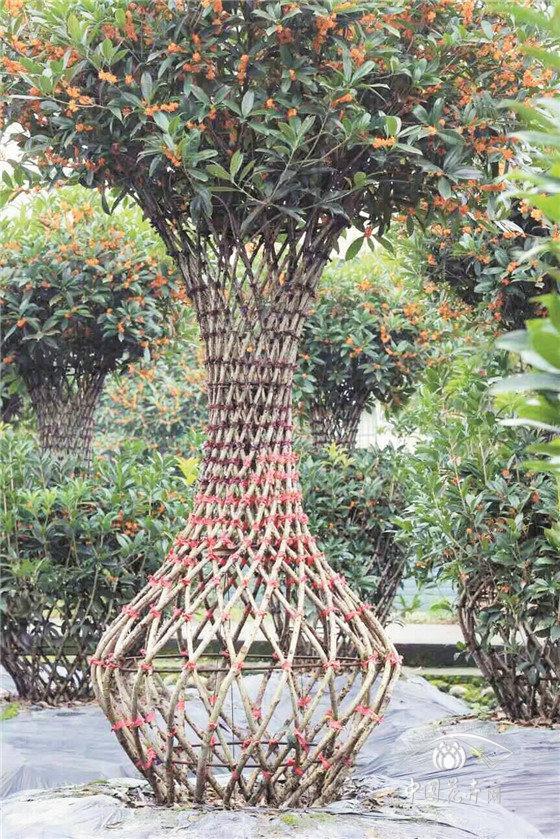
2. Flower vase shaped plants. The body of the flower vase is a vase-shaped object with left and right symmetry and very natural, smooth, and beautiful curved lines. The technical requirements for flower vases are extremely high, and there must be a leader with strong independent thinking and hands-on ability to personally preside over this work in order to see practical results. The nursery's person in charge, Zhang Lin, looked at many picture albums, wall calendars, and cultural relics. He carefully measured and recorded the dimensions of the four key parts of these vases (vase body, vase belly, vase neck, and vase mouth) from many precious photos and actual vase objects displayed in shops, and copied them after returning. He bends the trunks with skillful force, making the curves beautiful and natural without causing the trunks to break. After several years of careful management, the junctions of the small plant trunks completely heal into "interlocked branches." One after another graceful shaped flower vase with the homophonic meaning of wealth and peace is supplied to the market in a concentrated manner. The original "mold-shaped vases" on the market, with their stiff image and high prices, are no match at all. Combination-shaped flower vases achieve the demonstration effect of "where others have, we are refined."
3. Flower gourd shaped plants. The Xiangmanlin Nursery grows gourds itself, which are very good on-site teaching materials. Gourds are homophonic with fulu, symbolizing good fortune and auspiciousness, so we created a flower gourd shaped plant. The flower gourd has one more cylindrical object than the flower vase (the flower gourd has two, while the flower vase has only one); at the same time, the diameter of the gourd neck and gourd mouth must be thinner and smaller than the vase neck and vase mouth. Therefore, the shaping technique will be more complex and difficult, and a longer maintenance and management time is needed. At present, the nursery is only conducting small-scale trial production, mainly to create the publicity effect of "where others are refined, we are unique."
Ecological civilization construction is our country's basic national policy. Lucid waters and lush mountains are invaluable assets has become a broad consensus among Chinese people. We believe that in the upsurge of greening and afforestation, shaped plants are favored by all parties because they take little time, produce quick results, and have good quality. We will devote ourselves wholeheartedly to the battle, always using the three major innovative concepts of "where others do not have, we do," "where others have, we are refined," and "where others are refined, we are unique," to lead the country and bravely win the title of pioneer.
Osmanthus flower vase
Crape myrtle gourd
Crape myrtle flower pillar