The highest level of morbid beauty in bonsai requires life experience to appreciate
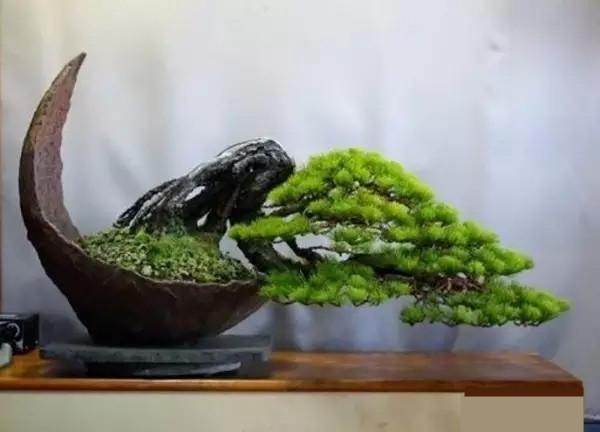
A senior once said: only when you have life experience, combined with your own journey through life, can you appreciate the morbid beauty at the highest level of bonsai.
Compared with the beauty of natural health, morbid beauty seems to lack some reasonableness: twisted branches, exaggerated deadwood, or sparse foliage. But it cannot be denied that this morbid beauty has been recognized by the world.
Aesthetics is the understanding and perception of the beauty of a thing or object through reason and emotion, the subjective and the objective. It is like how most young people love liveliness, gathering in crowds, full of youthful energy. After growing older and weathering storms, one longs for quiet, steady and calm.
Large tree-style boxwood
Large tree-style green gem
When I first got into bonsai, I liked the short, domineering large tree style with lush branches and leaves, and it would be even more perfect with flowers and fruit. As for pines and cypresses with deadwood and shari, no matter how the seniors interpreted them, I thought they were not good-looking. I was young then, with shallow knowledge, no gullies in my chest, no mountains and rivers in my eyes, only a pure heart. I thought trees should be lush and leafy, and rivers should flow slowly downward, clear enough to see the bottom.
It was also then that I started running a bonsai business. From knowing nothing about the industry at the beginning, to experiencing a blood-loss situation where almost an entire field of material was destroyed, to being cheated by "bare-stick stuck in soil" material bought from a shady tree dealer, to going through marriage and having children, the great joys and sorrows of a family member's passing, exclusion and competition from peers, the hardship of a broken capital chain, and friends and partners either supporting me or leaving. These joys, angers, confusions, bewilderments, helplessness and calmness wove together into the "tuition fees" I paid to the industry over these years.
I do not know when it happened, but I came to like the twists and turns of bonsai, the exposed and the hidden. I understood that so-called bonsai masters are not masters because of superior techniques, but because they are better at using skill to express insight in bonsai, stirring resonance in the viewer.
Shari trunk shimpaku juniper
The so-called "living toward death": in nature, enduring wind howls and lightning strikes, soil erosion and insect bites, still relying on a single water line to struggle and persist in survival, seeking vitality, propagating life, and even when pressed by rocks, still growing in bends. The dead white bone and the fresh green branches form one body, life and death depending on each other. Precisely because this is so rare and precious, people call it "shari." It is also very much like life: only by not avoiding death can one face challenges more bravely.
Another example is the "literati tree." It gives people a morbid impression full of sorrow, clear and sparse, withered and thin, incomplete, yet still proud. Literati trees are mostly meant to express the self. In China, since ancient times most literati and scholars have been lofty and aloof, walking alone. They cannot stand the complexity and chaos of the mundane world, and though they exhaust all their strength, they are unable to change it, instead leaving themselves covered in wounds. On second thought, better to cultivate oneself and just be oneself, and let everything else be.
There is another type that can be called the pinnacle of morbid beauty, namely Suran-style bonsai. Its founder was the abbot master of Haizhuang Temple, the monk Suran. Unlike the self-expression of literati bonsai, "the world does not understand me, so I become an immortal and leave," Suran-style bonsai focuses more on expressing people's understanding of the world. Monks in cultivation, accompanied all day by green lamps and ancient Buddhas, study Buddhist teachings, strip away the dusty and complicated to leave purity and leanness, leaning toward the withered and lonely aesthetics of Zen. In terms of form, Suran-style bonsai has dry branches and thin trunks, very few branches and leaves, and a large area of blank space. When appreciating it, one does not focus only on the tree itself, but on the imagery and insight formed by the tree's connection with its surrounding environment. People call it a "Zen tree." It has quite a feeling of "after great joy and great sorrow, ultimately returning to the withered stillness of calm, sorrowful but not wounding, everything light as wind and clouds."
Most people think they like healthy and complete beauty, yet they are often moved by morbid beauty. A professor on Lecture Room once said, "The highest realm of Chinese aesthetics is morbid beauty." On careful thought, it is indeed so. Compared with Xue Baochai's open-mindedness and liveliness, her handling of everything perfectly, Lin Daiyu's paleness and melancholy, so delicate that one cannot help but pity her, leaves a deeper impression. Or in film stories, a tragic ending can stir more insight and association in viewers than a perfect happy ending.
Welcome to follow Shuyuan Bonsai, and I also hope bonsai friends will exchange ideas more.