Survey of Wild Paris polyphylla Resources: Distribution and Current Status in the Bijie Region
Survey of Wild Paris polyphylla Resources in the Bijie Region
[Fund Project] Sub-project of the National Key Technology Support Program "Research on Conservation, Propagation, Quality Standards and Quality Control of Characteristic and Advantageous Chinese Medicinal Materials" (2015BAI05B03); Special Project for Research and Development of the Modernization of Traditional Chinese Medicine Science and Technology Industry in Guizhou Province "Research on Collection, Identification and Evaluation of Germplasm Resources of Paris polyphylla in Guizhou Province" [Qian Ke He Zhong Yao Zi (2013) 5042-1]; Bijie City Science and Technology Plan Project "Research on Quality Detection and Evaluation of Advantageous Chinese Medicinal Materials in Bijie City Based on Active Ingredients" [Bi Ke Cheng Zi (2014) 8]
Paris polyphylla is the collective name for plants of the genus Paris in the family Liliaceae, also known as Dengtaiqi, Wangsun, Zaoxiu, Qiye Yizhihua (Paris polyphylla var. chinensis), and others. There are 24 species worldwide, and 19 in China, including 10 varieties, mainly distributed in Sichuan, Guizhou and Yunnan provinces in China, with Yunnan having the greatest variety of species. Paris polyphylla is a commonly used Chinese medicinal material, with effects such as clearing heat and detoxifying, reducing swelling and relieving pain, cooling the liver and calming fright, as well as anti-cancer, hemostatic, anti-inflammatory, analgesic, antitussive and antiasthmatic, and immunomodulatory effects. At present, there are 65 types of Chinese patent medicines on the domestic market that use Paris polyphylla as a raw material, such as Gongxuening and Reduqing, consuming about 3,000 t of raw medicinal material annually. In recent years, although artificial cultivation has been carried out in some areas of Yunnan, Guizhou and Sichuan, the raw medicinal material still mainly relies on wild resources. Combined with the long growth cycle of Paris polyphylla and severe harvesting of wild resources, it is already facing a crisis of exhaustion.
Research on the resources of the genus Paris in Guizhou Province began in the 1980s. He Shunzhi discovered the distribution of Paris polyphylla in Datiankeng, Zhenning County, Guizhou Province in 1987; Zhou Hanhua et al. discovered the distribution of Paris polyphylla var. yunnanensis (red-fruited Wuzhilian) in Shuicheng, Guizhou Province in 1990; Li Huajun et al. discovered the distribution of Paris polyphylla var. brevipetala and Paris polyphylla var. yunnanensis in Baiyi, Guiyang City from 2007 to 2009; Tian Zhenhua et al. investigated the distribution of medicinal plants of the genus Paris in Guizhou Province and found that there are 9 species, 9 varieties and 1 form of medicinal plants of the genus Paris distributed in Guizhou, with Paris plants distributed in Weining County, Nayong County and Dafang County of Bijie City, mainly including Wuzhilian, Paris polyphylla var. ovalifolia, Qiye Yizhihua (Paris polyphylla var. chinensis), Paris polyphylla var. stenophylla and Paris polyphylla var. thibetica; Shen Yuxiang et al. investigated the resources of Paris polyphylla var. yunnanensis produced in Guizhou and concluded that the core distribution area of Paris polyphylla var. yunnanensis in Guizhou extends from Anshun westward through Qianxinan Prefecture to Qujing, Yunnan, and during its spread to surrounding areas it is gradually replaced by other plants of the same genus. The higher-altitude areas bordering the Wumeng Mountains to the north, such as Liupanshui and Bijie, are mainly replaced by species such as Paris polyphylla var. stenophylla, Paris fargesii and Paris mairei, and Bijie City also has a relatively large distribution. Up to now, research on the resources of the genus Paris in Guizhou Province has been relatively limited, and research on the distribution of the genus Paris in Bijie City has not been systematic enough. Due to the long growth period of Paris plants, which usually require more than 6 years before they can be used as medicine, and the increasing demand for Paris polyphylla medicinal material by pharmaceutical enterprises year by year, wild resources have been severely indiscriminately harvested and dug up. In order to effectively protect and rationally develop and utilize Paris resources, the author conducted a comprehensive survey of the distribution of Paris resources in the Bijie region, providing a scientific basis for evaluating the conditions for artificial cultivation and development prospects of Paris polyphylla in the Bijie region.
1 Survey Methods
The survey period was from March 2013 to August 2016, lasting 4 years, with a cumulative total of 14 participants. Through consulting relevant literature, interviewing heads of cooperatives related to Paris polyphylla cultivation and folk doctors, the townships in Dafang, Zhijin, Weining, Nayong and Qixingguan counties (districts) of Bijie City that might have distribution of the genus Paris were finally determined for investigation. The survey scope included 8 townships in Hezhang County, 12 townships in Dafang County, 10 townships in Zhijin County, 9 townships in Weining County, 7 townships in Nayong County and 8 townships in Qixingguan District. The survey time was mainly concentrated from February to September each year. For areas with relatively large distribution quantities, live plants were transplanted to a resource nursery for preservation, and specimens were made, habitat and whole-plant photographs were taken, while relevant information such as place of origin, latitude and longitude, altitude, community type, habitat, soil and associated plants was recorded.
2 Results and Analysis
2.1 Types of Resource Distribution
A total of 134 Paris plant samples were collected, and 6 species were identified: Qiye Yizhihua (Paris polyphylla var. chinensis), Paris polyphylla var. yunnanensis, Paris polyphylla var. stenophylla, Paris fargesii, Paris polyphylla var. thibetica and Paris mairei. Among the 134 plant samples, Qiye Yizhihua was the most numerous, with 66 samples, accounting for 49.25%; Paris polyphylla var. stenophylla had 32 samples, accounting for 23.88%; Paris polyphylla var. yunnanensis had 17 samples, accounting for 12.69%; Paris fargesii had 12 samples, accounting for 8.96%; Paris mairei had 5 samples, accounting for 3.73%; and Paris polyphylla var. thibetica had 2 samples, accounting for 1.49%.
2.2 Scope of Resource Distribution
The survey showed that all 54 townships surveyed had distribution of wild Paris resources. Among them, a total of 10 townships (towns) including Yemachuan Town in Hezhang County, Yangchang Town, Huangnitang, Liulong Town, Duijiang Town, Fengshan Township, Hetao Township, Shachang Township and Xingxiu Township in Dafang County, and Houzhai Township in Zhijin County had relatively more distribution points and resource quantities, while other townships had less or only sporadic distribution. Among the 6 species of the genus Paris, Qiye Yizhihua had the widest distribution, but the population density was generally low, with the number of individuals per population ranging from 1 to 3 plants, and there was no connection between populations, showing an isolated and scattered state; the distribution of the other Paris species was extremely scattered, with most having only 1 individual. The survey found that Paris polyphylla var. thibetica was only distributed in extremely small amounts in Yemachuan Town, Hezhang County; Paris fargesii was only distributed in extremely small amounts in Dafang County; Paris mairei was only distributed in extremely small amounts in Houzhai Township, Zhijin County; and few survey sites had several different Paris species distributed at the same time.
2.3 Vertical Distribution
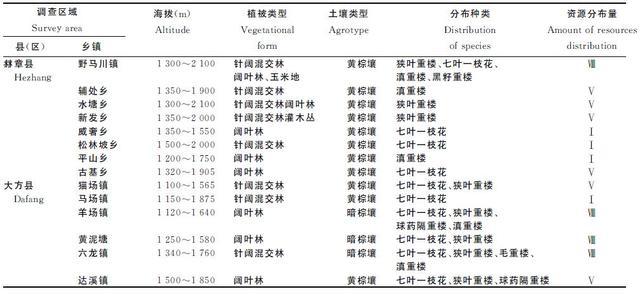
The altitude of Paris distribution in the Bijie region is 1,000-2,100 m, with relatively more distribution under broad-leaved forests and mixed coniferous-broadleaved forests at altitudes of 1,000-2,000 m (Table). Among them, Qiye Yizhihua is mainly distributed in broad-leaved forests at altitudes of 1,000-1,750 m, with very few in mixed coniferous-broadleaved forests; Paris polyphylla var. stenophylla is distributed in broad-leaved forests, mixed coniferous-broadleaved forests and shrublands; the vertical distribution of Paris fargesii is mainly concentrated in broad-leaved forests at around 1,500 m altitude; Paris polyphylla var. yunnanensis has a relatively large vertical distribution range, distributed from 1,200-2,100 m altitude, but with fewer individuals.
Table Distribution of Wild Paris Resources in the Bijie Region
Note: VIII, relatively abundant; V, relatively scarce; I, sporadic distribution.
2.4 Associated Plants
Paris polyphylla is a shade-loving plant, easily growing in moist, shady places, especially in places with high shade density under forests. It has many types of associated plants, mainly including Melia azedarach, Betula luminifera, Quercus fabri, Castanea seguinii, Toxicodendron vernicifluum, Populus adenopoda, Litsea pungens, Pinus yunnanensis, Rhus punjabensis var. sinica, Zanthoxylum simulans, Mahonia bealei, Pyracantha fortuneana, Gardenia jasminoides, Pueraria montana, Millettia dielsiana, Rhododendron, Lyonia ovalifolia var. elliptica, Aralia chinensis, Myrica rubra, Corylus heterophylla var. sutchuenensis, Betula luminifera, Houttuynia cordata, Epimedium, Codonopsis pilosula, Plantago asiatica, Viola, Anemone vitifolia, Duchesnea indica, Osbeckia octandra, Cyclosorus and Polygonatum sibiricum, etc. In the survey, most Paris plants were distributed in primary environments, and only a small number were found in corn fields, bamboo forests and small shrublands. Among them, Paris plants distributed in primary environments grew well due to relatively high canopy density under the forest, rich humus layer and sufficient water; while Paris plants distributed in secondary environments, due to direct sunlight, relatively thin humus layer and insufficient water, showed poor growth, shorter stems, yellowed and relatively smaller leaf edges, accompanied by root rot, damping-off and leaf blight, etc.
3 Conclusions and Discussion
All 54 townships surveyed had distribution of wild Paris plants, but most individuals within populations were within 8 plants, mainly distributed under broad-leaved forests and mixed coniferous-broadleaved forests at altitudes of 1,000-2,000 m, preferring to grow in shady and moist places under mixed forests, shrub forests and broad-leaved forests. The distributed species included 6 types: Qiye Yizhihua, Paris polyphylla var. yunnanensis, Paris polyphylla var. stenophylla, Paris fargesii, Paris polyphylla var. thibetica and Paris mairei. Among them, Qiye Yizhihua was the most numerous in the survey area, with a total of 66 samples collected.
The Bijie region has abundant resources of the genus Paris, among which Qiye Yizhihua and Paris polyphylla var. yunnanensis are the source plants of Paris polyphylla recorded in the Chinese Pharmacopoeia. It also has distribution of other Paris plants such as Paris polyphylla var. stenophylla, Paris fargesii, Paris polyphylla var. thibetica and Paris mairei, among which Paris polyphylla var. thibetica and Paris mairei are extremely rarely distributed. According to Li Heng's classification of the genus Paris, the 6 species of Paris found in this survey all belong to the subgenus Paris. Tian Zhenhua et al. recorded in their survey of the resources and distribution of medicinal plants of the genus Paris in Guizhou Province that Paris polyphylla var. thibetica is distributed in Dafang and Wuzhilian is distributed in Nayong, but this survey did not find Paris polyphylla var. thibetica in Dafang, and found the distribution of this variety in Hezhang; in Nayong, only Paris polyphylla var. yunnanensis and Paris polyphylla var. stenophylla were found, and Wuzhilian was not found.
The unique geographical and climatic environment of Bijie is relatively suitable for the growth of plants of the genus Paris. During this survey and visit, it was also found that some farmers and companies cultivate Qiye Yizhihua, Paris polyphylla var. yunnanensis and Paris polyphylla var. stenophylla. Most of the Paris plants cultivated by farmers are wild species dug from the mountains for centralized transplanting, mostly Qiye Yizhihua and Paris polyphylla var. stenophylla, while the Paris plants cultivated by companies are Paris polyphylla var. yunnanensis propagated from seeds purchased from Yunnan. In recent years, the price of Paris polyphylla in market circulation has been relatively high, with the general goods price already selling for more than 750 yuan/kg. Such prices have attracted a large number of farmers to go up the mountains to dig wild Paris polyphylla, causing a rapid decline in wild Paris polyphylla resources. During the survey in various counties (districts) of Bijie City, it was found that local farmers concentrated on going up the mountains from May to July to dig Paris polyphylla and sell it at markets. This practice will first cause great damage, even devastating damage, to the wild Paris plant resources of Bijie City; second, because the varieties of Paris polyphylla are not distinguished at the source, the Paris varieties purchased by medicinal merchants are mixed, which is not conducive to later sorting and processing of the medicinal material and may even lead to inconsistent medicinal efficacy. Therefore, it is recommended to effectively protect wild Paris polyphylla resources to prevent further damage; second, to guide existing Paris polyphylla cultivation professional cooperatives to unify varieties in accordance with the pharmacopoeia and improve cultivation techniques, so as to achieve large-scale, standardized and normalized production.