Detailed Explanation of Key Points of Paris bashanensis Propagation Techniques
Research on Propagation Techniques of Paris bashanensis
1 Materials and Methods
1.1 Overview of the Experimental Site
The experimental site is located in Huaping Village, Zengjia Town, Zhenping County, at an altitude of 1,300 m, 32°06′14.201″ N, 109°24′41.310″ E, with an annual average temperature of 15.1 °C, a frost-free period of 233 d, average precipitation of about 1,000 mm, humus soil, pH 6.5, uniform fertility, and a forest coverage rate of 83%. The area has a wide variety of Chinese medicinal herbs and enjoys the reputation of "Bashan Medicine Township," making it suitable for cultivating Paris bashanensis.
1.2 Experimental Materials
The rhizomes of Paris bashanensis used in the experiment were collected from wild varieties at an altitude above 1,500 m in Huaping Village, Zengjia Town.
1.3 Experimental Methods
1.3.1 Planting and management methods. Starting in December 2013, rhizomes of Paris bashanensis with uniform size were randomly selected for planting, with 3 replicates, and 200 rhizomes planted per replicate [8]. Row spacing and plant spacing were 20 cm × 20 cm, with dedicated personnel regularly loosening soil and weeding. Seven shading methods were designed for the growing period: shade net shading rates of 0%, 25%, 50%, and 75%; and understory planting with canopy densities of 0.2, 0.4, and 0.6.
1.3.2 Indicator calculation methods. Using DPSv 7.0 software, multiple comparisons of experimental data were conducted using Duncan's new multiple range method. The indicator calculation formulas are as follows:
Survival rate (%) = (number of rhizomes dug after 3 years / number of rhizomes before planting, 200) × 100 [8];
Rhizome weight gain multiple after 3 years of planting (times) = total rhizome weight after 3 years / total rhizome weight before planting [8].
2 Results and Analysis
2.1 Survival Rate of Paris bashanensis After 3 Years of Planting Under Different Shading Methods
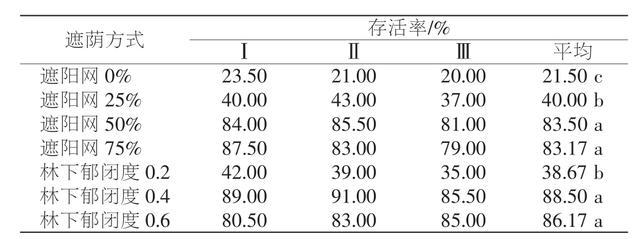
As shown in Table 1, after 3 years of planting, there was a large difference in the survival rate of Paris bashanensis under different shading methods. When using 0%-50% shade net shading, the survival rate increased significantly with increasing shading rate, but when exceeding 50%, the survival rate no longer increased. In understory trial planting, as canopy density increased, the survival rate also first increased and then tended to stabilize. The 0% shade net treatment was significantly different from other treatment groups (P<0.05). After Paris bashanensis emerges, if shading is too strong, the underground rhizomes are prone to rot or death from disease infection; if shading is too low, the aboveground parts are prone to drying up and dying. From the perspective of survival rate indicators, the shading methods of 50% shade net and understory canopy density 0.4 had better effects, and the difference was not significant (P>0.05). However, considering actual costs, the understory canopy density 0.4 shading method is suitable for planting promotion.
Table 1 Comparison of Survival Rate of Paris bashanensis After 3 Years of Planting Under Different Shading Methods
Note: Different letters after data in the same column indicate significant differences (P<0.05). The same below.
2.2 Rhizome Weight Gain of Paris bashanensis After 3 Years of Planting Under Different Shading Methods
As shown in Table 2, multiple comparisons of rhizome weight gain multiples of Paris bashanensis after 3 years of planting under different shading methods showed that under the understory canopy density 0.4 shading method, Paris bashanensis grew fastest, with a weight gain of 2.83 times, significantly different from other experimental groups (P<0.05). Understory planting at a suitable canopy density allows soil humus to decompose easily and provides fertile soil, without affecting photosynthesis of Paris bashanensis, resulting in obvious weight gain effects. The 0% shade net had the worst weight gain effect, only 1.47 times, significantly different from other groups (P<0.05),重楼是阴生植物,露天种植下,光照强烈影响重楼光合作用,土壤腐殖质低,重楼根茎增重低。
Table 2 Comparison of Rhizome Weight Gain of Paris bashanensis After 3 Years of Planting Under Different Shading Methods
2.3 Survival Rate and Rhizome Weight Gain of Cut Rhizomes of Paris bashanensis After 3 Years of Planting Under Understory Canopy Density 0.4
As shown in Tables 3 and 4, under the condition of understory canopy density 0.4, the survival rate of transversely cut rhizomes was significantly greater than that of longitudinally cut rhizomes (P<0.05)。横切根茎的平均增重显著大于纵切根茎(P<0.05)。重楼一般以种子和根茎进行繁殖为主,种子存在休眠现象,出苗率无保证。根茎整株繁殖出苗率低、周期长,而采用横切根茎繁殖,保存完整的顶芽,可以提高根茎出苗率。纵切根茎繁殖,易造成顶芽破坏,存活率、增重效果差。
Table 3 Comparison of Rhizome Survival Rate of Paris bashanensis After 3 Years of Planting Under Understory Canopy Density 0.4
3 Conclusions and Discussion
The experimental results show that transverse cutting of Paris bashanensis for asexual propagation increases yield and shortens the propagation cycle of Paris bashanensis. Transverse cutting propagation is best carried out in winter, when there is less rain and fewer pests and diseases, which is suitable for wound healing. The cut wounds should be treated with plant ash to prevent pathogen infection. Suitable shading plays an important role in increasing yield and growth of Paris bashanensis. If canopy density is too low, light intensity is strong, easily causing Paris bashanensis to wither and die. If canopy density is too high, light is weak, the photosynthesis of Paris bashanensis itself weakens, soil humus degradation also weakens, soil fertility decreases, and underground rhizomes grow slowly.
Table 4 Comparison of Rhizome Weight Gain of Paris bashanensis After 3 Years of Planting Under Understory Canopy Density 0.4
Considering factors such as economic cost, survival rate, and rhizome weight gain, for seedlings of about 10 g transplanted and grown for 3 years, the best shading method for Paris bashanensis is understory cultivation with canopy density 0.4, and transversely cut rhizomes are superior to longitudinally cut rhizomes for propagation. At present, some medicinal herb growers in original ecological or imitative ecological high-altitude areas of Zengjia Town, Zhenping County have begun to try planting transversely cut propagated Paris bashanensis. Paris bashanensis has shown good growth momentum, forming a pattern of forest-medicine integration, resource sharing, and complementary advantages, reflecting a saving-oriented, circular, and ecological understory economic development, and is worth promoting in the mountainous forest areas of Ankang [9]. The next step is to continue transverse cutting propagation of second-generation rhizomes, with the plan to ensure seedling emergence and loose, clean, and fertile soil while ensuring that seedlings grow robustly under the forest after transplanting.