Medicinal Plant Taxa and Resource Survey of the Paris sect. Axiparis (Paris genus) in Shaanxi
Medicinal Plant Taxa and Resource Survey of the Paris sect. Axiparis (Paris genus) Produced in Shaanxi
Fund projects: Public Health Special Project of Traditional Chinese Medicine (2011); Scientific Research Special Project of the Traditional Chinese Medicine Industry (201207002); 2012 Provincial Key Laboratory Scientific Research Project of the Shaanxi Provincial Department of Education (12JSO40); Shaanxi Provincial Social Development Science and Technology Tackling Project (2016SF-360); Scientific Research Project of the Shaanxi Provincial Administration of Traditional Chinese Medicine (13-ZY046); National College Student Innovation and Entrepreneurship Training Program (201610716030)
1 Equipment and Supplies
Handheld GPS locator, Nikon D7000 digital camera, Sony HDR-PJ760E video camera, specimen dryer, etc.
2 Methods
2.1 Literature Survey
Relevant county annals, professional monographs, research papers and other existing literature were consulted, and visits were made to the plant herbaria (rooms) of research institutes such as Northwest University, Northwest A&F University, Shaanxi Normal University, Xi'an Botanical Garden, and Shaanxi University of Chinese Medicine, to compile statistics on the original medicinal plant taxa and natural distribution areas of the Paris sect. Axiparis (Paris genus) in Shaanxi, providing basic data for field investigation.
2.2 Field Visits and Interviews
Local herb growers, folk healers and Chinese medicinal material purchasers were interviewed, and with reference to county forest type maps, agricultural zoning maps, traffic maps and topographic maps, the distribution overview of Paris medicinal plants within the survey route areas was grasped as fully as possible.
2.3 Field Survey
Based on the results of the above investigations, combined with the Fourth National Survey of Chinese Materia Medica Resources, from March 2013 to June 2017, this research group selected 6 representative counties, and in each county selected at least one main survey route longer than 30 km through natural distribution areas and surrounding accessible small areas. Field surveys were conducted over 21 rounds in suitable natural distribution environments of Paris medicinal plants under deciduous broad-leaved forests and mixed coniferous-broad-leaved forests at altitudes of 1050-2300 m, including: Jinyangou and Yinggecha in the Huayang management area of Luofu Town, and Puyu in Mengyuan Town, and Huangfuyu in Yuquan Subdistrict, Huayin City in the east; Zhaojin Town, Yaozhou District, Tongchuan City in the north; Dongcha Town to Tuoshi Town to Fenggeling Town, Xishan District, Baoji City in the west; Honghegu to Shangbansi, and Haopingsi to Dadian to Dianbingchang, Yingtou Town, Mei County on the north slope of the Qinling Mountains; Yingge Town to Taochuan Town to Tangkou Town to Huangbaiyuan Town, Taibai County, spanning the north and south slopes; and Bashan Town to Rencun Town to Sanyuan Town to Yongle Town to Dachi Town, Zhenba County on the south slope. Original plant photos were taken on site, information was recorded, qualified specimens were collected, and data were compiled and analyzed indoors, with herbarium specimens prepared. All specimens were jointly identified by members of the research group.
3 Results
3.1 Literature Survey
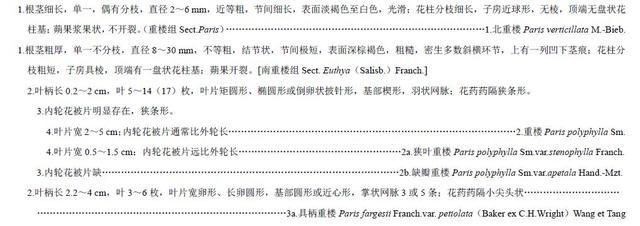
According to literature records, the Paris medicinal plants produced in Shaanxi include 3 species and 2 varieties (those with no typical variety but only varieties are counted as 1 species; the same below), among which the Paris sect. Axiparis has 2 species and 2 varieties. The taxonomic key is as follows.
3.2 Field Survey
In addition to the originally recorded Paris sect. Paris species Paris verticillata and the Paris sect. Axiparis species Paris polyphylla, Paris polyphylla var. stenophylla and Paris polyphylla var. fargesii, the Paris genus produced in Shaanxi also includes 5 varieties: Paris polyphylla var. latifolia, Paris polyphylla var. appendiculata, Paris polyphylla var. thibetica, Paris polyphylla var. chinensis and Paris polyphylla var. yunnanensis, all of which are new distribution records, totaling 2 species and 6 varieties. All rhizomes are used as the Chinese materia medica Chonglou (Paris rhizome). No specimens of Paris incompleta were collected.
3.2.1 Main Morphological Characteristics of Each Taxon in the Paris sect. Axiparis and Their Distribution in the Survey Area. The characteristics of Paris polyphylla, Paris polyphylla var. stenophylla and Paris polyphylla var. latifolia have already been described in the literature; here only the distribution status in the survey area and the main morphological features of other taxa are described. 2a. Paris polyphylla var. stenophylla (see Figure 1).
Figure 1 Paris polyphylla var. stenophylla. Notes: 1. Naturally growing original plant; 2. Flower characteristics; 3. Herbarium specimen
Produced in Mei County, Taibai County and Zhenba County, widely distributed on both the north and south slopes of the Qinling Mountains, mostly growing under shaded and moist broad-leaved forests at altitudes of 1200-1820 m.
2c. Paris polyphylla var. latifolia (see Figure 2)
Figure 2 Paris polyphylla var. latifolia. Notes: 1. Naturally growing original plant; 2. Flower characteristics; 3. Herbarium specimen
Produced in Huayin City, Yaozhou District, Huanglong and Zhenba County, widely distributed on both the north and south slopes of the Qinling Mountains, mostly growing under shaded and moist broad-leaved forests, beside gullies and streams, and at forest margins at altitudes of 1200-1840 m.
2d. Paris polyphylla var. appendiculata (see Figure 3)
Figure 3 Paris polyphylla var. appendiculata. Notes: 1. Naturally growing original plant; 2. Flower characteristics; 3. Herbarium specimen
Leaves 6-9; pedicels shorter than leaves; stamens 6-10; filaments about 1/3 the length of anthers; connectives 1-3 mm. Flowering period March-June, fruiting period May-October. Mostly growing under shaded and moist broad-leaved forests, beside gullies and streams, and at forest margins at altitudes of 1090-1840 m. Produced in Mei County, Taibai County and Zhenba County, mostly growing under shaded and moist broad-leaved forests and at forest margins at altitudes of 1050-1300 m.
2e. Paris polyphylla var. yunnanensis (see Figure 4)
Figure 4 Paris polyphylla var. yunnanensis. Notes: 1. Naturally growing original plant; 2. Flower characteristics; 3. Herbarium specimen
Rhizome thick and stout; leaves 8-10, thickly papery; petioles 0.5-1.8 cm long. Outer tepals lanceolate to broadly lanceolate, 3-4.5 cm long; inner tepals 4-8, linear, green or yellow-green, up to 3-6 mm wide above the middle, about 1/2 as long as to nearly equaling the outer ones; stamens 10-14; anthers 1-1.5 cm long; filaments very short; connectives 1-2 mm; ovary subglobose; style thick and short, with 5-7 branches at the apex; style base often dark purple. Seeds globose, red. Flowering period March-June, fruiting period July-October. Produced in Zhenba County, mostly growing under shaded and moist broad-leaved forests and at forest margins at altitudes of 1100-1500 m.
2f. Paris polyphylla var. chinensis (see Figure 5)
Figure 5 Paris polyphylla var. chinensis. Notes: 1. Naturally growing original plant; 2. Flower characteristics; 3. Herbarium specimen
Rhizome thick and stout; plant height up to 2 m. Petioles 0.2-5 cm long; leaves 5-17; leaf blades 2.8-5.5 cm wide, 7-20 cm long. Flowers 3-10; inner tepals narrowly linear, usually widened above the middle, green to yellow-green, 2.5-6.6 cm long, 1.5-2 (2.5) mm wide, 1/3 as long as to nearly equaling the outer tepals; stamens twice the number of flowers; anthers 1.2-1.5 (2) cm long, 3-4 times as long as filaments; connectives 1-1.5 (2) mm; carpels equal in number to flowers; style cylindrical, free, irregularly recurved outward; style base, style and stigma often dark purple; fruit ridges equal in number to ovary locules and floral merosity, diameter up to 5.4 cm. Seeds globose, red. Flowering period March-June, fruiting period June-October. Produced in Taibai County and Zhenba County, mostly growing under shaded and moist broad-leaved forests and at forest margins at altitudes of 1050-1400 m.
2g. Paris polyphylla var. thibetica (see Figure 6)
Figure 6 Paris polyphylla var. thibetica. Notes: 1. Naturally growing original plant; 2. Flower characteristics; 3. Herbarium specimen
Leaves 6-9; petioles 1-2 cm long. Inner tepals narrowly linear, about 1/2 as long as the outer ones, yellow-green; stamens 6-10; filaments about 1/3 the length of anthers; connectives 6-23 mm long. Flowering period March-June, fruiting period May-October. Produced in Taibai County and Zhenba County, mostly growing under shaded and moist broad-leaved forests at altitudes of 1100-1480 m.
3a. Paris polyphylla var. fargesii (see Figure 7)
Figure 7 Paris polyphylla var. fargesii. Notes: 1. Naturally growing original plant; 2. Flower characteristics; 3. Herbarium specimen
Plant height 30-100 cm; leaves 3-6; leaf blades broadly ovate, 6-18 cm long, 4.5-12 cm wide, apex shortly acute, base broadly rounded to nearly cordate; petioles 2.2-4 cm long; palmate reticulate veins prominently 3 or 5. Flowers 2-5; stamens 6-12; anthers slightly longer than filaments; connectives small and pointed, about 1-2 mm long. Seeds orange-red. Flowering period March-June, fruiting period May-October.
Produced in Mei County, Taibai County and Zhenba County; also distributed in Liuba County, Feng County, Zhashui County and other places, mostly growing under shaded and moist broad-leaved forests at altitudes of 1150-1340 m.
The key to the above taxa is as follows.
3.2.2 Biological Characteristics of Newly Distributed Taxa
The morphological specificity of each taxon is significant, and the range of trait variation is relatively large. In the natural distribution and growth environment, each taxon is easy to classify, but the diameter and length of the rhizome, the color of the stem base, the number and length-width of leaves, petiole length, floral merosity, pedicel length, the width and length of inner tepals, the relative length of stamens and anthers, the length of connectives, fruit size and number of mature seeds often increase or enlarge to a certain extent with increasing growth years. There are occasional crossed traits and relatively extreme traits, such as occasionally observed in Paris polyphylla, Paris polyphylla var. latifolia and Paris polyphylla var. stenophylla plants where the pedicel length is shorter than the leaf length; in Paris polyphylla var. chinensis and Paris polyphylla var. yunnanensis the inner tepals are sometimes longer than the outer tepals, but their upper parts are significantly widened; in Paris polyphylla var. fargesii the floral merosity can be as few as 2, and sometimes at the early flowering stage the petiole length is less than 2 cm, but its leaf shape and vein characteristics are distinctive; in Paris polyphylla var. appendiculata, Paris polyphylla var. thibetica and Paris polyphylla var. fargesii the inner tepals are sometimes nearly equal to or slightly longer than the outer tepals. In wild seedling transplant sites and artificial cultivation sites, if the growth environment is unsuitable, the plants grow slowly or even fail to sprout, the leaves turn yellow-green to withered at the tips, the tail end of the rhizome rots, and the biomass decreases year by year with increasing growth years, until it is exhausted and the plant dies.
3.2.2.1 Phenological Differences Between the North and South Slopes of the Qinling Mountains Are Significant
Among the 4 selected counties on the north slope of the Qinling Mountains, the longitude difference between Huayin City in the east and Xishan District of Baoji City in the west is 2.6°, and the latitude difference between the northernmost Yaozhou District and Mei County and Taibai County is also 1.06°. The phenological periods of the same taxon of the Paris sect. Axiparis distributed in these areas are relatively consistent, whereas the latitude difference between Taibai County on the north slope of the Qinling Mountains and Zhenba County on the south slope of the Qinling Mountains is only about 2.5°, yet the phenological periods of the 2 survey areas differ significantly (see Table 1), similar to the main production areas in Yunnan and Sichuan [28-30].
Table 1 Phenological Periods of Various Taxa of the Paris sect. Axiparis (Paris genus) on the North and South Slopes of the Qinling Mountains in Shaanxi
3.2.2.2 Habitat Diversity
On the north slope of the Qinling Mountains, they mostly grow under shaded and moist broad-leaved forests at altitudes of 1040-1840 m, where the humus soil layer is relatively thick, and the vegetation ecological types of tree, shrub, herb and ground cover layers are complete [12-13]. Sometimes they are also distributed in environments such as beside streams, riverbanks, forest margins and roadsides under relatively sparse forests, growing well. In Zhenba County, they are mainly distributed under mixed coniferous-broad-leaved forests at altitudes of 1100-1540 m, and grow normally in artificially simulated wild transplant sites under sparse forests, indicating that the growth environments of various taxa of the Paris sect. Axiparis produced in Shaanxi have a certain degree of transitionality and diversity.
3.2.3 Overview of the Chinese Medicinal Materials Market
The dried rhizomes of all medicinal plant taxa of the Paris sect. Axiparis produced in Shaanxi, with buds and fibrous roots removed, are all used as bulk Chonglou Chinese medicinal materials, which is the same as the situation in the main production areas of Yunnan and Sichuan where multiple species are used as medicine with the same efficacy and the same name [20, 28-30]. They mainly flow to nearby Chinese medicinal materials markets, significantly affecting regional supply and demand. Due to the increasing shortage of natural resources, the price of medicinal materials has remained persistently high. In the first half of 2017 alone, the production-area unit price of dried Chonglou rose to nearly 1300 yuan per kilogram, with supply falling short of demand, and even adulterants derived from lower-priced Trillium rhizomes appeared.
3.2.4 Overview of Natural Plant Resources
At present, the Chinese medicinal materials of Shaanxi-produced Chonglou mainly come from natural resources. Due to the high purchase price, local residents even harvest them regardless of season whenever they see them, and because the natural distribution areas are at mid-altitude regions with high traffic accessibility, the natural resources are in a de facto endangered state. Various taxa of the Paris genus produced in Shaanxi have been listed in the second batch submitted for approval of the National Key Protected Wild Plants List as National (Class II) and in the China Species Red List as threatened plants from Near Threatened (NT) to Vulnerable (VU).
The survey shows that the natural distribution areas of various taxa of the Paris sect. Axiparis produced in Shaanxi overlap significantly, and there are obvious differences in the relative abundance of individual numbers (see Table 2). It can be seen that the original plants of Shaanxi-produced Chinese materia medica Chonglou mainly come from Paris polyphylla, Paris polyphylla var. latifolia, Paris polyphylla var. stenophylla, and Paris polyphylla var. chinensis and Paris polyphylla var. yunnanensis in some counties of southern Shaanxi.
Table 2 Distribution Overview of Various Taxa of the Paris sect. Axiparis (Paris genus) Produced in Shaanxi
Notes: * refers to the relative abundance of that taxon in the total amount of all naturally distributed taxa of the Paris sect. Axiparis within the survey area: +++++ very common, ++++ relatively common, +++ common, ++ relatively rare, + occasional; ** all are herbarium specimens, deposited respectively at the Shaanxi Research Center for Development and Information of Chinese Medicine Resources and the Chinese Medicine Herbarium of the School of Pharmacy, Shaanxi University of Chinese Medicine
To fill the huge current and foreseeable gap in the Chinese medicinal materials market, Taibai County, Mei County, Zhenba County, Ningshan County, Mian County, Huayin City and other places are actively exploring artificial production approaches for Chonglou. Through methods such as direct transplanting of wild seedlings and tending in simulated wild environments, a certain number of seedling plants have been protected and maintained, and preliminary results have been achieved in experimental artificial propagation.