Paris yunlongensis confirmed as a new species of the genus Paris in the family Melanthiaceae
Paris yunlongensis, a new species of the genus Paris (Melanthiaceae)
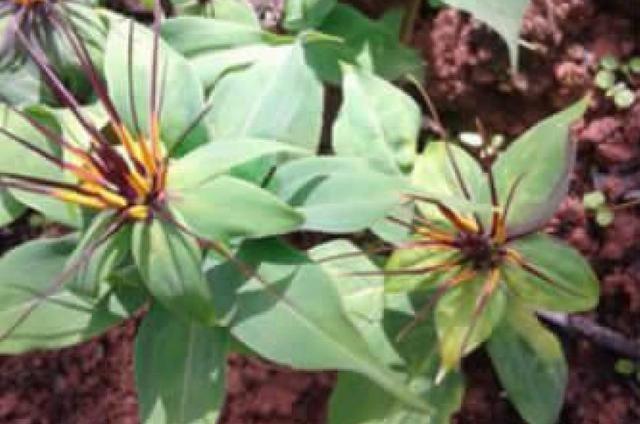
The genus Paris [Melanthiaceae: Parideae, formerly placed in the broad sense of Liliaceae: Asparagoideae: Parideae (and also once assigned to Trilliaceae)], comprises about 27 species of perennial rhizomatous plants, distributed in temperate Eurasia, mainly in East Asia, with the Yunnan-Guizhou Plateau of China as the center of diversity. Plants of the genus Paris mostly contain steroidal saponins, flavonoid glycosides and other compounds, and have important medicinal value. On April 23 and September 1, 2016, the authors collected specimens of a plant of this genus at the flowering stage (2016-4-23, Wang Yuehu, Luo Jifeng, Wang Linlin, Li Heng 009) and fruiting stage [2016-9-1, Li Heng, Lei Ligong, Liu Yanchi 030 (young fruit), 031 (dehisced mature fruit), 032 (undeveloped fruit), all collected from nearby mountain forests by Mr. Liu Yanchi, the owner of this Paris cultivation area] in a Paris cultivation base under a mixed forest of Pinus yunnanensis + Alnus nepalensis at an altitude of 2 500 m in Guanping Township, Yunlong County, Yunnan Province. It was found to be clearly different from other known species of the genus, and is confirmed as a new species, which is reported here. Paris yunlongensis, new species, Subgenus Daiswa, Section Euthyra, see Figure 1.
Figure 2 Color plate of Paris yunlongensis
Note: 1. Habitat, Paris cultivation area under a Pinus yunnanensis + Alnus nepalensis forest; 2. A population; 3. Single-stem plant, showing leaves, flower, rhizome and fibrous roots; 4. Three-stem plant, showing leaves,
flower, showing rhizome and fibrous roots; 5. One whorl of leaves; 6. A plant with a flower in five parts, petals absent, stamens 10 (2 whorls), showing the very long connective appendage; 7. A flower in six parts,
petals 4, green, stamens 12 (2 whorls), showing anthers that have already shed pollen and the long connective appendages; 8. A flower in six parts, petals 5, stamens 12 (2 whorls), showing anthers that have
shed pollen and the long connective appendages; 9. Dehisced mature capsule, showing persistent sepals (6), petals (5), withered stamens and red seeds; 10. Opened
capsule, showing seeds and parietal placentation; 11. Part of an opened capsule, showing parietal placentation, with some seeds removed; 12. Opened capsule, seeds removed, showing parietal
placentation and sterile ovules (white; from the sterile ovules it can be seen that the funicle is relatively thick, but no aril has developed); 13. Seeds; 14. Seed with the fleshy, juicy outer seed coat removed,
showing the white inner seed coat (photographed and composed by Lei Ligong, among which 2, 4 and 6 were photographed by Li Heng).
Perennial herb, glabrous. Rhizome horizontal, surface earth-brown, interior white, farinaceous, 2.5-8.5 cm long, 0.2-2.5 cm thick, the 3-year-old newly grown portion bearing fibrous roots. Stems 1 or 3, erect, pale purplish red, 12.5-40 cm tall, 3-4 mm thick. Base surrounded by 3 dry membranous scale leaves, scale leaves 1-3 cm long, appressed and surrounding the stem base, leaving 3 annular rings on the rhizome after withering. Leaves in 1 whorl, borne at the top of the stem, 5-7 (9); petiole 2-8 mm long, 1-2 mm wide, purple; blade ovate, ovate-oblong, green, pale green abaxially, 4-9.5 cm long, 1.5-3.5 cm wide; base gradually narrowed and decurrent onto the petiole, cuneate, rounded, apex acuminate, margin slightly ciliate; midrib sunken adaxially, raised abaxially, lateral veins 2-3 pairs, the first pair nearly basal, extending straight to the middle of the leaf margin, the second pair alternate near the middle of the midrib, arcuately ascending, the third pair of lateral veins pinnate, slender or almost invisible. Flower solitary at the top of the stem, pedicel 3.5-5 cm long, 2-3 mm thick, elongating to 7-10 cm and 3-4 mm thick in fruit, pale green or pale purple. Sepals 4-6, free, green, pale green abaxially, ovate, lanceolate, 2-5 cm long, 0.7-1.5 cm wide, apex acuminate, margin slightly ciliate, persistent; petals 2-6, or fewer than the sepals, or absent, filiform, purple, becoming green in fruit, 2-3 cm long, unequal in length, persistent; stamens in 2 whorls, 8-12, purple, 2.0-2.2 cm long, persistent, filaments 2-3 mm long, anthers 5-6 mm long, pollen grains ellipsoidal, yellow, connective appendage purple, later becoming green, 10-15 mm long, filiform. Ovary ovate, green, with 4-6 purple longitudinal ridges, 2.5-4 mm long, 2-4 mm in diameter, 1-loculed, parietal placentae 4-6, ovules numerous, ovate, anatropous, white, stylar base purple, enlarged into a short pyramidal shape, covering the top of the ovary, its angles decurrent onto the longitudinal ridges of the ovary, style and stigma purple, 4-6, free, erect, 3-5 mm long. Capsule spherical, yellow-green, 2-2.5 cm in diameter, with 5-6 winged raised longitudinal ridges, irregularly dehiscent between the ridges; seeds nearly spherical, about 3 mm in diameter, outer seed coat red and juicy, inner seed coat white. Flowering: April-June, fruiting: July-September.
The leaf shape and texture of this new species are similar to those of Paris mairei Léveillé of the same section [Section Euthyra (Salisbury) Franchet], but the petals are usually absent or fewer than the sepals, and the connective appendage of the stamens is 1-1.5 cm long. Its difference from P. polyphylla Smith var. pseudothibetica H. Li of the same section lies in the petals usually being absent, or fewer than the sepals, rarely equal in number to the sepals, pale purple, later becoming green, the stamens pale purple or purple, and the lateral veins of the blade only 2-3 pairs, arcuate, distant. The stamens of P. thibetica Franchet of Section Thibeticae H. Li of the same subgenus [Subgenus Daiswa (Rafinesque) H. Li] also have a very long connective appendage reaching up to 2.7 cm at most, but this new species differs from it in the seeds being red and without an aril (the outer seed coat of P. thibetica seeds is black, with a red aril surrounding the base to half of the seed). As for the similarity in leaf texture between this new species and P. mairei, it is because their leaf surfaces have similar micro-papillae covering, appearing hairy, but actually caused by the raised anticlinal walls of the leaf epidermal cells (including the guard cells of the stomata).
Acknowledgements: We thank Mr. Liu Yanchi, a Paris cultivator in Yunlong County, Yunnan Province, for providing information on the collected new species and for providing transportation, food and accommodation for the authors' field investigation; the new species is therefore named after him. We also thank Ms. Wang Ling of the Herbarium of the Kunming Institute of Botany, Chinese Academy of Sciences, for drawing the line illustrations for this paper.