Morphological and Biological Characteristics of Chuan Walnut in Hezhang County and Techniques for Flower and Fruit Retention
Morphological and Biological Characteristics of Chuan Walnut in Hezhang County and Techniques for Flower and Fruit Retention
1 Morphological and Biological Characteristics of 1 Chuan Walnut Tree in Hezhang County
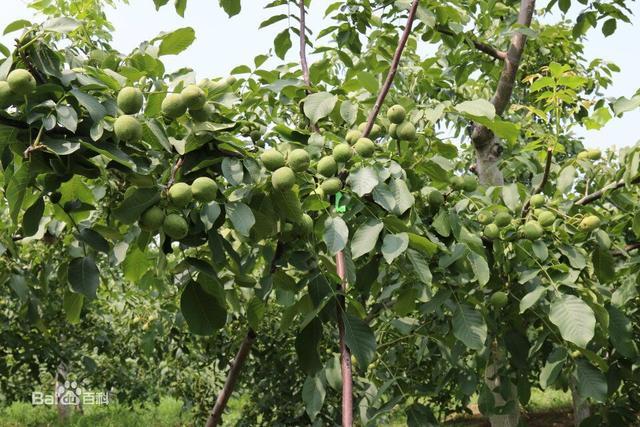
The investigated Chuan walnut tree is located in Luobuga Village, Caishen Town, Hezhang County, with a tree age of 70 years, diameter at breast height of 54 cm, tree height over 12 m, relatively spreading tree posture, spherical crown shape, medium tree vigor, weak branching ability, number of fruit branches sprouting from lateral buds 2, length of vegetative branches 10-30 cm, leaflet shape long elliptic, no apical leaf degeneration phenomenon, number of leaflets 7-11, mostly 9, leaf color green, leaf tip shape acuminate, leaf margin shape entire, dichogamy type synchronous protandrous and protogynous, mother tree begins flowering and fruiting only after more than 5 years from sowing, inflorescence axis length 2.5 cm, number of fruits per branch 5-10, mostly 6, high yielding ability, strong continuous fruiting ability, bud break stage early April, leaf expansion stage mid-April, leaf fall stage mid-October, male flower initial opening stage early April, female flower full bloom stage mid-April, female flower initial opening stage early April, female flower full bloom stage mid-April, fruit ripening stage late September.
Green husk thickness 6 mm, nut shape oblate, shell surface feature shallow and numerous grooves, fruit apex shape pointed, fruit shoulder shape rounded, fruit base shape flat, suture line flat, suture line tightness relatively weak, longitudinal diameter 29.49 mm, transverse diameter 24.38 mm, lateral diameter 27.20 mm, single nut weight 6.01 g, kernel yield 58%, shell thickness 0.94 mm, inner septum wall degenerated, diaphragm membranous, kernel relatively plump, kernel skin color light yellow, nuts uniform, kernel fat content 71.16%, protein content 16.76%, kernel flavor good.
2 Techniques for Flower and Fruit Retention of Chuan Walnut
2.1 Pest and Disease Control
2.1.1 Walnut Bacterial Blight
Walnut bacterial blight occurs on walnut leaves, young shoots, flowers and fruits. After leaves are affected, nearly circular and polygonal small brown spots first appear on leaf veins, which can merge with each other in severe cases, and the lesion periphery has a water-soaked halo. A few diseased leaves show perforation phenomenon in later stages, diseased leaves shrink and deform, lesions on petioles are elongated brown and slightly sunken, and in severe cases the lesions extend to young shoots and young leaves; when the lesions surround a branch in 1 ring, the branches above the lesion die. After inflorescences are infected, black water-soaked spots first appear, they cannot unfold, the flower axis turns black and bends, leading to early dropping. On fruits, the disease first produces black spots that are water-soaked, after which the lesions rapidly expand, causing the entire fruit skin to turn black; when young fruits are affected, the pathogen invades the kernel, causing the shell to turn black and leading to early fruit drop, while in later stages the lesions on affected fruits are limited to the outer fruit skin.
2.1.2 Walnut Anthracnose
After fruits are affected, brown lesions first appear on the green fruit skin, then turn black. The lesions are nearly circular and sunken, with small dark brown dots in the center of the lesions, sometimes arranged in concentric rings. When humidity is high, the small black dots on the lesions become pinkish small protrusions, namely the pathogen's acervuli and conidia. There are multiple lesions on 1 fruit, and after the lesions merge into patches, the entire fruit turns black and rots, with no edible value; in some cases the kernel rots and gives off a foul odor, causing early fruit drop. After leaves are infected, the lesions are irregular, and lesions extend along the leaf margin, causing yellowing and withering. When humidity is high, pinkish slime appears on the small black dots of the lesions. After buds and young shoots of seedlings and young trees are infected, they often wither from the top downward, and leaves turn scorched yellow and fall off.
2.1.3 Walnut Sunflower Moth
The larvae bore into the green husk and kernel of walnuts. Affected fruit skins gradually turn black, become sunken and drop early. Generally the rate of affected walnut fruits is 10%-20%, and in severe cases the rate of insect-damaged fruits reaches 50%-80%. It occurs 1-2 generations a year. Adults mostly rest on the underside of walnut leaves or on grass and stones in the morning and at noon, with their hind legs raised and constantly shaking, sometimes jumping, and walking with the front and middle legs. Flying, mating and oviposition mostly occur from 17:00 to 20:00, with the peak activity period from 18:00 to 19:00. Adults mostly lay eggs in the gaps where two fruits meet, at the calyx depression and at the stalk depression; eggs are laid singly, 1-2 eggs per fruit. Adults have slight phototaxis, adult lifespan 3-8 d, egg stage 5-8 d.
2.1.4 Walnut Shoot Weevil
It occurs 1 generation a year, overwinters as adults, and begins to emerge from dormancy and climb the trees in early April when walnut trees begin to sprout, gnawing young buds and tender leaves to supplement nutrition. In mid-May, the number of emerged adults increases greatly, and mating and oviposition begin when the temperature reaches 16°C. Eggs hatch within 4-8 d in the fruit skin. Newly hatched larvae bore and feed on the fruit skin in the original fruit for 3-4 d, then bore into the nut to feed on the kernel, continuously pushing dark brown insect frass out from the bore hole. The kernel gradually turns black and rots, causing fruit drop. From oviposition to fruit drop generally takes about 20 d [Jishan Huayao].
2.1.5 Control Measures
Select and breed disease-resistant varieties, planting density should not be too dense, and the tree canopy should be well ventilated and receive sufficient light. Strengthen integrated management, maintain healthy tree vigor and growth, improve disease resistance, promptly clean up diseased branches, leaves and fruits to reduce pathogen sources, and strengthen pest control.
Practice intercropping of forest and crops, plow the tree base soil, destroy the overwintering ecological environment of larvae, reduce the water content of the surface soil, or bury larvae into deeper soil layers, greatly increasing the mortality rate of overwintering larvae. From early June to early July during the fruit drop period of the walnut shoot weevil, persist in collecting insect-damaged dropped fruits every 1-3 d and burying them deeply, or before the shoot weevil massively climbs the trees to lay eggs, in early to mid-May, spray the canopy with 50% phoxim 1000-fold solution, 2.5% deltamethrin 3000-fold solution, 20% fenpropathrin solution 3000-fold solution, 48% chlorpyrifos 300-400-fold solution. Generally spray the tree base soil 1-3 times to prevent adults from climbing the trees [3].
2.2 Other Measures
(1) Carry out timely and rational fertilization, irrigation, pruning, removal of male flowers and other integrated scientific management of walnut trees to improve the nutritional status of walnut trees, which can reduce the number of flower and fruit drops, increase the fruit set rate, and thereby increase yield and quality;
(2) During the female flower full bloom stage, carry out artificial supplementary pollination to improve flower and fruit drop caused by poor fertilization;
(3) According to the number of fruits on each fruiting branch after nut maturity, carry out fruit thinning, which is beneficial for improving nut quality;
(4) During the flowering and fruiting stages, spray female flowers with gibberellin, which is beneficial for improving flower and fruit drop and increasing yield.